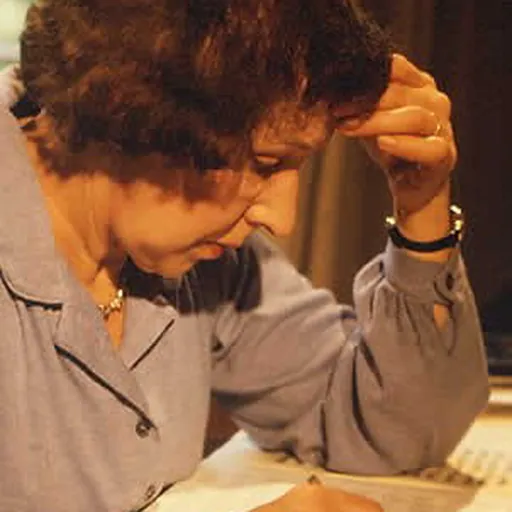
About Rosemary Brown
Lived 1916 – 2001 (aged 85). Rosemary Brown was a British composer, pianist, spiritual medium and mediumship.
Rosemary Isabel Brown (nee Dickeson, 27 July 191616 November 2001) Many other members of Brown's family were allegedly psychic, including her parents and grandparents.
She worked for the Post Office from the age of 15. In 1948 she acquired a second-hand upright piano, and took some lessons for three years. In 1952 she married Charles Brown, a government scientist. They had a son and a daughter before her husband died in 1961.
Critical reception
Brown's claims about spirit communication were disputed by sceptics, although there were a number of musicians and musicologists who supported her claims. Humphrey Searle, who was an authority on Liszt, wrote in his autobiography Quadrille with a Raven, referring to Grubelei, a piece inspired by Liszt: 'It is certainly in keeping with Liszt's experimental style, being mostly written in single notes in each hand; it is highly chromatic, and one hand is written in 5/4 time against 3/2 in the other. The latter is not a thing that Liszt ever did as far as I know, but it is the sort of thing he might have done as I said in my broadcast, which was reproduced on this record sleeve without my knowledge! Since then Fiona and I have got to know Rosemary well and believe her to be perfectly genuine. Even if the pieces dictated to her by dead composers are not masterpieces - although some of them are very nice works - she has had no technical training in composition and could not possibly produce pastiches like, say, those by Joseph Cooper in his TV programme "Face the Music".
Professor Ian Parrott was also a supporter, and participated in a documentary, and wrote Rosemary Brown's obituary for the Guardian: '…Grübelei (meditation), partly dictated under the watchful gaze of BBC reporter Peter Dorling and a television studio crew, is undoubtedly a most spectacular and unusual piece. It has strong harmonies, cross-rhythms and occasional instructions in French - a point conferring authenticity, but difficult to fake. The composer and Liszt specialist Humphrey Searle said: "We must be grateful to Mrs Brown for making it available to us." '
After studying her compositions, musicologists and psychologists came to the conclusion they were the work of Brown's own subconscious. Leonard Zusne and Warren H. Jones in their book Anomalistic Psychology: A Study of Magical Thinking (1989) noted that "Brown wrote hundreds of pieces of music dictated by the various composers. They were passable works, entirely in the style of these composers, but appeared to be simply reworkings of existing pieces."
Professor of psychology John Sloboda wrote that Brown's music offers "the most convincing case of unconscious composition on a large scale."
Psychologist Robert Kastenbaum analysed Brown's music compositions and came to doubt that they were dictated to Brown by spirits of well known composers. According to Kastenbaum:
Kastenbaum suggested the composers were secondary personalities of Brown herself.
Brown maintained that she had never had any musical training aside from a few piano lessons, though paranormal investigator Harry Edwards says:
According to the psychologist Andrew Neher:
Musicologist Denis Matthews described her music as "charming pastiches" and suggested she was re-creating compositions. Similarly Alan Rich, music critic of New York magazine, having heard a privately issued record of Brown's piano pieces, concluded that they were just sub-standard re-workings of some of their purported composers' better-known compositions.
Concert pianists Peter Katin, Philip Gammon, Howard Shelley, Cristina Ortiz and John Lill have all performed her music.
Brown was the subject of a BBC Radio 4 drama, The Lambeth Waltz by Daniel Thurman, first broadcast in 2017.
An LP spoofing her work, Rosemary Brown Psyches Again! was issued in 1982 by Enharmonic Records.
Publications Rosemary Brown published three books:
Unfinished Symphonies: Voices from the Beyond William Morrow, 1971; Immortals at My Elbow Bachman & Turner, 1974; Look Beyond Today Bantam Press, 1986; Sheet music available at Keturi Musikverlag (Germany)
Don’t just read it —
keep it.
Full-length biographies made to live with: read them, listen on the way to work, watch them tonight.
- E-book
- Audio
- Video
Instant download · yours to keep · every purchase keeps this site free
Important facts
People in Rosemary Brown's life
Named in this biography and alive at the same time






Related people
Same field, nearest in time



Contemporaries
People whose lives overlapped Rosemary Brown's





Frequently asked questions
Who was Rosemary Brown?
Self proclaimed spiritual medium (1916–2001)
When was Rosemary Brown born?
Rosemary Brown was born on 27 July 1916 in London.
When did Rosemary Brown die?
Rosemary Brown died on 16 November 2001 in London.
What was Rosemary Brown's occupation?
Rosemary Brown was a composer, pianist, spiritual medium and mediumship.
What nationality was Rosemary Brown?
Rosemary Brown was British.
Sources & further reading
· DBpedia: Rosemary Brown (spiritualist)
Cite this page
APA: Biography.guide. (2026). Rosemary Brown. https://biography.guide/rosemary-brown-composer/
MLA: "Rosemary Brown." Biography.guide, https://biography.guide/rosemary-brown-composer/.
Chicago: "Rosemary Brown." Biography.guide. https://biography.guide/rosemary-brown-composer/.
Data last updated: 2026-09-22 · Spot an error? Report a correction.
Portrait: Wikimedia Commons · author & licence
Page generated 2026-09-27 05:01 UTC