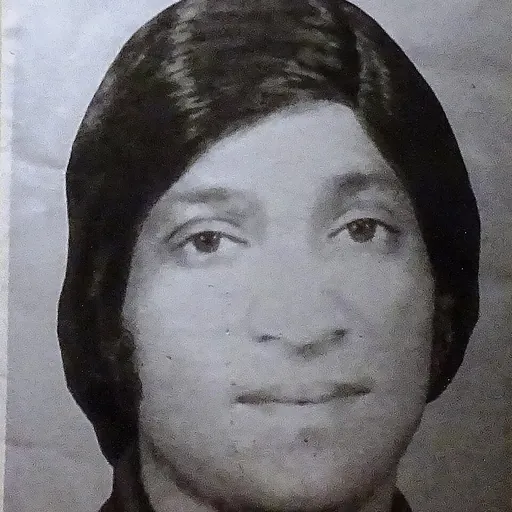
About Rosario Rodrigues
Lived 1944 – 2003 (aged 58). Rosario Rodrigues was a playwright, theatre director, comedian and composer.
Rosario Lourenço Santana Rodrigues (24 October 1944 – 5 August 2003) was an Indian playwright, theatre director, comedian, and composer known for his work in khell tiatr productions and non-stop dramas. Referred to as the "Goan Shakespeare" and "Father of khell tiatr", he founded the "non-stop drama" format, alike to one-act play of three hours duration in the 1970s, from the traditional two act plays of khell tiatr. His drama format had its peak period between 1970 and 2000.
Early life Rosario Lourenço Santana Rodrigues was born on 25 October 1944 in Benaulim, Goa, which was part of Portuguese India during the Portuguese Empire. He was born into a Goan Catholic family, the eldest of four siblings. His parents were Rosario Filipinho Rodrigues, a musician, and Natalia Tereza Furtado, a homemaker. Rodrigues had three sisters - Maria (born 1951), Martinho (born 1954), and Aninha (born 1957) - as well as a younger brother, David (born 1945). During his schooling at Holy Trinity High School in Benaulim, Rodrigues was described as an academically gifted student who demonstrated a strong interest in dramatics. Benaulim was known for its literate and illiterate khell tiatrists, a local cultural tradition.
During the annual chapel feast, Rodrigues would compose original tiatr plays, with the local youth-including future popular tiatrists like Nelson Afonso and A. S. Conception-joining the performance troupe. Rodrigues also played a role in providing performance opportunities and cultivating new talent. When some actors failed to show up for rehearsals, Rodrigues would call upon Seby to step in and learn the lines quickly, allowing him to gain acting experience through these tiatr productions. Rodrigues also participated in competitive showings of khell tiatr, a related dramatic form. During these contests, two directors would present their khell productions, and the audience would vote by a show of hands to decide the victor. Throughout his career, Rodrigues engaged in competition with popular khell tiatr directors like Antonio Moraes, Vitorino Pereira, Menino Alfonso, and Soccoro de Verna.
In the early 1970s, Goan theater underwent a significant transformation with the emergence of a new dramatic format pioneered by Rodrigues. Dubbed "khell-tiatr," these productions differed from the traditional tiatr by featuring a shorter runtime of approximately 90 minutes. Rodrigues himself was at the forefront of this innovation, writing and directing several popular khell tiatr productions, including Ekech Rati (In One Night) and Ami Fator (We are Stones), in 1972. The success of Rodrigues' khell tiatrs inspired other directors to adopt a similar approach, leading to the proliferation of this format across the Goan theater landscape. Beyond his work in the khell tiatr genre, Rodrigues went on to script and produce a diverse range of 90-minute productions. These included works such as 12 Vorsanni (12 Years), Patang (Kite), Patkin (Sinner), Tem (She), Chedde Cheddvam (Boys and Girls), Ekleanuch Poila (Witnessed by Oneself), Hindustani Cheddvam (Hindustani Girls), and Frank Sinatra, among others, which have become recognized as some of his acclaimed creations. In the year 1976, Rodrigues revolutionized khell tiatr by introducing an element called the non-stop drama. Departing from the conventional tiatr structure of two separate plays, Rodrigues presented a single, full-length production titled Fattim Paulo (I've reached Back) that ran for three hours. This production featured a revolving stage set, special effects, and lighting, marking a significant stylistic departure from the traditional format. Rodrigues' success with the "non-stop drama" inspired other directors to follow suit, contributing to the increasing popularity and recognition of this new theatrical approach. Historically, tiatrs had been primarily enjoyed by the educated elite, while khell tiatrs appealed more to the masses. However, Rodrigues' pioneering work in elevating the status and production values of the non-stop drama helped to bridge this divide, making the format accessible and appealing to a wider range of audiences across different socioeconomic groups in Goa. Rodrigues implemented a unique method by personally transporting his stage settings between various venues to streamline the production of his theatrical works. According to the Konkani historian Wilson Mazarello, "Rodrigues was a reasonably well-educated and intelligent writer" who introduced an innovative concept to the khell tiatr tradition. He observed that the conventional format of two separate plays within a single program placed an unnecessary cognitive burden on the audience, who had to remember two distinct narratives. He proposed a novel solution - the non-stop drama format, which featured a single, continuous narrative. This innovation was a significant contribution that distinguished Rodrigues' work and approach within the khell tiatr tradition.
According to accounts by Mazarello, Rodrigues crafted a khell tiatr named Meenaxi with a distinctive format of a single 3-hour play (parti) with an interval, departing from the conventional style of multiple shorter plays. Rodrigues chose to exclude unrelated songs (kantaram) within the performance, apart from an opening song. The play featured 14-15 cantos (musical sequences) that were integral to the performance. Rodrigues integrated the traditional tiatr elements and advancements attributed to Antonio Moraes into the khell tiatr format, a novel approach that garnered acclaim from audiences, especially in South Goa. Building on this success, he further expanded his repertoire with the play Fattim Paulo, showcasing a cohesive storyline presented in a single 3-hour performance encompassing approximately 15 cantos. However, he chose to rebrand the performance, shifting from the term "khell tiatr" to "non-stop drama." This new designation proved equally appealing to audiences, who flocked to the shows in ever-increasing numbers. Rodrigues received acclaim for his talent in engaging audiences with storytelling techniques, dialogues, and the incorporation of "cantos" that enriched the theatrical experience. Both the Meenaxi and Fattim Paulo productions were hailed as unprecedented successes in the evolution of the Goan theatrical landscape. Together, Rodrigues and his wife Carmina had one child, a son named Floyd (born 1980). Carmina herself was a stage actor and composer who had been active in the early 1970s. She had made her debut in two khell tiatr productions directed by Rodrigues - Ekech Ratri and Ami Fator. It is likely that the couple met through their shared involvement in Goa's theatrical scene during this period. After marrying Rodrigues, Carmina largely withdrew from her performance career, though she occasionally continued to participate in productions. Another Konkani comedian, known by the stage name "Comedian Jesus" (Jose Antao), also identified Rodrigues as his preferred tiatr playwright. Insights into Rodrigues's scriptwriting process have been provided by J. P. Pereira of The Navhind Times. Pereira reported that Rodrigues would routinely consult with fellow writer Tertuliano "Tedol" Fernandes to develop the narratives and plots for his khell tiatr works. On 5 August 2003, Rodrigues, aged 58, died at his residence in Mazilvaddo, Benaulim.
Don’t just read it —
keep it.
Full-length biographies made to live with: read them, listen on the way to work, watch them tonight.
- E-book
- Audio
- Video
Instant download · yours to keep · every purchase keeps this site free
Important facts
People in Rosario Rodrigues's life
Named in this biography and alive at the same time



Related people
Same field, nearest in time


Contemporaries
People whose lives overlapped Rosario Rodrigues's


Frequently asked questions
Who was Rosario Rodrigues?
Indian playwright and director (1944–2003)
When was Rosario Rodrigues born?
Rosario Rodrigues was born on 24 October 1944 in Benaulim.
When did Rosario Rodrigues die?
Rosario Rodrigues died on 5 August 2003 in Benaulim.
What was Rosario Rodrigues's occupation?
Rosario Rodrigues was a playwright, theatre director, comedian and composer.
Sources & further reading
· Wikipedia: Rosario Rodrigues
Cite this page
APA: Biography.guide. (2026). Rosario Rodrigues. https://biography.guide/rosario-rodrigues/
MLA: "Rosario Rodrigues." Biography.guide, https://biography.guide/rosario-rodrigues/.
Chicago: "Rosario Rodrigues." Biography.guide. https://biography.guide/rosario-rodrigues/.
Data last updated: 2026-09-23 · Spot an error? Report a correction.
Portrait: Wikimedia Commons · author & licence
Page generated 2026-09-27 05:04 UTC