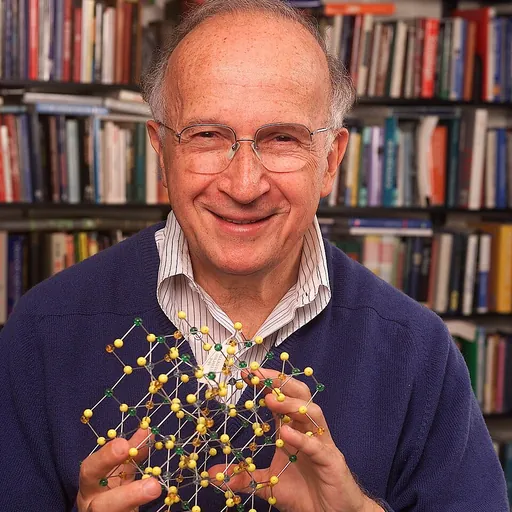
About Roald Hoffmann
Born 1937. Roald Hoffmann is a Polish and American playwright, chemist, poet, university teacher and writer, known for Extended Hückel method, Isolobal principle and Woodward–Hoffmann rules.
Roald Hoffmann (born Roald Safran; July 18, 1937) is a Polish-American theoretical chemist who shared the 1981 Nobel Prize in Chemistry with Kenichi Fukui “for their theories, developed independently, concerning the course of chemical reactions”. He has also published plays, poetry and popular science. He is the Frank H. T. Rhodes Professor of Humane Letters Emeritus at Cornell University.
Early life
Escape from the Holocaust Hoffmann was born in Złoczów, Poland (now Zolochiv, Ukraine), to a Polish-Jewish family, and was named in honor of the Norwegian explorer Roald Amundsen. His parents were Clara (Rosen), a teacher, and Hillel Safran, a civil engineer. After Germany invaded Poland and occupied the town, his family was placed in a labor camp where his father, who was familiar with much of the local infrastructure, was a valued prisoner. As the situation grew more dangerous, with prisoners being transferred to extermination camps, the family bribed guards to allow an escape. They arranged with a Ukrainian neighbor named Mykola Dyuk for Hoffmann, his mother, two uncles and an aunt to hide in the attic and a storeroom of the local schoolhouse, where they remained for eighteen months, from January 1943 to June 1944, while Hoffmann was aged 5 to 7.
His father remained at the labor camp, but was able to occasionally visit, until he was tortured and killed by the Germans for his involvement in a plot to arm the camp prisoners. When she received the news, his mother attempted to contain her sorrow by writing down her feelings in a notebook her husband had been using to take notes on a relativity textbook he had been reading. While in hiding his mother kept Hoffmann entertained by teaching him to read and having him memorize geography from textbooks stored in the attic, then quizzing him on it. He referred to the experience as having been enveloped in a cocoon of love. They migrated to the United States on the troop carrier Ernie Pyle in 1949.
Hoffmann visited Zolochiv with his adult son (by then a parent of a five-year-old) in 2006 and found that the attic where he had hidden was still intact, but the storeroom had been incorporated, ironically enough, into a chemistry classroom. In 2009, a monument to Holocaust victims was built in Zolochiv on Hoffmann's initiative.
Personal life Hoffmann married Eva Börjesson in 1960. They have two children, Hillel Jan and Ingrid Helena.
Education and academic credentials Hoffmann graduated in 1955 from New York City's Stuyvesant High School, where he won a Westinghouse science scholarship. He received his Bachelor of Arts degree at Columbia University (Columbia College) in 1958. He earned his Master of Arts degree in 1960 from Harvard University. He earned his doctor of philosophy degree from Harvard University while working He has investigated the structure and reactivity of both organic and inorganic molecules, and examined problems in organo-metallic and solid-state chemistry.
With Robert Burns Woodward he developed the Woodward–Hoffmann rules for elucidating reaction mechanisms and their stereochemistry. They realized that chemical transformations could be approximately predicted from subtle symmetries and asymmetries in the electron orbitals of complex molecules. For this work Hoffmann received the 1981 Nobel Prize in chemistry, sharing it with Japanese chemist Kenichi Fukui, who had independently resolved similar issues. (Woodward was not included in the prize, which is given only to living persons,
Some of Hoffman's most recent work, with Neil Ashcroft and Vanessa Labet, examines bonding in matter under extreme high pressure. which explores the juncture between the arts and science.
Non-fiction He has published books on the connections between art and science: Roald Hoffmann on the Philosophy, Art, and Science of Chemistry and Beyond the Finite: The Sublime in Art and Science.
Poetry Hoffmann is also a writer of poetry. His collections include The Metamict State (1987, ), Gaps and Verges (1990, ), and Chemistry Imagined (1993, , co-produced with artist Vivian Torrence.
Honors and awards
Nobel Prize in Chemistry In 1981, Hoffmann received the Nobel Prize in Chemistry, which he shared with Kenichi Fukui "for their theories, developed independently, concerning the course of chemical reactions".
Other awards Hoffmann has won many other awards,
ACS Award in Pure Chemistry, 1969 Award of the International Academy of Quantum Molecular Science, 1970, "pour sa methode de calcul des fonctions d'onde moleculaires et pour ses etudes theoriques des reactions chimiques" Fellow of the American Academy of Arts and Sciences, elected 1971 Elected member of the National Academy of Sciences, elected 1972 Arthur C. Cope Award in Organic Chemistry, 1973 (with Robert B. Woodward) Nobel Prize in Chemistry, 1981 National Medal of Science, 1983 Fellow of the American Philosophical Society, elected 1984 Elected a Foreign Member of the Royal Society (ForMemRS) in 1984 Foreign Member of the Royal Swedish Academy of Sciences, elected 1985 Foreign Member of the Finnish Society of Sciences and Letters, elected 1988 Priestley Medal, 1990 Harvard Centennial Medalist, 1994 Pimentel Award in Chemical Education, 1996 E.A. Wood Science Writing Award, 1997 Literaturpreis of the Verband der Chemischen Industrie for his textbook The Same and Not The Same, 1997 Kolos Medal, 1998 American Institute of Chemists Gold Medal, 2006 James T. Grady-James H. Stack Award for Interpreting Chemistry, 2009 Fellow of the American Chemical Society, 2009 Fellow of the Kosciuszko Foundation of Eminent Scientists of Polish Origin and Ancestry, 2014 Ullyot Public Affairs Lecture, Science History Institute, 2019 Marie Curie Medal of the Polish Chemical Society, 2019
Hoffmann is a member of the International Academy of Quantum Molecular Science and the Board of Sponsors of The Bulletin of the Atomic Scientists.
In August 2007, the American Chemical Society held a symposium at its biannual national meeting to honor Hoffmann's 70th birthday.
In 2008, the Göttingen Academy of Sciences and Humanities awarded him its Lichtenberg Medal.
In August 2017, another symposium was held at the 254th American Chemical Society National Meeting in Washington DC, to honor Hoffmann's 80th birthday.
The Hoffmann Institute of Advanced Materials in Shenzhen, named after him, was founded in his honor in February 2018 and formally opened in his presence in May 2019.
In 2023, Roald Hoffmann was named by Carnegie Corporation of New York as an honoree of the Great Immigrants Awards.
Don’t just read it —
keep it.
Full-length biographies made to live with: read them, listen on the way to work, watch them tonight.
- E-book
- Audio
- Video
Instant download · yours to keep · every purchase keeps this site free
Important facts
People in Roald Hoffmann's life
Named in this biography and alive at the same time




Related people
Same field, nearest in time



Contemporaries
People whose lives overlapped Roald Hoffmann's




Frequently asked questions
Who is Roald Hoffmann?
Polish-American Nobel laureate chemist and playwright
When was Roald Hoffmann born?
Roald Hoffmann was born on 18 July 1937 in Zolochiv.
What is Roald Hoffmann's occupation?
Roald Hoffmann is a playwright, chemist, poet, university teacher and writer.
What is Roald Hoffmann known for?
Roald Hoffmann is known for Extended Hückel method, Isolobal principle and Woodward–Hoffmann rules.
What nationality is Roald Hoffmann?
Roald Hoffmann is Polish and American.
Sources & further reading
Cite this page
APA: Biography.guide. (2026). Roald Hoffmann. https://biography.guide/roald-hoffmann/
MLA: "Roald Hoffmann." Biography.guide, https://biography.guide/roald-hoffmann/.
Chicago: "Roald Hoffmann." Biography.guide. https://biography.guide/roald-hoffmann/.
Data last updated: 2026-09-20 · Spot an error? Report a correction.
Portrait: Wikimedia Commons · author & licence
Page generated 2026-09-27 04:57 UTC