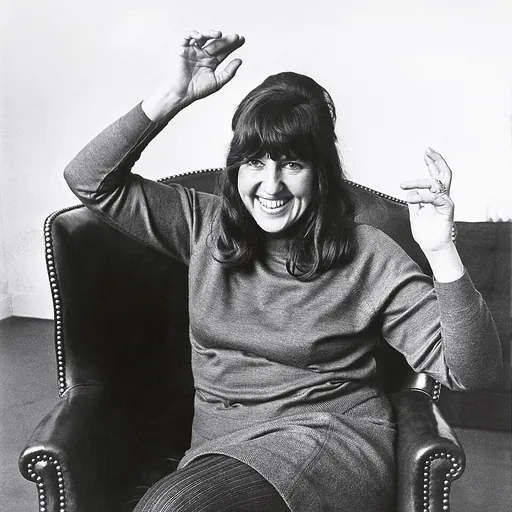
About Rosalyn Drexler
Lived 1926 – 2025 (aged 98). Rosalyn Drexler was an American painter, artist, playwright, writer, professional wrestler and screenwriter.
Rosalyn Drexler ( Bronznick; November 25, 1926 – September 3, 2025) was an American visual artist, novelist, Obie Award-winning playwright, Emmy Award-winning screenwriter and professional wrestler. Although she had a polymathic career, Drexler is perhaps best known for her pop art paintings and as the author of the novelization of the film Rocky, under the pseudonym Julia Sorel. Drexler lived and worked in New York City, New York.
Early life and education Rosalyn Drexler (née Bronznick) was born on November 25, 1926, in the Bronx, New York. She grew up in the Bronx and East Harlem, New York. Drexler had considerable exposure to the performing arts as a child, attending vaudeville shows with her friends and family. Her parents also exposed her to the visual arts at an early age, buying her art posters, books, coloring boxes, and crayons, which she cited as an influence. She attended the High School of Music and Art in New York City where she majored in voice. She is the subject of many of her husband's paintings.
Professional wrestling career In 1951, Drexler and her husband lived in Hell's Kitchen in Manhattan near Bothner's Gymnasium, where a number of female professional wrestlers practiced. While on tour, she wrestled in odd places such as a graveyard and an airplane-hangar. She went on tour around the country, but returned home after becoming upset about racism in the southern states, such as segregated seating and water fountains.
Drexler's experience as Rosa Carlo later formed the basis of her 1972 critically acclaimed novel To Smithereens. Lost Match (1962), and The Winner (1965).
Writing career
Novels
I Am the Beautiful Stranger (Grossman, 1965, ) One or Another (1970) To Smithereens (1972) The Cosmopolitan Girl (1974) Unwed Widow (1975)—written under the pseudonym Julia Sorel Starburn: The Story of Jenni Love (1979) Bad Guy (1982) Art Does (Not!) Exist (1996) Vulgar Lives (2007)
Adapted screenplays Written under the pseudonym Julia Sorel: Her works were shown in New York in 1960 at Reuben Gallery, at which she participated in Happenings. Her work was praised by David Smith and Franz Kline of the New York School. When the Reuben Gallery closed after one year, she received no offers because "women [sculptors] were not bankable at [the] time." She made a swift shift to painting in an attempt to gain more offers. She did odd jobs to make a living while artmaking, including being a waitress, a cigarette girl, a hatcheck, and a masseuse. She searched through old magazines, posters, and newspapers to source imagery for her paintings. Her self-taught process consisted of blowing up images from magazines and newspapers, collaging them onto canvas, and then painting over them in bright, saturated colors. She also has a fondness for Elmer's Glue in her work, saying it "doesn't get enough credit for its role in art."
Drexler signed with Kornblee Gallery, where she had solo shows from 1964 to 1966. In January 1964 her work was included in the "First International Girlie Exhibit" at Pace Gallery, New York. She and Marjorie Strider were the only two women Pop artists included in this exhibition, which also featured Warhol, Roy Lichtenstein, and Tom Wesselmann. Drexler exhibited collages cut and pasted from girlie magazines. The work scandalized some, but her paintings were mostly well received. One critic noted, "Miss Drexler's collage paintings…fly through contemporary life and fantasy with a virtuosic, uninhibited imagination that is refreshingly direct in its frank expression of brutality, desire, pathos and playfulness."
Drexler's paintings continued to enjoy favorable reviews and were exhibited in major Pop art exhibitions throughout the 1960s. She did not gain the level of recognition of many of her male peers; the major themes in her paintings—violence against women, racism, social alienation—were controversial topics in a genre known for being "cool" and detached. She stated:
I was happy being productive and having good friends and being ignored. But now I'm getting angry about it, looking back! In spite of this, in 1968, Drexler signed the "Writers and Editors War Tax Protest" pledge, vowing to refuse tax payments in protest against the Vietnam War.
In 2018 her work received renewed critical attention and a career retrospective exhibition at the Rose Art Museum. In 2022, the Hirshhorn Museum and Sculpture Garden referenced the name of Drexler's 1963 painting "Put it this way" in their exhibit "Put It This Way: (Re)visions of The Hirshhorn Collection," which ran until Fall 2023.
Major themes and works
As well as drawing from her own experience, Drexler's work often revolves around women's roles as portrayed in pulp cinema, including women as moll, femme fatale, home wrecker - those in need of "moral comeuppance". Her images were drawn from easily understood public media.
Her The Love and Violence series is a body of paintings that depicts abusive relationships between men and women. The canvases evoke the covers of pulp fiction novels, B-movie posters, and scenes from gangster films or film noir. Works such as I Won't Hurt You (1964), This is My Wedding (1963), and Rape (1962) depict sexual violence against women. While the men depicted are most often the abusers, in some paintings, such as Kiss Me, Stupid (1964) and Dangerous Liaison (1963), the dynamic between the male and female subjects is left more indeterminate. Other works in this series include The Bite (1963), Love and Violence (1965), and Baby, It's Alright (1963).
Is It True What They Say About Dixie? (1966) was inspired by a newspaper photo of Bull Connor, the police chief who instigated the Birmingham race riot of 1963, leading a group of white supremacists. The figures advance towards the viewer dressed in black suits against a stark white background. The painting, with a title taken from an American popular song, acts as an ironic commentary on the racial violence of her time. Similar in composition and intent is the painting F.B.I. (1964) that both glamorizes the depicted government agents and questions their status as figures of authority.
The Men and Machines series, showing working men with various types of mechanical equipment, portrays Cold War era images of technological advancements and plays on the cliché of machines as phallic symbols of male sexual power. Paintings in this series include Pilot to Tower (1966). Marilyn Pursued by Death (1967) is an image of Marilyn Monroe being followed by a male figure. Although "Death" appears to be a stalker or member of the paparazzi, the photograph after which the painting was made makes clear that the man is actually her bodyguard.
Rosalyn Drexler Paintings made after movie posters include King Kong aka The Dream (1963), modeled after the lobby card for John Lemont's 1961 film Konga, and Chubby Checker (1964), based on the poster for 1961 movie musical Twist Around the Clock.
Connections with other artists Drexler listed Franz Kline and Bill and Elaine de Kooning as close friends of her and her husband. Rosalyn Drexler and the Ends of Man: Works from 1961–2001, Paul Robeson Gallery, Rutgers University–Newark, September 5 – October 18 (2006) Rosalyn Drexler: I Am the Beautiful Stranger, Paintings of the '60s, Pace Wildenstein, New York, March 16 – April 21 (2007) Rosalyn Drexler: Vulgar Lives, Garth Greenan Gallery, New York, February 19 – March 28 (2015) Rosalyn Drexler: Who Does She Think She Is?, Rose Art Museum, Brandeis University, Waltham, Massachusetts, February 11, 2016 – June 6, 2016; Albright Knox Art Gallery, Buffalo, October 22, 2016 – January 29, 2017; Mildred Lane Kemper Art Museum, St. Louis, February 10 – April 17, 2017 (2016) Human Interest: Portraits from the Whitney's Collection, Whitney Museum of American Art, New York, April 6, 2016 – February 12, 2017 (2016) Inventing Downtown: Artist-Run Galleries in New York City, 1952–1965, Grey Art Gallery, New York University, January 10 – April 1 (2017) March Madness, Fort Gansevoort, New York City, March 17 – May 7 (2017) POP ART - Icons that matter, Collection du Whitney Museum of American Art, New York, musée Maillol, Paris - September 22, 2017 – January 21, 2018 (2018)
Public collections Allen Memorial Art Museum, Oberlin College, Ohio Davison Art Center, Wesleyan University, Connecticut Grey Art Gallery and Study Center, New York University, New York Greenville County Museum of Art, South Carolina Hirshhorn Museum and Sculpture Garden, Smithsonian Institution, Washington, D.C. Wadsworth Atheneum, Hartford, Connecticut Walker Art Center, Minneapolis, Minnesota Whitney Museum of American Art, New York Cornell Fine Arts Museum, Winter Park, Florida Philadelphia Museum of Art, Philadelphia Pennsylvania Academy of the Fine Arts, Philadelphia Rose Art Museum, Brandeis University, Waltham, Massachusetts
Select awards 1964 Obie Award for Distinguished Play, Home Movies 1965, 1968, 1974, 1986 Rockefeller Grants in Playwriting 1966 Paris Review Humor Prize, Dear 1970-71 Guggenheim Fellowship for Fiction 1973 Emmy Award for Best Writing for Comedy-Variety (Special Program), Lily 1979 Obie Award for Best Playwriting, The Writer's Opera 1985 Obie Award for Best Playwriting, Transients Welcome 1990 New York Foundation for the Arts, Grant in Playwriting 1991 National Endowment for the Arts, Grant in Theater 1994, 2000 Pollock-Krasner Foundation, Grant in Painting 1997-8 Bunting Fellowship at Radcliffe College/Harvard University, Visual Arts-Painting 2005 Helen & George Segal Foundation, Grant in Painting 2007 Honorary Degree of Doctor of Fine Arts from the University of the Arts, Philadelphia
References in pop culture In 1975, Drexler was the subject of Who Does She Think She Is? (1975), an hour-long film directed by Patricia Lewis Jaffe and Gaby Rodgers. Her novel To Smithereens suggested Below the Belt in 1980, directed by Robert Fowler.
Personal life and death Drexler had a son and a daughter with her husband, Sherman Drexler. Her daughter died in 2010, and her husband died in 2014. She died in Manhattan, New York City on September 3, 2025, at the age of 98.
Don’t just read it —
keep it.
Full-length biographies made to live with: read them, listen on the way to work, watch them tonight.
- E-book
- Audio
- Video
Instant download · yours to keep · every purchase keeps this site free
Important facts
Family & relationships
People in Rosalyn Drexler's life
Named in this biography and alive at the same time






Related people
Same field, nearest in time


Contemporaries
People whose lives overlapped Rosalyn Drexler's

Frequently asked questions
Who was Rosalyn Drexler?
American artist (1926–2025)
When was Rosalyn Drexler born?
Rosalyn Drexler was born on 25 November 1926 in The Bronx.
When did Rosalyn Drexler die?
Rosalyn Drexler died on 3 September 2025 in Manhattan.
What was Rosalyn Drexler's occupation?
Rosalyn Drexler was a painter, artist, playwright, writer, professional wrestler and screenwriter.
What nationality was Rosalyn Drexler?
Rosalyn Drexler was American.
Sources & further reading
Cite this page
APA: Biography.guide. (2026). Rosalyn Drexler. https://biography.guide/rosalyn-drexler/
MLA: "Rosalyn Drexler." Biography.guide, https://biography.guide/rosalyn-drexler/.
Chicago: "Rosalyn Drexler." Biography.guide. https://biography.guide/rosalyn-drexler/.
Data last updated: 2026-09-23 · Spot an error? Report a correction.
Portrait: Wikimedia Commons · author & licence
Page generated 2026-09-27 05:06 UTC