
About Rosa Jochmann
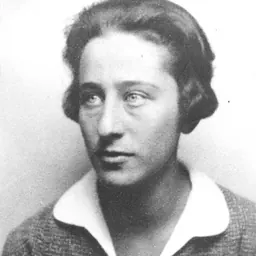
Lived 1901 – 1994 (aged 92). Rosa Jochmann was an Austrian politician and german resistance to Nazism.
Rosa Jochmann (19 July 1901 – 28 January 1994) was an Austrian resistance activist and Ravensbrück concentration camp survivor who became a politician (SPÖ).
Life Provenance and early years Rosa Jochmann was born in the 20th district of Vienna, the fourth of her parents' six children. Her father worked as an iron foundryman: her mother worked in domestic service and as a laundry worker. While she was still very young the family moved to the 11th district (Simmering Viertel), in the southeast of the city, where they lived in a succession of rented rooms until 1912 when they moved into an apartment in one of the new so-called "Krankenkassenhäusern" (social housing – literally: "sickness insurance houses") which had been built at the instigation of the socialist politician Laurenz Widholz, alongside the "Braunhubergasse" (street). She would still be living in southeast Vienna seventy years later. The language spoken at home was for the most part Czech. Jochmann later recalled that her father had never really learned German. He was, according to at least one source, frequently unemployed because of his reputation as a political activist. The Jochmann children grew up bilingual. Still aged only 25, she emerged to be appointed union secretary of the Chemical Workers Union.
Rosa Jochmann also joined the Social Democratic Party ("Sozialdemokratischen Arbeiterpartei" / SDAP) in 1926. She attended that year's party conference, at which the important new party programme was adopted, as an observer, viewing from the visitors' gallery. Very quickly, however, she moved up the party hierarchy. In 1932 she became a member of the party Women's Secretariat. In 1933, at the last party conference before the SDAP was banned, Rosa Jochmann and Helene Postranecky (1903–1995) were elected to the party national executive in succession to Adelheid Popp(1869–1939) and Therese Schlesinger (1863–1940). Bauer escaped across the border to the north, and would spend the next four years as a political exile in Brno. He instantly resigned the party leadership, but during the difficult years that followed was able to remain in frequent contact with former party comrades as an advisor and inspiration. All the individuals who had been members of the party national executive faced charges of high treason: most were arrested in the days following the armed altercation.
Directly after the February events the SDAP was expressly outlawed, in the context of a more far reaching programme of destruction by the Dollfuss government, aimed at Austria's democratic political structure. Jochmann managed to evade immediate capture and continued with – now illegal – party work while using a forged identity card as "Josefine Drechsler" (which was her younger sister's name). She was able to remain at liberty for more than half a year, and was at the centre of attempts to create an illegal successor organisation to the SDAP. On 26 February 1934 five political comrades who had not been arrested met in a private apartment in Vienna 9:
Ravensbrück Ravensbrück concentration camp held approximately 132,000 women and children, 20,000 men and 1,000 "female young people", who came, according to registration data, from more than forty nations. Tens of thousands would be murdered or would die from hunger and illness. Through the intervention of a fellow inmate, the economist-politician Käthe Leichter, Rosa Jochmann found herself appointed a "block senior" in the so-called "politicals'" block till 1943. Appointing inmates to undertake administrative roles gave the camp guards more time for their own priorities. The position was one of privilege but also of heightened political risk. It could provide opportunities to mediate between inmates and the camp authorities, and Jochmann was sometimes able to get together with others in order to arrange extra food rations or medication in cases of exceptional need. Jochmann seems to have managed to find in herself a greater level of physical and mental strength than many. But she still had to stand idly by as her friend and political soulmate Käthe Leichter was taken away to Auschwitz to be murdered.
After the camp was liberated by Soviet forces in April 1945, Rosa Jochmann was one of many who stayed on for several weeks to help care for survivors. From Austria, there came no evidence of any official offer to return the Austrian Ravensbrück survivors across the mountains back to their home country. Jochmann therefore travelled to Vienna with the communist Friederike "Friedl" Sinclair and negotiated the provision of transport with the Soviet military commander there. She then returned to the camp and helped organise the repatriation. Travelling home with fellow survivors, she celebrated her forty-fourth birthday.
In 1967, now aged 66, Rosa Jochmann retired from all but one of her political offices. The exception was her role as chair of the "Bund sozialistischer Freiheitskämpfer" ("Association of Socialist Freedom Fighters"), which consists of former members of the old Revolutionary Socialists.
Death and burial
Rosa Jochmann died following a heart attack at the Hanusch Hospital in Vienna on 28 January 1994.
Mission Jochmann warned throughout her life against Far-right extremism and Antisemitism. She presented countless lectures and communicated her own contemporary experiences and insights, addressing schools and as a conference speaker, both in Austria and abroad.
Public recognition and celebration Rosa Jochmann was one of the prominent Ravensbrück concentration camp inmates who was publicly commemorated during the liberation celebrations at the Ravensbrück National Memorial of the German Democratic Republic (GDR), like Martha Desrumaux, Yevgenia Klemm, Antonina Nikiforova, Mela Ernst, Katja Niederkirchner, Rosa Thälmann, Olga Benário Prestes, Olga Körner, Minna Villain, and Maria Grollmuß.
Rosa Jochmann was awarded Honorary citizenship ("Ehrenbürgerrecht") of Vienna in 1981.
In 1995, the year following her death, a street in the 11th district (Simmering Viertel) of Vienna was renamed, "Rosa-Jochmann-Ring" in celebration of her life and contribution. In the adjacent Leopoldstadt quarter the naming of the Rosa Jochmann Park also honours her memory.
In 2004, a newspaper poll reported by the Kurier (Vienna-based newspaper) identified Rosa Jochmann as one of the fifty most important Austrians of the last fifty years.
Don’t just read it —
keep it.
Full-length biographies made to live with: read them, listen on the way to work, watch them tonight.
- E-book
- Audio
- Video
Instant download · yours to keep · every purchase keeps this site free
Important facts
People in Rosa Jochmann's life
Named in this biography and alive at the same time


Related people
Same field, nearest in time






Contemporaries
People whose lives overlapped Rosa Jochmann's



Frequently asked questions
Who was Rosa Jochmann?
Austrian politician (1901–1994)
When was Rosa Jochmann born?
Rosa Jochmann was born on 19 June 1901 in Vienna.
When did Rosa Jochmann die?
Rosa Jochmann died on 28 January 1994 in Vienna.
What was Rosa Jochmann's occupation?
Rosa Jochmann was a politician and german resistance to Nazism.
What nationality was Rosa Jochmann?
Rosa Jochmann was Austrian.
Sources & further reading
Cite this page
APA: Biography.guide. (2026). Rosa Jochmann. https://biography.guide/rosa-jochmann/
MLA: "Rosa Jochmann." Biography.guide, https://biography.guide/rosa-jochmann/.
Chicago: "Rosa Jochmann." Biography.guide. https://biography.guide/rosa-jochmann/.
Data last updated: 2026-09-22 · Spot an error? Report a correction.
Page generated 2026-09-27 05:33 UTC