
About Ronald Joseph
Lived 1910 – 1992 (aged 81–82). Ronald Joseph was a Belgian artist.
Ronald Joseph (1910–1992) was an African-American artist, teacher, and printmaker.
Personal life
Ronald Joseph was born on the Island of St. Kitts in the West Indies. When he was very young, his mother decided to come to the US but she could not afford to take him with her. Mr. and Mrs. Theophilus Joseph, a childless couple who were friends of Joseph's mother, adopted him. Afterwards, the Joseph family moved to the Island of Dominica, where they stayed for ten years. In 1921, his foster parents also decided to come to the US. In New York, Joseph met his mother but remained living with his foster parents. An artistic prodigy, Ronald Joseph had his student works shown at the Metropolitan Museum of Art. He was honored as "the most promising" young artist in New York City's schools.
During the 1930s and 1940s, Joseph participated in many exhibitions of African-American art, the Works Progress Administration mural project, and the Harlem Artists Guild.
Ronald Joseph enlisted in the U.S. Army Air Corps at the declaration of World War II and was posted as a member of the ground crew in Tuskegee, Alabama, and in Michigan. At the end of the war in 1945, he received his G. I. Bill of Rights scholarship. After this period he came back to New York without money and work and indicated this as period of hardship. At the Harlem Community Arts Center Joseph met Robert Blackburn, who was his classmate. In 1937 Ronald Joseph depicted Blackburn, Joseph described the Harlem Art Center as a "healthy and lively" place, where he had made wonderful friends.
In the 1930s, Joseph became chairman of the Harlem Artists Guild and represented it in Washington with Stuart Davis and Hugo Gellert. Ronald Joseph was also a participant in the mural section of WPA and a representative of the Harlem Artists' Guild to the New York World's Fair (1939–1940). His pastels and gouaches from the late forties and early fifties showed a highly structured abstraction combined with a studied spontaneity. Ronald Joseph's finely tuned abstractions often incorporated representational elements along with apparently "purer" forms. He described this aspect of his work in these terms: "It's not abstract and abstract at the same time. It's pure creation.” His works from the 1950s employed both still life and landscape as pretexts for masterly exercises in nearly abstract pictorial construction related to cubism and fauvism.
During World War II, Joseph was drafted. After the war he formed "a kind of a group" with Robert Blackburn, Charles White, Larry Potter, and Reginald Gammon and made woodcuts. In 1948, after he received fellowships he traveled to Peru and then to Paris, where his work grew increasingly abstract. When he returned to New York, he lived in Greenwich Village and continued to paint, but with little recognition. In 1956, feeling discouraged about his place in the art scene in the US, Ronald Joseph left the US for Brussels, where he continued his artistic career.
1939: Contemporary Negro Art - Baltimore Museum of Art
December 9, 1941 – January 3, 1942: American Negro Art: 19th and 20th Centuries - Downtown Gallery
1943: Library of Congress in Washington, D.C
February 6, 2010 – July 24, 2010: A Force for Change: African American Art and the Julius Rosenwald Fund - Montclair Art Museum
Works of art Tenement Window (lithograph) - c. 1935, Metropolitan Museum of Art
Robert Blackburn (lithograph) - c. 1937, Metropolitan Museum of Art
Country Scene (lithograph) - c. 1934–36, Metropolitan Museum of Art
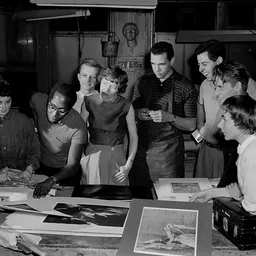
The Graphic Workshop (lithograph) - c. 1935–37, Metropolitan Museum of Art
Under the Elevated (lithograph) - c. 1934–36, Metropolitan Museum of Art
Still Life (gouache) - 1950/1954, Harvey B. Gantt Center for African-American Arts+Culture
The Family (paper / gouache) - 1953, Harvey B. Gantt Center for African-American Arts+Culture
Two Musicians (paper) - 1952/1955, Harvey B. Gantt Center for African-American Arts+Culture
Paris Vista (#6) (oil on linen canvas) - 1950-52
Selected collections Metropolitan Museum of Art, New York, New York
Harvey B. Gantt Center for African-American Arts+Culture, Charlotte, North Carolina
Don’t just read it —
keep it.
Full-length biographies made to live with: read them, listen on the way to work, watch them tonight.
- E-book
- Audio
- Video
Instant download · yours to keep · every purchase keeps this site free
Important facts
People in Ronald Joseph's life
Named in this biography and alive at the same time




Related people
Same field, nearest in time



Contemporaries
People whose lives overlapped Ronald Joseph's





Frequently asked questions
Who was Ronald Joseph?
American artist, teacher, and printmaker (1910–1992)
When was Ronald Joseph born?
Ronald Joseph was born in 1910 in Saint Kitts, West Indies.
When did Ronald Joseph die?
Ronald Joseph died in 1992 in Brussels-Capital Region.
What was Ronald Joseph's occupation?
Ronald Joseph was an artist.
What nationality was Ronald Joseph?
Ronald Joseph was Belgian.
Sources & further reading
· DBpedia: Ronald Joseph (artist)
Cite this page
APA: Biography.guide. (2026). Ronald Joseph. https://biography.guide/ronald-joseph/
MLA: "Ronald Joseph." Biography.guide, https://biography.guide/ronald-joseph/.
Chicago: "Ronald Joseph." Biography.guide. https://biography.guide/ronald-joseph/.
Data last updated: 2026-09-20 · Spot an error? Report a correction.
Page generated 2026-09-27 05:29 UTC