
Roman Verostko
American artist and educator
About Roman Verostko
Lived 1929 – 2024 (aged 94). Roman Verostko was an American contemporary artist and minneapolis College of Art and Design, known for Algorithmic art.
Roman Verostko (September 12, 1929 – June 1, 2024) was an American artist and educator who created code-generated imagery, known as algorithmic art. Verostko developed his own software for generating original art based on form ideas he had developed as an artist in the 1960s. His software controls the drawing arm of a machine known as a pen plotter that was designed primarily for engineering and architectural drawing. In coding his software Verostko conceives of the machine's drawing arm as an extension or prosthesis for his own drawing arm. The plotter normally draws with ink pens but Verostko adapted oriental brushes to fit the drawing arm and wrote interactive routines for achieving brush strokes with his plotters. In 1995, he co-founded the Algorists with Jean-Pierre Hébert.
Biography Roman Verostko was born in Tarrs, Pennsylvania, a coal-mining town fifty miles east of Pittsburgh. A painter in his early life, he also studied as a Benedictine monk at Saint Vincent Seminary in Latrobe, Pennsylvania, from 1952 to 1968, joining the faculty there in 1963. His monastic travels took him to places such as New York, Washington, and Paris. After leaving religious life in 1968, he continued experimenting with automatic drawing that led him to explore methods of writing code to achieve some form of computer automatism. This led him to redirect all his artistic practices toward algorithmic art. He married Alice Wagstaff in August 1968. She was a psychologist and gave seminars at the monastery when Verostko met her. She died in 2009. He resided in Minneapolis, Minnesota, where he taught at the Minneapolis College of Art and Design (MCAD) from 1968 to 1994 and held the title of Professor Emeritus. Verostko died in Minneapolis on June 1, 2024, at the age of 94.
Education After graduating from high school, Verostko studied at the Art Institute of Pittsburgh, where he received a diploma in illustration in 1949. In 1950 he entered the Saint Vincent Archabbey scholastic program for monks that included entrance to Saint Vincent College, monastic vows in 1954, a BA in philosophy in 1955, four years of Theology in the St. Vincent Major Seminary and ordination as a priest in 1959. While Verostko remained a monk attached to Saint Vincent Archabbey, he pursued graduate work in the early 1960s at other institutions, first in an MFA program at Pratt Institute in 1961, then studies in art history at New York University and Columbia University from 1961 to 1962. Verostko then traveled to Paris, where he studied printmaking at Stanley William Hayter's Atelier 17 from 1962 to 1963, as well as took courses at the École du Louvre and visited religious sites. Much of Verostko's work in Paris "pursued visual manifestations of inner experience that transcended rational observation". For many of these 'automatic' works he maintained a private notebook of 'experience states' related to their execution". Perhaps unsurprisingly, Hayter worked very closely with the Surrealists, exploring semi-automated methodologies for image-making in the belief that its source was the irrational. Hayter also associated with many of the forerunners of the Algorists, among them Le Corbusier. Many of the themes Verostko would explore in his life's work - EXAMPLES - emerged in this time period in and around Paris.
He resumed creating abstract expressionist paintings and toured an innovative light-and-sound show he had created based on the Psalms, while editing the New Catholic Encyclopedia in Washington, D.C.
Verostko wrote his first code in punch cards at the Control Data Institute in the late 1960s. In the summer of 1970, with a Bush Foundation Fellows Grant to explore "the humanization of new technologies", he worked with Gyorgy Kepes at MIT's Center for Advanced Visual Studies (CAVS). "But my real coding work began with the first personal computers, the Apples we had in '78 and the IBM that came out in August 1981," he said. Each copy of the book contains unique multi-pen plotter drawings with the frontispiece including a single brush stroke created using the same algorithm.
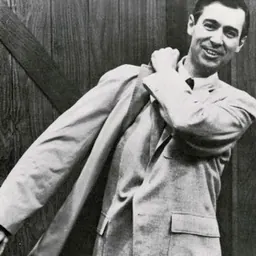
In 2008, Verostko installed an "upside-down" mural, with 11 units spanning two stories inside the main entrance of the Fred Rogers Early Childhood Learning Center located on the Saint Vincent College campus, Latrobe, Pennsylvania. The images are digital transformations of his original pen and ink drawings created for an "Upsidedown Book" in the 1970s. His "Upsidedown Book" was published and dedicated to Fred Rogers on August 2, 2008.
Awards and honors 1970 Bush Leadership Fellow 1971, 1974 Outstanding Educators of America 1995 ARTEC '95, Recommendatory Prize. 1994 Golden Plotter Award, First Prize, Gladbeck, Germany
Public collections His work is held by the Victoria and Albert Museum, Minneapolis Institute of Arts, Saint Vincent College, Spalding University in Louisville, and the Frey Science and Engineering Center at the University of St. Thomas in St. Paul. His drawings have also been featured in over 30 exhibitions in shows in Rome, Berlin, Istanbul, Lima, Tokyo and New York.
Don’t just read it —
keep it.
Full-length biographies made to live with: read them, listen on the way to work, watch them tonight.
- E-book
- Audio
- Video
Instant download · yours to keep · every purchase keeps this site free
Important facts
People in Roman Verostko's life
Named in this biography and alive at the same time





Related people
Same field, nearest in time



Contemporaries
People whose lives overlapped Roman Verostko's



Frequently asked questions
Who was Roman Verostko?
American artist and educator (1929–2024)
When was Roman Verostko born?
Roman Verostko was born on 12 September 1929 in Tarrs.
When did Roman Verostko die?
Roman Verostko died on 1 June 2024 in Minneapolis.
What was Roman Verostko's occupation?
Roman Verostko was a contemporary artist and minneapolis College of Art and Design.
What was Roman Verostko known for?
Roman Verostko was known for Algorithmic art.
What nationality was Roman Verostko?
Roman Verostko was American.
Sources & further reading
Cite this page
APA: Biography.guide. (2026). Roman Verostko. https://biography.guide/roman-verostko/
MLA: "Roman Verostko." Biography.guide, https://biography.guide/roman-verostko/.
Chicago: "Roman Verostko." Biography.guide. https://biography.guide/roman-verostko/.
Data last updated: 2026-09-22 · Spot an error? Report a correction.
Page generated 2026-09-27 05:32 UTC