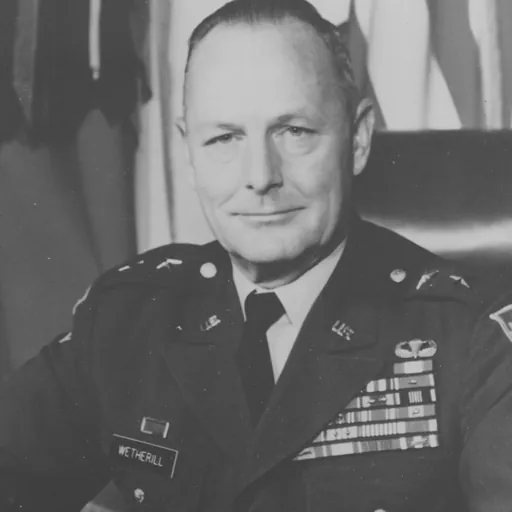
Roderick Wetherill
United States Army general
About Roderick Wetherill
Lived 1918 – 1978 (aged 60). Roderick Wetherill was an American.
Major General Roderick Wetherill Sr. (January 19, 1918 – June 26, 1978) was a notable officer of the United States Army, serving from World War II through to the Vietnam War. The official Army History of The War in southeast Asia considers him to have been a "key ... commander in Vietnam". He is the son of Richard Wetherill and Elenor Jane Eckerson.
Education and early career Wetherill graduated from West Point Military Academy in 1940, as had his father and both his sons, Roderick Jr. and Robert Wetherill as well as both grandsons, Chad and Brett Wetherill. his bride was a daughter of Army officer Alexander R. Bolling, who later became a lieutenant general and former Chief of Army Intelligence.
Wetherill was working there at West Point after graduation, and residing in Highland Falls, New York, when his son, Roderick Wetherill Jr., was born on January 20, 1942. His first son was born six weeks after the attack on Pearl Harbor, and the day after his own birthday.
Wetherill was promoted several times during and after World War II. In June 1953, then-Lieutenant Colonel Wetherill took part in a "retrograde movement" at Pukhan River as commander of the 176th Field Artillery Battalion, towards the end of the Korean War. He was awarded the Silver Star and the Legion of Merit for his service. He was "division artillery advisor" at the battle of Pukhan River, and witnessed first-hand the horrible casualties; he said, "I could see by the gun flashes the arms legs and faces hanging all over the wire." From April 1963 to December 1964, he was chief of staff of V Corps in Germany, at the rank of brigadier general.
Vietnam War Walter Cronkite reported on location during the Vietnam War. After a long military career, Wetherill rose to the rank of major general. He was appointed the Senior Advisor, IV Corps, Delta Military Assistance Command on June 1, 1969, He advised General Creighton Abrams in June 1969 to transfer certain units of the Army of the Republic of Vietnam out of Saigon to the Mekong delta area to allow them to gain combat experience, but Wetherill's advice was ignored. Just as he feared, the People's Army of Vietnam (PAVN) invaded the Mekong Delta in August 1969. Wetherill was quoted extensively in a nationally syndicated UPI story about the offensive.
In September 1969, Walter Cronkite of CBS News reported that some civilian advisors had also advised withdrawing United States troops; he further quoted Wetherill as describing both the displaced persons there and the withdrawal of American troops.
Fort Sill Old infantry barracks at Fort Sill, Comanche County, outside Lawton, Oklahoma. Wetherill was sent stateside to Fort Sill, which he commanded from February 1970 through the end of May 1973.
As a commanding officer of Fort Sill, and its artillery school during the early 1970s, Wetherill was the named defendant in a famous conscientious objector case during the Vietnam War, Polsky v. Wetherill, 438 F.2d 132 (10th Cir. 1971). The Tenth Circuit decided Polski on jurisdictional grounds, without getting into the merits of the case, while sitting en banc. On remand, the Tenth Circuit ruled in favor of the petitioner's request for a writ of habeas corpus, and against Wetherill, in Polsky v. Wetherill, 455 F.2d 960 (10th Cir. 1972). Polsky v. Wetherill was cited was precedent ("mandatory authority") in Miller v. United States Army, 458 F.2d 388 (10th Cir. 1972).
Wetherill once sent an enlisted man to psychiatric evaluation, rather than trial, in Lozinski v. Wetherill, 21 USCMA 77, 44 CMR 131 (C.M.A. 1971). In another case, Robertson v. Wetherill, 21 USCMA 77, 44 CMR 131 (C.M.A. 1971), he ordered an enlisted man who was charged with possession of marijuana to face a general, rather than special, court martial.
Major General Wetherill retired from the army on May 31, 1973.
Awards
Distinguished Service Medal Silver Star Legion of Merit He was the editor of the United States Army's monograph about the history of U.S. Field Artillery from 1972 to 1973.
Roderick Wetherill Jr. Both Wetherill and his son were graduates of West Point, and wore the famous grey uniform.
Roderick "Rick" Wetherill Jr. (b. January 20, 1942 – September 9, 1996) was an officer of the United States Army from the Vietnam War through the Reagan administration's arms war. Wetherill Jr. was the son of Wetherill and Josephine Bolling, daughter of army officer Alexander R. Bolling, who later became a lieutenant general and Chief of Army Intelligence. So many of Wetherill's relatives attended West Point—his father, a grandfather, and two uncles among them He also graduated from the Command and General Staff Schools of the army.
Don’t just read it —
keep it.
Full-length biographies made to live with: read them, listen on the way to work, watch them tonight.
- E-book
- Audio
- Video
Instant download · yours to keep · every purchase keeps this site free
Important facts
People in Roderick Wetherill's life
Named in this biography and alive at the same time
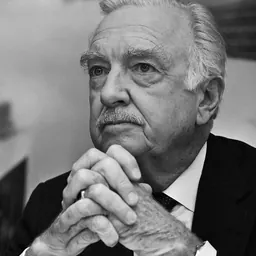

Contemporaries
People whose lives overlapped Roderick Wetherill's


Frequently asked questions
Who was Roderick Wetherill?
United States Army general (1918–1978)
When was Roderick Wetherill born?
Roderick Wetherill was born on 19 January 1918 in Chicago.
When did Roderick Wetherill die?
Roderick Wetherill died on 26 January 1978.
What nationality was Roderick Wetherill?
Roderick Wetherill was American.
Sources & further reading
· Wikipedia: Roderick Wetherill
Cite this page
APA: Biography.guide. (2026). Roderick Wetherill. https://biography.guide/roderick-wetherill/
MLA: "Roderick Wetherill." Biography.guide, https://biography.guide/roderick-wetherill/.
Chicago: "Roderick Wetherill." Biography.guide. https://biography.guide/roderick-wetherill/.
Data last updated: 2026-09-23 · Spot an error? Report a correction.
Portrait: Wikimedia Commons · author & licence
Page generated 2026-09-27 05:07 UTC