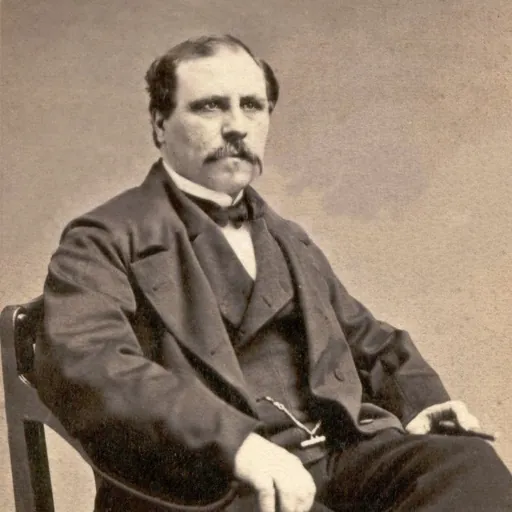
About Robert Stoepel
Lived 1821 – 1887 (aged 65–66). Robert Stoepel was a German and American composer, composer (music) and conductor (music).
Robert Auguste Stoepel (born Auguste Stöpel, 1821 – 1 October 1887) was a German-born American composer and conductor. His compositions include Hiawatha, a symphony for orchestra and vocal soloists, as well as incidental music for plays, piano works, songs, and several operas. Born in Berlin, Stoepel worked in Paris and London, but spent a large portion of his career in New York City where he died at the age of 66. From 1857 until their separation in 1869, he was married to the actress Matilda Heron. Their daughter Bijou Heron was also an actress.
Biography Robert Stoepel was born Auguste Stöpel in Berlin in 1821. Because his father had a reputation as a court musician, he adopted his forename. His sister, Hélène Stöpel, was noted as a "charming and talented pianist." (She later married the composer William Vincent Wallace.) After he graduated from the Berlin Conservatory of music, he went to Paris where he graduated from the Conservatoire de Paris, where his teachers included Luigi Cherubini, Fromental Halévy, and Friedrich Kalkbrenner. He got his start at composing incidental music for dramas there, being one of three composers who contributed to a stage production of Monte-Cristo, a play by Alexandre Dumas and Auguste Maquet which premiered on 3 February 1848 at the Théâtre Historique. According to his obituary in the Musical Times, while in Paris he wrote two operas, Indiana and Charlemagne. In an 1849 article in the Musical World it was noted that he was negotiating with John Medex Maddox to produce his opera, La sentinelle perdu, for the Princess Theatre in London, and that he had already composed a ballet which was performed at the Paris Opera.
He wrote incidental music for all of the plays written by Dion Boucicault during his stay in New York from 1854 through 1860. He was the conductor of many New York productions of Offenbach operettas, including La Grande-Duchesse de Gérolstein, La Vie parisienne, Fleur de Thé, and Geneviève de Brabant.
His most ambitious compositional effort was Hiawatha based on Henry Wadsworth Longfellow's poem The Song of Hiawatha. Subtitled "an Indian Symphony," this was a work symphonic in proportions with vocal soloists and a part for narrator. It was first performed by the Mendelssohn Union with soloists Mrs. I.I. Harwood (who alternated between the two female roles of Nokomis and Minnehaha), Harrison Millard (Hiawatha), J. Q. Wetherbee (who sang the Great Spirit and the Arrow-Maker) It was performed in New York shortly thereafter. Hiawatha had its London premiere on February 11, 1861.
He stayed at Wallack's Theatre throughout the 1860s. He also worked for the Winter Garden Theatre. After it burnt down in 1867, he worked for Daly's Fifth Avenue Theatre. There he composed and conducted incidental music for the stage productions The Hurricane, Divorce, Frou-Frou, Man and Wife, and Fernande.
Sometime in the 1870s he moved to London where he was engaged by Henry Miller. He composed incidental music for all of Miller's first successes. When Miller came to New York, Stoepel found that Miller was still using his music, so he filed a suit against him and settled for $2,000. Fairy Star schottisch (1856) (1857) The Lester Wallack Polka (1862) U.S. Army Calls (1862) quadrilles Jean Hosmer Polka (1865) Reminiscences of Leah (1868) Frou Frou Waltz (1870)
Incidental music and other works Ruling Passion (Wallack's Theatre, 1859) The Romance of a Poor Young Man (Wallack's Theatre, 1860) The Duke's Motto (Niblo's Garden, 1863) Columbus Reconstructed (Winter Garden, 1866) The Merchant of Venice (revival with Edwin Booth) (Grand Opera House, Manhattan, 1872)
Don’t just read it —
keep it.
Full-length biographies made to live with: read them, listen on the way to work, watch them tonight.
- E-book
- Audio
- Video
Instant download · yours to keep · every purchase keeps this site free
Important facts
Family & relationships
People in Robert Stoepel's life
Named in this biography and alive at the same time




Related people
Same field, nearest in time


Contemporaries
People whose lives overlapped Robert Stoepel's


Frequently asked questions
Who was Robert Stoepel?
American composer (1821-1887)
When was Robert Stoepel born?
Robert Stoepel was born in 1821 in Berlin.
When did Robert Stoepel die?
Robert Stoepel died on 1 October 1887 in New York City.
What was Robert Stoepel's occupation?
Robert Stoepel was a composer, composer (music) and conductor (music).
What nationality was Robert Stoepel?
Robert Stoepel was German and American.
Sources & further reading
Cite this page
APA: Biography.guide. (2026). Robert Stoepel. https://biography.guide/robert-stoepel/
MLA: "Robert Stoepel." Biography.guide, https://biography.guide/robert-stoepel/.
Chicago: "Robert Stoepel." Biography.guide. https://biography.guide/robert-stoepel/.
Data last updated: 2026-09-22 · Spot an error? Report a correction.
Portrait: Wikimedia Commons · author & licence
Page generated 2026-09-27 04:59 UTC