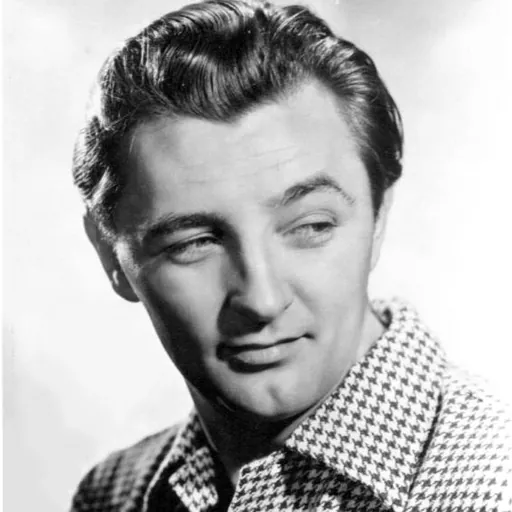
About Robert Mitchum
Lived 1917 – 1997 (aged 79). Robert Mitchum was an American actor, singer, military officer, film actor, film director and television actor.
Robert Charles Durman Mitchum (August 6, 1917 – July 1, 1997) was an American actor and singer. He is known for his antihero roles and film noir appearances. He received nominations for an Academy Award and a BAFTA Award. He received a star on the Hollywood Walk of Fame in 1984 and the Golden Globe Cecil B. DeMille Award in 1992. Mitchum is rated number 23 on the American Film Institute's list of the greatest male stars of classic American cinema. David Thomson wrote: "Since the war, no American actor has made more first-class films, in so many different moods."
Early life
Robert Charles Durman Mitchum was born in Bridgeport, Connecticut, on August 6, 1917, into a Methodist family of Scots-Irish, Native American, and Norwegian descent. His father, James Thomas Mitchum, a shipyard and railroad worker, was of Scots-Irish and Native American descent,
When all of the children were old enough to attend school, Ann found employment as a linotype operator for the Bridgeport Post. She married Lieutenant Hugh "The Major" Cunningham Morris, a former Royal Naval Reserve officer. They had a daughter, Carol Morris, born on the family farm in Delaware.
As a child, Mitchum was known as a prankster, often involved in fistfights and mischief. (Mitchum talked about his chain gang experience in the 1962 Saturday Evening Post interview: "I had hopped a freight train with about seventeen other kids and headed South.) In my pocket I had thirty-eight dollars – all I had in the world. When we reached Savannah, I was cold and hungry. So I dropped off to get something to eat. The big fuzz grabbed me. 'For what?' I asked. He grinned. 'Vagrancy – we don't like Yankee bums around here.' When I told him I had thirty-eight dollars, he just called me a so-and-so wise guy and belted me with his club and ran me in." The rest of the family soon also arrived and moved in with Julie. For the next three years, Mitchum continued traveling across the country and taking various jobs. He participated in 27 professional boxing matches but retired from the ring after a fight that broke his nose and left a scar on his left eye. Mitchum's conviction was later overturned by the Los Angeles court and district attorney's office on January 31, 1951, after being exposed as a setup.
Despite Mitchum's legal troubles, his popularity was not harmed. His upcoming film, Rachel and the Stranger, was rushed into release to take advantage of the publicity surrounding the arrest and became one of RKO's top grossers of 1948. Costarring with Loretta Young and William Holden, he played a mountain man competing for the hand of the indentured servant and wife of a recent widower. His performance received rave reviews, with critics noting his screen image as a quiet yet menacing drifter and pointing out that his presence enhanced the film's quality.
Mitchum starred in three films in 1949. The Red Pony, the film adaptation of John Steinbeck's novella, directed by Lewis Milestone and costarring Myrna Loy, was his first color film. A loan-out to Republic Pictures, it featured him as a trusted cowhand to a ranching family. Back at RKO in The Big Steal, an early Don Siegel film, he returned to film noir in a reunion with Jane Greer, playing an army lieutenant who chases a thief with the help of the thief's fiancée. It was a box office success. He was cast against type in the romantic comedy Holiday Affair opposite Janet Leigh.
By the end of the 1940s, Mitchum had become RKO's biggest star. Before the filming of Holiday Affair, RKO studio head Howard Hughes bought Selznick's share of his contract for $400,000. and paired him for the first time with Jane Russell, RKO's top female star at the time. Richard Fleischer was brought on by Howard Hughes for extensive reshooting of John Farrow's original cut. The Racket (1951), a noir remake of the 1928 silent crime drama of the same name, featured him as a police captain fighting corruption in his precinct. Four other directors contributed to the project alongside the credited John Cromwell. Macao (1952) reunited him with Russell, casting him as a victim of mistaken identity at an exotic resort casino. Director Josef von Sternberg was forced off the set by Hughes and replaced by Nicholas Ray. While The Racket was one of RKO's most successful films of 1951, both His Kind of Woman and Macao cost so much that they lost money.
Following the Korean War drama One Minute to Zero (1952) with Ann Blyth, which was one of RKO's biggest pictures of the year, Mitchum returned to the Western genre. He starred as a veteran rodeo champion in The Lusty Men (also 1952), directed by Nicholas Ray and costarring Susan Hayward and Arthur Kennedy. His performance was lauded by critics, with Variety and The Hollywood Reporter calling it his best to date. Manny Farber wrote in The Nation, "Mitchum is the most convincing cowboy I've seen in horse opry, meeting every situation with the lonely, distant calm of a master cliché-dodger."
In 1953, Mitchum starred in Otto Preminger's Angel Face, the first of his three films with Jean Simmons. He played an ambulance driver who allows a murderously insane heiress to fatally seduce him. The initial reviews were mixed, but the film is now recognized as a noir classic. In a retrospective review in 2010, Richard Brody wrote in The New Yorker that "the ever-cool Mitchum radiates heat without warmth."
In exchange for Hayward's appearance in The Lusty Men, Mitchum was loaned to 20th Century Fox for White Witch Doctor (1953) opposite Hayward, playing a hunter who falls in love with a nurse in Africa. Although director Henry Hathaway was impressed by Mitchum's performance, the critics were not. Back at RKO, Mitchum appeared in the studio's first 3-D production, Second Chance (also 1953), playing a boxer whose girlfriend is trailed by a mobster in Mexico. The film, directed by Rudolph Maté and costarring Linda Darnell and Jack Palance, was a box office success and received fairly positive reviews. However, Mitchum had not liked the script and was increasingly dissatisfied with the projects assigned to him by RKO.
In 1954, Mitchum reteamed with Simmons in the romantic comedy She Couldn't Say No, his last film released by RKO. (The film was not the last film Mitchum made for RKO, but the last that was released.) That same year, he was loaned out for two films. At 20th Century Fox, he costarred with Marilyn Monroe in Preminger's Western River of No Return, which was a box office hit. In William A. Wellman's psychological drama Track of the Cat for Wayne/Fellows Productions, John Wayne's independent production company, he played the bullying brother of Teresa Wright and Tab Hunter. Mitchum recalled the film, which was shot in the deep snow at Mount Rainier, as his toughest location shooting experience. The film was not a success on release, Wellman later describing it in his autobiography as "a flop artistically, financially, and Wellmanly." However, it is now recognized as a unique masterpiece by some critics, noted for its color-drained visual style, the story that evokes Eugene O'Neill and Carl Theodor Dreyer, and Mitchum's menacing performance.
Mitchum left RKO after his contract expired on August 15, 1954.
As a freelancer, Mitchum appeared in three films in 1955. The first was Stanley Kramer's melodrama Not as a Stranger costarring Olivia de Havilland and Frank Sinatra, in which he starred as an idealistic young doctor who marries an older nurse only to question his morality many years later. The picture was one of the ten highest-grossing films of the year, but critical reactions were mixed, with Leslie Halliwell pointing out that all of the actors were too old for their characters.
Mitchum's second film in 1955 was The Night of the Hunter, Charles Laughton's only film as a director. Based on a novel by Davis Grubb, the noir thriller starred Mitchum as a serial killer posing as a preacher to find money hidden by his cellmate in the man's home. A commercial failure on release, Mitchum's performance as Preacher Harry Powell is considered by many one of the best of his career, and the image of him with the words "HATE" and "LOVE" tattooed on his knuckles has left an enduring impact on popular culture, frequently referenced in various media. In a 1985 review for the Chicago Reader, Dave Kehr described the Preacher as "the role that most fully exploits his [Mitchum's] ferocious sexuality." Roger Ebert wrote in the Chicago Sun-Times in 1996, "Nobody who has seen The Night of the Hunter has forgotten it, or Mitchum's voice coiling down those basement stairs: 'Chillll... dren?'" Mitchum made headlines for having been fired from Blood Alley (1955) at the request of director William A. Wellman. Reportedly, he had thrown the film's transportation manager into San Francisco Bay, a story he denied. Producer John Wayne eventually took the role himself.
On March 8, 1955, Mitchum formed DRM Productions, named after his and his wife's initials, and signed a five-film deal with United Artists; four ultimately were produced. The first was Bandido, in which he played an American adventurer who sides with the rebels and is attracted to the wife of a gunrunner working for the army during the Mexican Revolution. A commercial success, it was his second film released in 1956, following the poorly received color noir Foreign Intrigue.
Mitchum made two films back to back in Trinidad and Tobago that were released in 1957. John Huston's World War II drama Heaven Knows, Mr. Allison cast him as a Marine corporal stranded on a Pacific Island with a nun, played by Deborah Kerr, as his sole companion, until Japanese soldiers arrive and establish a base. In this character study, they struggle with the elements, the garrison, and their growing feelings for one another. It was the first of his four films with Kerr, his favorite leading lady. Their performances and chemistry were praised by critics, many of whom highlighted the tenderness he brought to his character. The film was nominated for two Academy Awards, Best Actress and Best Adapted Screenplay. For his role, Mitchum was nominated for a BAFTA Award for Best Foreign Actor. In Robert Parrish's Fire Down Below, he and Jack Lemmon played two tramp boat owners in the Caribbean whose friendship is challenged when passenger Rita Hayworth arrives on the scene. The film received mixed reviews and failed at the box office.
Mitchum appeared in one more film in 1957, Dick Powell's World War II submarine film The Enemy Below, in which he played the captain of a US Navy destroyer who matches wits with a wily German U-boat skipper, portrayed by Curt Jurgens. The following year, he starred in his second DRM production, Thunder Road. The film was loosely based on an incident in which a driver transporting moonshine was said to have fatally crashed on Kingston Pike in Knoxville, Tennessee, somewhere between Bearden Hill and Morrell Road. According to Metro Pulse writer Jack Renfro, the incident occurred in 1952 and may have been witnessed by James Agee, who passed the story on to Mitchum. He produced, co-wrote the screenplay for, and is rumored to have directed much of the film, which featured his son James playing his younger brother. He also co-wrote the theme song, "The Ballad of Thunder Road," with Don Raye. The film was frequently shown in drive-in and third-house theaters in the 1960s and has since earned the reputation as the definitive road movie, with a particularly significant following in the South. According to Geoff Andrew in his review for Time Out, Thunder Road stands out for "a stunningly laconic performance from Mitchum, white-hot night-time road scenes, and an affectionate but unsentimental vision of backwoods America."
Mitchum followed Thunder Road with his second film directed by Dick Powell, The Hunters (1958), in which he played a flying ace who is smitten with the wife of a pilot under his command during the Korean War. He was initially offered the role of Colonel Dean Hess in another Korean War drama, Battle Hymn (1957), but the casting choice was vetoed by Hess himself, who cited Mitchum's marijuana scandal. In 1959, Mitchum appeared in Robert Aldrich's thriller The Angry Hills as an American war correspondent entrusted with a list of Greek resistance leaders during World War II, before starring in his third DRM production, The Wonderful Country. Opposite Julie London, he portrayed an American expatriate gunslinger in Mexico who returns to the States for an arms deal and falls for the wife of an army major. Largely ignored by audiences and critics at the time, the film is now more highly regarded. Mitchum's performance is considered by some critics one of his best and most overlooked.
Mitchum starred in four films in 1960. In Vincente Minnelli's melodrama Home from the Hill, opposite Eleanor Parker, he played the intimidating, philandering patriarch of a powerful Texan family. The film opened to positive reviews, and modern critics have cited it as one of Minnelli's masterpieces and highly praised Mitchum's performance. He and Kerr were reunited for Fred Zinnemann's The Sundowners, playing an Australian husband and wife struggling in the sheep industry during the Depression. The film was hailed for its freshness and warmth and received five Academy Awards nominations. Mitchum's performance was universally acclaimed, with Variety commenting that he "projects a great deal of feeling with what appears to be a minimum of effort." The Night Fighters (also known as A Terrible Beauty), his last DRM production, cast him as an IRA member who becomes disillusioned with the organization during World War II. He was teamed with former leading ladies Kerr and Simmons, as well as Cary Grant, for Stanley Donen's romantic comedy The Grass Is Greener, playing an American millionaire who seduces a British countess. While The Night Fighters
After moving to a farm in Talbot County, Maryland, with his family in 1959, Mitchum developed a new passion for quarter horse breeding and, for the next several years, gradually became indifferent to selecting his films, also losing interest in his work as a producer. He renamed DRM Productions as Talbot Productions after his new home county. He stated that it had since become only a "co-production" company and that he had never really produced any of his own films again.
Mitchum turned down John Huston's Western The Misfits (1961), claiming that he did not like the script and had found Huston too demanding during their last collaboration, Heaven Knows, Mr. Allison. Instead, he starred as Arch Hall Sr. in The Last Time I Saw Archie (1961), a service comedy directed by Jack Webb. While he received some positive reviews for his comedic performance, the film went unnoticed at the box office. He would often call it his favorite film, pointing out that he was paid $400,000 for just four weeks' work and had time off to go home for Christmas and New Year's.
In 1962, Mitchum costarred with Gregory Peck in Cape Fear, playing an ex-convict seeking revenge on the attorney who testified against him. His performance brought him further renown for playing cold, predatory characters. However, the film itself received mixed reviews, with some critics citing its lack of engaging storytelling; it also failed at the box office. Bosley Crowther of The New York Times stated that Mitchum delivered the "cheekiest, wickedest arrogance and the most relentless aura of sadism that he has ever managed to generate" while noting the disgust and regret provoked by the film itself. Jonathan Rosenbaum commented in 2006 that the film's "only classic credentials are a terrifying performance by Robert Mitchum and a Bernard Herrmann score." Mitchum followed Cape Fear with The Longest Day, joining the international ensemble cast of the epic war film about the D-Day landings in Normandy. He portrayed General Norman Cota, rallying demoralized troops and blasting a path from Omaha Beach. The film opened to generally positive reviews, was nominated for five Academy Awards, winning two, and went on to become the highest-grossing film in the domestic market among 1962 releases. Mitchum's performance was highlighted by critics.
Mitchum's next five films received mostly negative reviews. He was considered miscast as an indecisive lawyer in Robert Wise's romantic drama Two for the Seesaw (1962), opposite Shirley MacLaine. Two years after turning down The Misfits, he appeared in a cameo in Huston's The List of Adrian Messenger (1963), regarded as one of the director's weaker efforts. Rampage (1963), an adventure film shot in Hawaii that he made for a family vacation, starred him opposite Elsa Martinelli and Jack Hawkins as a big-game trapper vying for the affections of a hunter's girlfriend during an expedition to capture a tiger-leopard hybrid. It was viewed as either absurd or dull by critics. Guy Hamilton's courtroom drama Man in the Middle (1964) cast him as a defense attorney, with his performance perceived as lethargic. He was reunited with MacLaine as one of her all-star husbands in the comedy What a Way to Go!. It was one of the ten highest-grossing films of the year, but critics found it disjointed and overlong.
In 1965, Mitchum starred in Mister Moses, opposite Carroll Baker, as a diamond smuggler in Africa who is mistaken for a modern-day Moses and trusted by a tribe to lead them to a promised land. Mitchum, usually reluctant to participate in publicity events, undertook an extensive tour to promote the film at distributor United Artists' request, stating that he believed it was "a pretty good picture." The reviews were fairly positive, with critics noting his casual charm.
Following the release of Mister Moses, Mitchum revealed in interviews that he might leave Maryland with his family. While he enjoyed the privacy the farm provided, the challenging weather conditions and his wife's feelings of isolation eventually prompted their return to Los Angeles, a move he recalled as the right decision given his film commitments. During this time, he went on two USO tours to Vietnam.
Mitchum returned to the Western genre with two releases in 1967. While the epic The Way West with Kirk Douglas and Richard Widmark turned out to be a critical and commercial disappointment, El Dorado with John Wayne was a major success. The film, considered a quasi-remake of director Howard Hawks's Rio Bravo (1959), cast Mitchum as a drunken sheriff who, together with his gunslinger friend, helps a rancher fight a corrupt land baron. At the time of filming, rumors about Mitchum's professional attitude, Wayne's health, and Hawks's age raised doubts about the film's prospects. However, it became a box office hit domestically and internationally. The Hollywood Reporter called it Hawks's best film since Rio Bravo. The New York Times Howard Thompson described Mitchum's performance as "simply wonderful," and the Los Angeles Times Kevin Thomas wrote, "Mitchum delivered one of the loveliest hangover sequences on record."
Over the next two years, Mitchum appeared in six films that received mixed to poor reviews. The Western Villa Rides (1968) cast him alongside Yul Brynner's Pancho Villa as a soldier of fortune, a portrayal that critics felt suffered from a weak script. Edward Dmytryk's World War II epic Anzio (1968) starred him as a cynical war correspondent, with the directing and acting considered uninspired by many. He turned down The Wild Bunch (1969), stating that he did not want to work with director Sam Peckinpah. Instead, he costarred with Dean Martin in Henry Hathaway's 5 Card Stud (1968), again playing a homicidal preacher. The reviews of his performance were generally favorable, but the film was deemed formulaic. Joseph Losey's Secret Ceremony (1968), starring Elizabeth Taylor and Mia Farrow and featuring him in a guest appearance as an incestuous stepfather, polarized critics. Mitchum rounded out the decade with two Westerns directed by Burt Kennedy. Young Billy Young (1969) with Angie Dickinson was coldly received, while The Good Guys and the Bad Guys (1969) with George Kennedy was praised by some for its balance of drama and comedy.
1970s
Mitchum made a departure from his typical screen persona with the 1970 David Lean film Ryan's Daughter, in which he starred as Charles Shaughnessy, a mild-mannered schoolmaster in World War I–era Ireland. At the time of filming, Mitchum was considering retiring from acting and was also concerned about the film's demanding schedule. He initially turned down the script but eventually accepted the role after screenwriter Robert Bolt approached him again. Though the film was nominated for four Academy Awards (winning two) and Mitchum was much publicized as a contender for a Best Actor nomination, he was not nominated. George C. Scott won the award for his performance in Patton, a project Mitchum had rejected. Mitchum said that Patton and Dirty Harry, another picture he turned down, were movies he would not do for any amount of money because he disagreed with the morality of the scripts.
The 1970s featured Mitchum mainly in crime dramas, to mixed result. The Friends of Eddie Coyle (1973) had the actor playing an aging Boston hoodlum caught between the Feds and his criminal friends. Sydney Pollack's The Yakuza (1974) transplanted the typical film noir story arc to the Japanese underworld. Mitchum's stint as an aging Philip Marlowe in the Raymond Chandler adaptation Farewell, My Lovely (1975) (a remake of 1944's Murder, My Sweet) was sufficiently well received by audiences and critics for him to reprise the role in 1978's The Big Sleep, a remake of the 1946 film of the same title.
Mitchum also appeared in 1976's Midway about the crucial World War II naval battle.
Later work In 1982, Mitchum played Coach Delaney in the film adaptation of playwright/actor Jason Miller's 1973 Pulitzer Prize-winning play That Championship Season. At the premiere, an intoxicated Mitchum assaulted a female reporter and threw a basketball that he was holding (a prop from the film) at a female photographer from Time magazine, causing a neck injury and knocking out two of her teeth. She sued him for $30 million in damages. Following the widespread negative response, he apologized a month later, saying that his statements were "prankish" and "foreign to my principle." He claimed that the problem had begun when he recited a purportedly racist monologue from his role in That Championship Season and the reporter believed that the words were Mitchum's. He claimed that he had only reluctantly agreed to the interview and then proceeded to "string... along" the reporter with his statements. He returned to the role in the 1988 sequel miniseries War and Remembrance,
He played George Hazard's father-in-law in the 1985 miniseries North and South, which also aired on ABC.
Mitchum starred opposite Wilford Brimley in the 1986 made-for-TV movie Thompson's Run.
In 1987, Mitchum was the guest host on Saturday Night Live, where he played private eye Philip Marlowe for the last time in the parody sketch "Death Be Not Deadly." The show ran a short comedy film he made (written and directed by his daughter, Petrine) called Out of Gas, a mock sequel to Out of the Past (Jane Greer reprised her role from the original film). He also was in Richard Donner's 1988 comedy Scrooged.
In 1991, Mitchum was set to receive a lifetime achievement award from the National Board of Review of Motion Pictures. He rejected it, however, after learning that he would have to pay for his own transport and accommodations and accept it in person. That same year, he received the Telegatto award and, in 1992 the Cecil B. DeMille Award from the Golden Globe Awards.
Mitchum continued to appear in films until the mid-1990s, such as Jim Jarmusch's Dead Man, and he narrated the Western Tombstone. Though he portrayed the antagonist in the original, he played the protagonist police detective in Martin Scorsese's remake of Cape Fear, but the actor gradually slowed his workload. His last film appearance was a small but pivotal role in the television biographical film James Dean: Race with Destiny, playing Giant director George Stevens. Mitchum's last starring role was in the 1995 Norwegian movie Pakten. Frank Sinatra said of Mitchum, "For anyone who's not a professional musician, he knows more about music, from Bach to Brubeck, than any man I've ever known." A year later, he recorded "The Ballad of Thunder Road", a song he had written for the film Thunder Road. The country-style song became a modest hit for Mitchum, reaching number 62 on the Billboard Pop Singles chart in September 1958. The song was included as a bonus track on a successful reissue of Calypso – is like so ....
Although Mitchum continued to use his singing voice in his film work, he waited until 1967 to record his follow-up record, That Man, Robert Mitchum, Sings. The album, released by Nashville-based Monument Records, took him further into country music and featured songs similar to "The Ballad of Thunder Road". "Little Old Wine Drinker Me", the first single, was a top-10 hit on country radio, reaching number nine there, and crossed over into mainstream radio, where it peaked at number 96. Its follow-up, "You Deserve Each Other", also charted on the Billboard Country Singles chart. Mitchum was nominated for an Academy of Country Music Award for Most Promising Male Vocalist in 1968.
Albums Year Album U.S. Country Label 1957 Calypso – is like so ... — Capitol 1967 That Man Robert Mitchum ... Sings 35 Monument
Singles Year Single Chart positions Album U.S. Country U.S. 1958 "The Ballad of Thunder Road" — 62 That Man Robert Mitchum ... Sings 1962 "The Ballad of Thunder Road" (re-release) — 65 1967 "Little Old Wine Drinker Me" 9 96 "You Deserve Each Other" 55 —
Personal life In the fall of 1933, at the age of 16, Mitchum met his future wife, 14-year-old Dorothy Spence, at a swimming hole near Camden, Delaware. The couple had three children: sons, James (May 8, 1941 – September 20, 2025) and Christopher (born October 16, 1943), both actors; and a daughter, Petrine (born March 3, 1952), a writer.
Despite his reported affairs with other women, including author Edna O'Brien and actresses Lucille Ball, Ava Gardner, Jean Simmons, Shirley MacLaine, and Sarah Miles, Mitchum and wife Dorothy remained together until his death in 1997. Mitchum supported Ronald Reagan in 1980 and George H. W. Bush in 1992, narrating a promotional film for the latter that played at the Republican National Convention.
Death A lifelong heavy smoker, Mitchum died in his sleep at 5 a.m. on July 1, 1997, at his home in Santa Barbara, California, from complications of lung cancer and emphysema. His wife of 57 years, Dorothy, was by his side.
Mitchum's body was cremated and, on July 6, his ashes were scattered into the Pacific Ocean off the coast near his home. The private ceremony was attended by only his family members and his longtime friend Jane Russell. The cenotaph was placed in his memory in his wife's family plot at the Odd Fellows Cemetery in Camden, Delaware. Mitchum's wife, Dorothy, died on April 23, 2014, at age 94. In accordance with the couple's wishes, her ashes were also scattered at sea so that they could be symbolically reunited at Easter Island.
Reception, acting style, and legacy Mitchum is regarded by some critics as one of the finest actors of the Golden Age of Hollywood. David Thomson hailed Mitchum as one of the three "most important actors in film history" along with Cary Grant and Barbara Stanwyck. Appraising Mitchum's career, Thomson wrote: "Since the war, no American actor has made more first-class films, in so many different moods." Roger Ebert wrote: Robert Mitchum was my favorite movie star because he represented, for me, the impenetrable mystery of the movies. He knew the inside story. With his deep, laconic voice and his long face and those famous weary eyes, he was the kind of guy you'd picture in a saloon at closing time, waiting for someone to walk in through the door and break his heart.Mitchum was the soul of film noir. He possessed a photographic memory that allowed him to remember lines with relative ease, and was also known for his proficiency with accents.
Director Robert Wise recalled that during the shooting of Blood on the Moon, Mitchum would mark his script with the letters "NAR," which meant "no acting required." He told Wise that he did not need a line and would give Wise a look instead. Dismissive of Method acting, when asked by George Peppard if he had studied it during filming of Home from the Hill, Mitchum jokingly responded that he had studied the "Smirnoff method".
Mitchum's subtle and understated acting style sometimes garnered him criticism of sleepwalking through his performances in the early stage of his career. In his contemporary review of Out of the Past, James Agee commented that Mitchum's "curious languor" in love scenes suggested "Bing Crosby supersaturated with barbiturates." The review of Where Danger Lives in the Monthly Film Bulletin in 1951 said, "Robert Mitchum performs somnambulistically." David Thomson noticed that Mitchum "began to attract respectable attention" around the late 1950s. Writing for the Village Voice in 1973, Andrew Sarris pointed out that Mitchum, with his stoic presence on the screen that was "mistaken for a stone face without feelings," had been "grossly maligned as an actor," while he was actually "reborn in every movie, recreated in every relationship." John Huston felt that Mitchum was on the same pedestal of actors such as Marlon Brando, Richard Burton and Laurence Olivier. Vincente Minnelli wrote that few actors he had worked with brought "so much of themselves to a picture," and none did it "with such total lack of affectation" as he did. Howard Hawks praised Mitchum for being a hard worker, labeling the actor a "fraud" for pretending to not care about acting. David Lean said of him: "He is a master of stillness. Other actors act. Mitchum is. He has true delicacy and expressiveness, but his forte is his indelible identity. Simply by being there, Mitchum can make almost any other actor look like a hole in the screen."
Jane Greer, his co-star in Out of the Past and The Big Steal, said of him: "Bob would never be caught acting. He just is."
Robert De Niro, Clint Eastwood, Michael Madsen, and Mark Rylance have cited Mitchum as one of their favorite actors.
AFI's 100 Years...100 Stars ranked Mitchum as the 23rd-greatest male star of classic Hollywood cinema. AFI also recognized Max Cady and Reverend Harry Powell as the 28th and 29th greatest screen villains of all time in AFI's 100 Years...100 Heroes and Villains.
For his contribution to the film industry, Mitchum has a star on the Hollywood Walk of Fame at 6240 Hollywood Boulevard. He was posthumously inducted into the Hall of Great Western Performers at the National Cowboy & Western Heritage Museum in 2013.
Mitchum provided the voice of the famous American Beef Council commercials that touted "Beef ... it's what's for dinner", from 1992 until his death.
A "Mitchum's Steakhouse" operated in Trappe, Maryland, where Mitchum and his family lived from 1959 to 1965.
On December 10, 2022, a historical marker commemorating Mitchum was unveiled in his father's hometown of Lane, South Carolina.
Filmography
Don’t just read it —
keep it.
Full-length biographies made to live with: read them, listen on the way to work, watch them tonight.
- E-book
- Audio
- Video
Instant download · yours to keep · every purchase keeps this site free
Important facts
Family & relationships
People in Robert Mitchum's life
Named in this biography and alive at the same time




Related people
Same field, nearest in time



Contemporaries
People whose lives overlapped Robert Mitchum's


Frequently asked questions
Who was Robert Mitchum?
American actor (1917–1997)
When was Robert Mitchum born?
Robert Mitchum was born on 6 August 1917 in Bridgeport.
When did Robert Mitchum die?
Robert Mitchum died on 1 July 1997 in Santa Barbara.
What was Robert Mitchum's occupation?
Robert Mitchum was an actor, singer, military officer, film actor, film director and television actor.
What nationality was Robert Mitchum?
Robert Mitchum was American.
Sources & further reading
Cite this page
APA: Biography.guide. (2026). Robert Mitchum. https://biography.guide/robert-mitchum/
MLA: "Robert Mitchum." Biography.guide, https://biography.guide/robert-mitchum/.
Chicago: "Robert Mitchum." Biography.guide. https://biography.guide/robert-mitchum/.
Data last updated: 2026-09-22 · Spot an error? Report a correction.
Portrait: Wikimedia Commons · author & licence
Page generated 2026-09-27 05:02 UTC