
About Robert Johnson
Lived 1745 – 1833 (aged 87–88). Robert Johnson was a barrister, politician and judge.
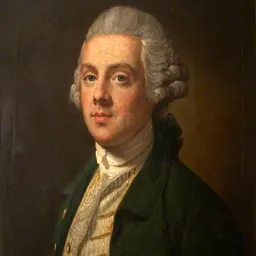
Robert (Bob) Johnson (1745–1833) was an Irish barrister, politician and judge. He sat in the Irish House of Commons and was a judge of the Court of Common Pleas (Ireland).
In 1803 he published a number of attacks on various members of the Irish Government in the form of a series of letters written under the pseudonym "Juverna". The letters caused a major scandal, and after some delay, Johnson was identified as the author. He was prosecuted after a further delay and convicted of seditious libel. He was spared a prison sentence but forced to resign from the Bench, and retired into private life, where he continued his feud with the Dublin administration.
Robert married Susan Evans, daughter of John Evans of Dublin in 1778 (William married her sister).
Career
He entered Middle Temple in 1774 and was called to the Bar in 1776. He took silk in 1791, and was appointed counsel to the Revenue Board. Others thought his rise to be due to his notorious servility to those in power.
He held office as Recorder of Hillsborough. He was also Barracks Master for Dublin, an office requiring no professional qualifications, which made him something of an object of ridicule, as it was widely considered demeaning for a barrister to hold it. Due to Downshire's patronage he was also elected MP for Hillsborough. He was opposed to Catholic Emancipation, and in the aftermath of the Irish Rebellion of 1798 he criticised the authorities for excessive leniency to the rebels. He supported the Act of Union 1800, and thereby lost the patronage of Lord Downshire, who was one of the strongest opponents of the Union, and damaged his career in the process. Downshire committed suicide in 1801: according to his family, this was a result of his loss of political influence.
Johnson served briefly in the last session of the pre-Union Irish Parliament as member for Philipstown, and was made a judge of the Common Pleas in 1801, shortly after the Union took effect. He was not highly regarded as a lawyer ("deficient in knowledge" was the general view), and his promotion, which was very badly received by the legal profession, was universally seen as his reward for supporting the Act of Union. He received compensation for the loss of his previous offices of Revenue counsel, and the somewhat embarrassing role of Barracks Master.
He had a townhouse in Dublin city centre and a house at Milltown in south County Dublin; he also had a country residence at the Derries, or Ballyshaneduff, near Ballybrittas, County Laois, which was built by his son-in-law. After his disgrace he lived for a time in Paris. He was a member of the popular drinking club, The Monks of the Screw (or Order of Saint Patrick), which had been founded about 1780 by John Philpot Curran.
The Juverna affair In 1803 the radical English journalist William Cobbett published a series of letters in his weekly newspaper The Political Register, written by an author calling himself "Juverna". The name Juverna (or "Iverna") is a variant of "Hibernia", and was used by certain Irish nationalists as a poetic symbol for Ireland. The "Juverna" letters attacked the Irish executive with great venom, and were sympathetic to the recently executed Robert Emmet. They were extremely well-informed about the Irish judiciary, suggesting that the author was himself a judge. Suspicion fell at first on Johnson's colleague on the Court of Common Pleas, Luke Fox, who was noted for his bad temper and violent outbursts in Court. However in a personal interview with William Downes, 1st Baron Downes, the Lord Chief Justice of Ireland, Fox was able to convince Downes of his innocence.
Further inquiries proved Johnson to be the author: he may have fallen under suspicion because many years earlier he had published a similar attack on a long-serving High Court judge, Christopher Robinson, under another pseudonym, "Causidicus". Johnson was highly intelligent and well-read, and could be an agreeable enough companion, but he had few friends or admirers: Daniel O'Connell probably spoke for many when he described him as "dishonest". His appointment to the Bench had been greeted with general condemnation by the legal profession, and his notorious servility to the rich and powerful drew on him the contempt of his colleagues. His plight accordingly aroused very little sympathy.
Apprehension of Offenders Act 1804 He pleaded for leniency (presumably he finally confessed to having written the letters), but the authorities took a severe view of the matter, and a warrant was issued for his arrest to stand trial in England for seditious libel. This was made possible by the recent passage of an act of Parliament, the Apprehension of Offenders Act 1804 (44 Geo. 3. c. 92) which provided that a warrant issued in England could be transmitted to Ireland and there endorsed for execution by a justice of the peace. Though its enactment was certainly convenient for the prosecution, there is no evidence that, as the Government's critics alleged, it was passed to deal specifically with the Johnson case.
Arrest and trial
Johnson did everything possible to evade prosecution, petitioning each of his judicial colleagues in vain to cancel the arrest warrant. Finally, Chief Justice Downes, losing patience, had him arrested and sent to London for trial. Downes, who was a very stern man, told Johnson that his attempt to evade justice was as serious a matter as the libel itself. After some further delay he was convicted of seditious libel in the autumn of 1805, but was spared a prison sentence. He was forced to resign from the Bench the following year, although rather surprisingly he was given a pension of £1,200 a year .
Last years
The rest of his long life was spent in retirement at the Derries, his daughter's country house in County Laois. He became increasingly eccentric, and made spirited attacks on whichever Government was in power. In his last years it was said that he talked endlessly about military matters, of which in fact he knew nothing.
On his death his estates passed to his grandson Robert Morellet Alloway (1810–1877); his daughter Margaret Johnson Alloway had died the previous year.
Don’t just read it —
keep it.
Full-length biographies made to live with: read them, listen on the way to work, watch them tonight.
- E-book
- Audio
- Video
Instant download · yours to keep · every purchase keeps this site free
Important facts
People in Robert Johnson's life
Named in this biography and alive at the same time



Related people
Same field, nearest in time


Contemporaries
People whose lives overlapped Robert Johnson's





Frequently asked questions
Who was Robert Johnson?
Irish barrister, politician, and judge (1745-1833)
When was Robert Johnson born?
Robert Johnson was born in 1745 in Dublin.
When did Robert Johnson die?
Robert Johnson died in 1833.
What was Robert Johnson's occupation?
Robert Johnson was a barrister, politician and judge.
Sources & further reading
· DBpedia: Robert Johnson (1745–1833)
Cite this page
APA: Biography.guide. (2026). Robert Johnson. https://biography.guide/robert-johnson-barrister/
MLA: "Robert Johnson." Biography.guide, https://biography.guide/robert-johnson-barrister/.
Chicago: "Robert Johnson." Biography.guide. https://biography.guide/robert-johnson-barrister/.
Data last updated: 2026-09-20 · Spot an error? Report a correction.
Page generated 2026-09-27 05:19 UTC