
About Robert Goodloe Harper
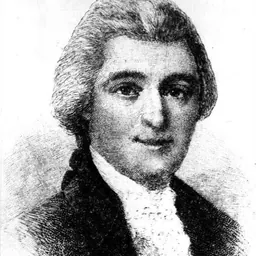
Lived 1765 – 1825 (aged 59–60). Robert Goodloe Harper was an American politician, lawyer and jurist.
Robert Goodloe Harper (January 1765 – January 14, 1825) was an American soldier and politician who was a member of the United States Senate from Maryland from January 1816 until his resignation in December of the same year. He also served in the South Carolina House of Representatives (1790–1795), the U.S. House of Representatives from South Carolina (1795–1801), and in the Maryland State Senate. He is best remembered for the phrase, "Millions for defense, but not one cent for tribute" in connection with the XYZ Affair. The town of Harper, Liberia, is named after him.
Early life Harper was born near Fredericksburg in the Colony of Virginia in January 1765. He was the fifth child and first son of Jesse Harper (b. 1733) and Emily Diana Goodloe (1734–1788) and moved with his parents to Granville, North Carolina around 1769. He received his early education at home and later attended grammar school.
At the age of fifteen, Harper joined a volunteer corps of Cavalry and served in the American Revolutionary Army. He made a surveying tour through Kentucky and Tennessee in 1783, and graduated from the College of New Jersey (now Princeton University) in 1785. He studied law in Charleston, South Carolina, teaching school at the same time, and was admitted to the bar in 1786.
Career He commenced practice in the Ninety-Six District of South Carolina, moving back to Charleston in 1789. From 1790 to 1795, Harper was a member of the South Carolina House of Representatives, at which time he was elected from South Carolina to the Third Congress to fill the vacancy caused by the death of Alexander Gillon. He was reelected to the Fourth, Fifth, and Sixth Congresses but was an unsuccessful candidate for reelection in 1800 to the Seventh Congress, serving as a U.S. Representative from February 9, 1795, to March 1801. While in Congress, he was the chairman of the Committee on Ways and Means in the Fifth and Sixth Congresses. Harper was one of the impeachment managers appointed by the House of Representatives in 1798 to conduct the impeachment proceedings against William Blount. He was one of the defense counsel in the impeachment trial of Samuel Chase in the United States Senate (1804-1805).
Political career in Maryland Harper moved to Baltimore, Maryland, and engaged in the practice of law. He consorted with the men of the mob riots of Baltimore against the British in June 1812. He served in the War of 1812, attaining the rank of major general. He assisted in organizing the Baltimore Exchange Co. in 1815 and was a member of the first board of directors. He then became a member of the Maryland State Senate, and was later elected from Maryland to the United States Senate for the term beginning March 4, 1815, serving from January 1816 until December 1816, when he resigned. He was an unsuccessful Federalist candidate for Vice President in the 1816 election. He also received one electoral vote for vice president in the 1820 election.
In 1815, Harper was elected a member of the American Antiquarian Society. and traveled extensively in Europe in 1819 and 1820. He took a prominent part in the ceremonies on the occasion of Lafayette's visit to Baltimore in 1824.
Personal life On May 7, 1800, Harper married Catherine Carroll (1778–1861) in Anne Arundel County, Maryland. Catherine was the daughter of Charles Carroll and Mary (née Darnall) Carroll. Her elder sister, Mary, married Richard Caton. Together, they were the parents of at least four children who survived to adulthood, including:
Charles Carroll Harper (1802–1837), who married Charlotte Hutchinson Cheffelle (1807–1867) in 1827. Mary Diana Harper (1803–1818), who died young. Richard Caton Harper (1806–1815), who died young. Elizabeth Hyde Harper (1809–1823), who died unmarried. Emily Louisa Harper (1812–1892), who never married. Robert Goodloe Harper Jr. (1814–1854)
He died in Baltimore on January 14, 1825, and was initially interred in the family burial ground on his estate, Oakland in Roland Park, and later reburied in Green Mount Cemetery in Baltimore.
Descendants Through his eldest son Charles, he was a grandfather of Emily Louisa Harper (1835–1908), who married William Clapham Pennington (1829–1913). Their son, Robert Goodloe Harper Pennington (1854–1920) was a prominent artist.
Ancestry
Don’t just read it —
keep it.
Full-length biographies made to live with: read them, listen on the way to work, watch them tonight.
- E-book
- Audio
- Video
Instant download · yours to keep · every purchase keeps this site free
Important facts
People in Robert Goodloe Harper's life
Named in this biography and alive at the same time


Related people
Same field, nearest in time



Contemporaries
People whose lives overlapped Robert Goodloe Harper's





Frequently asked questions
Who was Robert Goodloe Harper?
American politician (1765-1825)
When was Robert Goodloe Harper born?
Robert Goodloe Harper was born in 1765 in Fredericksburg.
When did Robert Goodloe Harper die?
Robert Goodloe Harper died on 14 January 1825 in Baltimore.
What was Robert Goodloe Harper's occupation?
Robert Goodloe Harper was a politician, lawyer and jurist.
What nationality was Robert Goodloe Harper?
Robert Goodloe Harper was American.
Sources & further reading
· Wikipedia: Robert Goodloe Harper
· DBpedia: Robert Goodloe Harper
Cite this page
APA: Biography.guide. (2026). Robert Goodloe Harper. https://biography.guide/robert-goodloe-harper/
MLA: "Robert Goodloe Harper." Biography.guide, https://biography.guide/robert-goodloe-harper/.
Chicago: "Robert Goodloe Harper." Biography.guide. https://biography.guide/robert-goodloe-harper/.
Data last updated: 2026-09-20 · Spot an error? Report a correction.
Page generated 2026-09-27 05:25 UTC