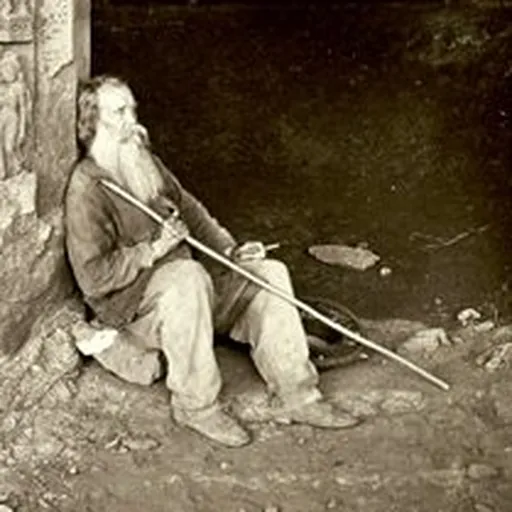
Robert Gill
British antiquarian, painter and photographer
About Robert Gill
Lived 1804 – 1875 (aged 70). Robert Gill was a British photographer, military personnel, antiquarian, draftsperson, archaeologist and soldier.
Major Robert Gill (1804–1879) was an army officer, antiquarian, painter and photographer in British India. He is best known for his paintings copying the frescoes of the Ajanta Caves. Gill was the first painter – after their rediscovery in 1819 – to make extensive copies of the Buddhist cave paintings, which mostly date to the 5th century CE. His surviving copies and drawings remain significant in Ajanta studies as the originals have significantly deteriorated since his time.
Biography
Family and military service Gill was born in Hackney, London, the son of a stockbroker. He joined the 44th Madras Native Infantry as a cadet in 1824 and became an ensign on 6 May 1825. Promotion to Lieutenant followed in September 1826, and to Captain on 6 May 1840; finally he was promoted to Major. On 25 May 1841, he married Frances Flowerdew Rickerby at St Luke's Church, Chelsea, in London. He was discharged as an invalid on 1 October 1852. His first child, a daughter called Frances Eliza Minchin Gill (1842-1930), was born in Madras. His first son, the soldier, explorer and intelligence officer William John Gill (1843-1882), was born in Bangalore. A second daughter, Rose Matilda Gill, was born in Chelsea in 1845 but died when less than three weeks old. A second son, the lawyer Robert Thomas Gill (1847-1927) was born in Jaulnah, as was a third daughter, Lucy Annie Gill (1849-1903). Robert Gill may have had several children who died in infancy by his first Indian mistress, Paro. He had two daughters by his second Indian mistress: Mildred Mary Gill (1866-1923) and Annie Gill (c.1864-1934).
Dancing girl in Ajanta fresco, showing deterioration between the cave now (left) and Gill's copy.
Career Gill was a member of The Royal Asiatic Society, and this association was eventually parlayed into copying the murals that had first been published in a lecture by James Fergusson to the Bombay branch of the Society, and later inclusion and illustration in his book in Indian rock-cut architecture. He had copied about 30 of the principal frescoes on canvas at almost full-size by 1863, when the painting phase of his work largely ended; these works were sent to London. Another was destroyed by a fire in a storeroom in the South Kensington Museum (now the Victoria and Albert Museum) in 1885. This was the same fire that destroyed most of the next generation of Ajanta copies, just completed by a team from the Bombay School of Art. None of Gill's lost copies had been photographed. The four surviving Gill copies are in the Victoria and Albert Museum in London; a number of his drawings are in the British Library. and One Hundred Stereoscopic Illustrations of Architecture and Natural History in Western India, with notes by James Fergusson.
Gill's surviving photographs, drawings, and paintings are constantly cited by scholars of Ajanta and Indian art generally, as they have preserved the memories of original painted surfaces that have undergone significant flaking. Accelerated deterioration began immediately upon the caves' rediscovery starting in 1819. According to the Victoria and Albert Museum, even in Gill's time the original cave paintings could be seen suffering damage from frequent, unsupervised visitation and also from "swarms of bees and bats." and others considerably repaired and tidied. Many of his plans, drawings, and photographs are available online at the British Library and other places.
Death and burial Like many other British Indian officers of those days, Gill was an avid hunter and killed about 150 tigers, mostly on foot.
Don’t just read it —
keep it.
Full-length biographies made to live with: read them, listen on the way to work, watch them tonight.
- E-book
- Audio
- Video
Instant download · yours to keep · every purchase keeps this site free
Important facts
People in Robert Gill's life
Named in this biography and alive at the same time





Related people
Same field, nearest in time


Contemporaries
People whose lives overlapped Robert Gill's






Frequently asked questions
Who was Robert Gill?
British antiquarian, painter and photographer (1804-1875)
When was Robert Gill born?
Robert Gill was born on 26 September 1804 in London Borough of Hackney.
When did Robert Gill die?
Robert Gill died on 10 April 1875 in Bhusawal.
What was Robert Gill's occupation?
Robert Gill was a photographer, military personnel, antiquarian, draftsperson, archaeologist and soldier.
What nationality was Robert Gill?
Robert Gill was British.
Sources & further reading
Cite this page
APA: Biography.guide. (2026). Robert Gill. https://biography.guide/robert-gill-photographer/
MLA: "Robert Gill." Biography.guide, https://biography.guide/robert-gill-photographer/.
Chicago: "Robert Gill." Biography.guide. https://biography.guide/robert-gill-photographer/.
Data last updated: 2026-09-21 · Spot an error? Report a correction.
Portrait: Wikimedia Commons · author & licence
Page generated 2026-09-27 04:59 UTC