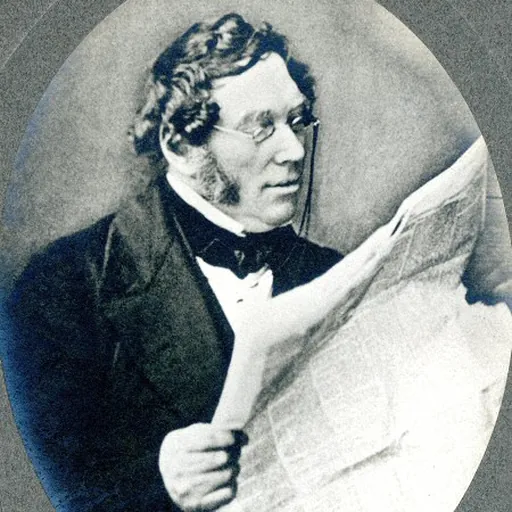
About Hugh Lee Pattinson
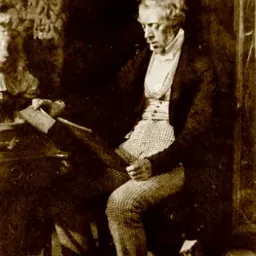
Lived 1796 – 1858 (aged 61). Hugh Lee Pattinson was a British photographer, engineer, metallurgist and chemist, known for Daguerreotype.
Hugh Lee Pattinson FRS (25 December 1796 – 11 November 1858) was an English industrial chemist. He was also an entrepreneur, sharing the risk of major industrial developments with famous ironmaster Isaac Lowthian Bell and cable manufacturer Robert Stirling Newall.
Although known in his time for his 1833 patent "An improved method for separating silver from lead", a process that bears his name, he is best remembered today for his daguerreotype photographs taken in 1840. Among these is the earliest known photograph of the Niagara Falls.
Biography
Pattinson was the son of Thomas Pattinson, a shopkeeper in the country town of Alston, Cumberland, and his wife Margaret Lee; they were Quakers. He was educated at local private schools. He was interested in science from an early age, doing experiments with electricity when he was 17, and also studying the chemistry of metals.
Pattinson process
Pattinson patented his process for enriching silver bearing lead in 1833. It exploited the fact that in molten lead containing traces of silver the first metal to solidify out of the melt is lead, leaving the remaining liquid richer in silver. Pattinson's equipment consisted basically of nothing more complex than a row of about 8–9 iron pots, which were heated from below. Some lead, naturally containing a small percentage of silver, was loaded into the central pot and melted. This was then allowed to cool. As the lead solidified, it was skimmed off and moved to the next pot in one direction, and the remaining metal which was now richer in silver was then transferred to the next pot in the opposite direction. The process was repeated from one pot to the next, the lead accumulating in the pot at one end and metal enriched in silver in the pot at the other. The level of enrichment possible is limited by the lead-silver eutectic and typically the process stopped around 600 to 700 ounces per ton (approx 2%), so further separation is carried out by cupellation.
The patent process, known as pattinsonisation, earned Pattinson £16,000 in royalties. The earlier process of "cupellation" had required at least of silver per ton of lead to be economic. Cupellation involved removing the lead from a silver-rich alloy by oxidising the lead to litharge, leaving the silver behind. The image is left-right inverted, and taken from the Canadian side. Pattinson made other photographs of the Horseshoe Falls as well as of Rome and Paris. These were then transferred to engravings to illustrate Noël Marie Paymal Lerebours' Excursions Daguerriennes (Paris, 1841–1864).
Other inventions
In 1841 Pattinson patented two other chemical processes, one for making lead carbonate, and the other for manufacturing "magnesia alba", a white magnesium oxide. Under an 1850 Indenture, Charles William Vane, Marquis of Londonderry, Pattinson and Bell declared themselves "chemical manufacturers and co-partners in trade".
Honours and achievements
In 1838 Pattinson became vice-president of the chemical section of the British Association. He was a fellow of the Geological Society and also of the Royal Astronomical Society.
Family life
Pattinson married Phoebe Walton on 25 December 1815, having been baptised by the vicar of Alston, Benjamin Jackson, as a member of the Church of England on 23 December 1815 in a public house, the Angel Inn at Alston, as Phoebe's family would not accept marriage to a "Quaker".
Pattinson's three daughters married, respectively, the ironmaster Isaac Lowthian Bell, the bookseller and publisher Robert Benson Bowman, and the cable manufacturer Robert Stirling Newall. The brothers-in-law, and Pattinson himself, shared several different business partnerships. In addition, all three brothers-in-law were members of Tyneside Naturalists' Field Club and the Natural History Society of Northumberland.
He died on 11 November 1858. He was buried in Washington, County Durham churchyard. He was survived by his son, also named Hugh Lee, and three daughters. Two other sons, Walter and Thomas, died before him.
Don’t just read it —
keep it.
Full-length biographies made to live with: read them, listen on the way to work, watch them tonight.
- E-book
- Audio
- Video
Instant download · yours to keep · every purchase keeps this site free
Important facts
People in Hugh Lee Pattinson's life
Named in this biography and alive at the same time


Related people
Same field, nearest in time



Contemporaries
People whose lives overlapped Hugh Lee Pattinson's






Frequently asked questions
Who was Hugh Lee Pattinson?
English industrial chemist (1796-1858)
When was Hugh Lee Pattinson born?
Hugh Lee Pattinson was born on 25 December 1796 in Alston.
When did Hugh Lee Pattinson die?
Hugh Lee Pattinson died on 11 November 1858.
What was Hugh Lee Pattinson's occupation?
Hugh Lee Pattinson was a photographer, engineer, metallurgist and chemist.
What was Hugh Lee Pattinson known for?
Hugh Lee Pattinson was known for Daguerreotype.
What nationality was Hugh Lee Pattinson?
Hugh Lee Pattinson was British.
Sources & further reading
· Wikipedia: Hugh Lee Pattinson
Cite this page
APA: Biography.guide. (2026). Hugh Lee Pattinson. https://biography.guide/hugh-lee-pattinson/
MLA: "Hugh Lee Pattinson." Biography.guide, https://biography.guide/hugh-lee-pattinson/.
Chicago: "Hugh Lee Pattinson." Biography.guide. https://biography.guide/hugh-lee-pattinson/.
Data last updated: 2026-09-21 · Spot an error? Report a correction.
Portrait: Wikimedia Commons · author & licence
Page generated 2026-09-27 04:58 UTC