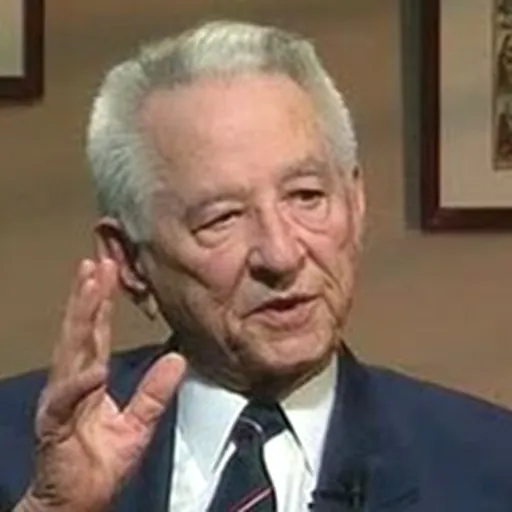
About Robert Galambos
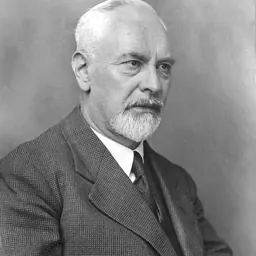
Lived 1914 – 2010 (aged 96). Robert Galambos was an American neuroscientist, university teacher and zoologist.
Robert Carl Galambos (April 20, 1914 – June 18, 2010) was an American neuroscientist whose pioneering research demonstrated how bats use echolocation for navigation purposes, as well as studies on how sound is processed in the brain.
Biography Galambos was born on April 20, 1914, in Lorain, Ohio, and was awarded his undergraduate and master's degrees in the field of zoology from Oberlin College, with earthworm locomotion as the subject of his master's dissertation, He attended Harvard University, where he was awarded a Ph.D. based on his research on bats. At Harvard, Galambos performed experiments for the military on the relationship between the shock waves from explosions and hearing loss. He earned his medical degree from the University of Rochester School of Medicine and interned at Emory University Hospital. After working as a researcher at Harvard, he partnered with future Nobel Prize winner David H. Hubel at the Walter Reed Army Institute of Research, where they studied how cats respond to unexpected sounds.
In the late 1930s, Galambos worked with Donald Griffin on studies of animal echolocation. Using sound capture technology that had been developed by physicist G. W. Pierce, Galambos and Pierce were able to determine that bats generate and hear sounds an octave higher than can be heard by humans and other animals. Experiments they conducted used methods developed by Hallowell Davis to monitor the brains of bats and their hearing responses as they navigated their way past wires suspended from a laboratory ceiling. They showed how bats used echolocation to accurately avoid obstacles, which they were unable to do if their mouths or ears were kept shut.
Using electrodes implanted in the brains of animals, Galambos was able to use electronic amplifiers to boost the signals of a single nerve to follow the impulses that travel from the ear to the brain in response to auditory stimuli, which allowed him to track how neurons respond to the presence (or absence) of sound at a particular frequency. This research allowed for the development of hearing tests for infants which could be performed by monitoring the brain's response directly to sounds, and could then be used to prescribe hearing aids. The research led to the development of auditory brainstem implants and cochlear implants which could be surgically implanted to allow individuals to regain the ability to hear for the profoundly deaf. he co-founded the department of neuroscience at the University of California, San Diego, and continued his research there after he was required to retire at age 67.
Galambos died at age 96 on June 18, 2010, of congestive heart failure at his home in La Jolla, San Diego, California. He was survived by his third wife, Phyllis Johnson. He was also survived by three daughters from his first marriage, to Jeannette Wright Stone, five grandchildren and three great-grandchildren. His second wife, Carol Armstrong Schulman predeceased him.
Don’t just read it —
keep it.
Full-length biographies made to live with: read them, listen on the way to work, watch them tonight.
- E-book
- Audio
- Video
Instant download · yours to keep · every purchase keeps this site free
Important facts
People in Robert Galambos's life
Named in this biography and alive at the same time






Related people
Same field, nearest in time


Contemporaries
People whose lives overlapped Robert Galambos's

Frequently asked questions
Who was Robert Galambos?
American neuroscientist (1914–2010)
When was Robert Galambos born?
Robert Galambos was born on 20 April 1914 in Lorain.
When did Robert Galambos die?
Robert Galambos died on 18 June 2010 in San Diego.
What was Robert Galambos's occupation?
Robert Galambos was a neuroscientist, university teacher and zoologist.
What nationality was Robert Galambos?
Robert Galambos was American.
Sources & further reading
Cite this page
APA: Biography.guide. (2026). Robert Galambos. https://biography.guide/robert-galambos/
MLA: "Robert Galambos." Biography.guide, https://biography.guide/robert-galambos/.
Chicago: "Robert Galambos." Biography.guide. https://biography.guide/robert-galambos/.
Data last updated: 2026-09-24 · Spot an error? Report a correction.
Portrait: Wikimedia Commons · author & licence
Page generated 2026-09-27 05:08 UTC