About Robert FitzWimarc
Lived 1006 – 1075 (aged 68–69). Robert FitzWimarc was a feudatory.
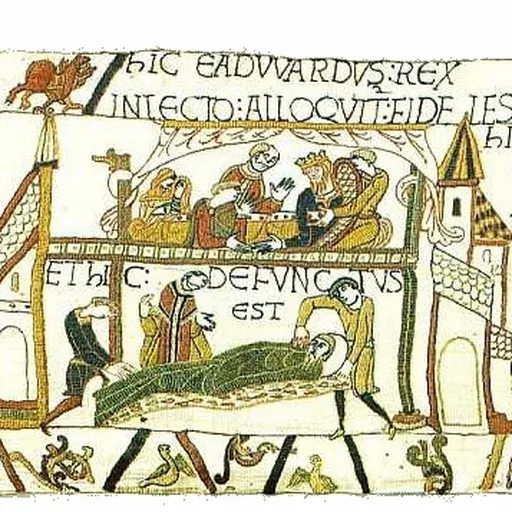
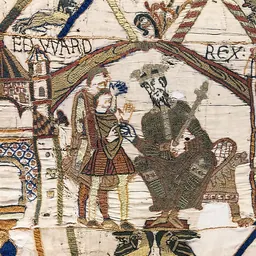
Robert as (possibly) pictured on the Bayeux Tapestry, supporting the pillow of Edward the Confessor on his deathbed. However Robert seems not to have been named on the embroidery. Robert fitz Wimarc (died before 1075, Theydon Mount, Ongar, Essex) was a kinsman of both Edward the Confessor and William of Normandy, and was present at Edward's death-bed.
Nothing of his background is known except his kinship to the English and Norman leadership and that his byname appears to contain a Breton female name, Wiomar'ch, apparently the name of his mother. He was brought to England by Edward and had a successful career, being rewarded with numerous lands in various parts of the country. He had a special interest in Essex and set up his main base at Clavering. It was to Clavering that many of Edward's Norman favourites fled when they were ousted from political power in 1052, before taking ship into exile. Despite being a Norman, Robert stayed in England and found further favour with Edward, and possibly with Harold Godwinson after him.
Robert was later made Sheriff of Essex and was described as "" – high officer or sometimes staller of the royal palace. When Edward died in January 1066, Robert was one of the four inner councillors present at his death bed, along with the Queen (Edith of Wessex), Earl Harold Godwinson and Archbishop Stigand, an event captured on the Bayeux Tapestry.
Robert seems to have acquiesced with Harold's succession to the throne, but also seems to have kept in touch with his homeland. When William landed at Pevensey it was Robert who contacted him to advise a retreat back to France. The advice was, apparently, that William had neither the strength nor numbers to win a battle against Harold, particularly as Harold was buoyed by his victory against the Norwegians at Stamford Bridge.
Robert clearly remained in favour with William after his victory at Hastings, and subsequent succession, as he retained his estates, and was further rewarded with others. He left his extensive estates to his son Suen (Swein of Essex), who went on to build Rayleigh Castle.
Robert fitz Wimarc seems to have been a prudent man, with a fair degree of wisdom who helped to ease the transition from Saxon to Norman England.
He is remembered in Rayleigh, Essex, where one of the town's secondary schools is named the FitzWimarc School.
Don’t just read it —
keep it.
Full-length biographies made to live with: read them, listen on the way to work, watch them tonight.
- E-book
- Audio
- Video
Instant download · yours to keep · every purchase keeps this site free
Important facts
People in Robert FitzWimarc's life
Named in this biography and alive at the same time
Related people
Same field, nearest in time


Contemporaries
People whose lives overlapped Robert FitzWimarc's


Frequently asked questions
Who was Robert FitzWimarc?
Kinsman of Edward the Confessor and William of Normandy
When was Robert FitzWimarc born?
Robert FitzWimarc was born in 1006.
When did Robert FitzWimarc die?
Robert FitzWimarc died in 1075 in Kingdom of England.
What was Robert FitzWimarc's occupation?
Robert FitzWimarc was a feudatory.
What nationality was Robert FitzWimarc?
Robert FitzWimarc's recorded nationality: Duchy of Normandy.
Sources & further reading
· Wikipedia: Robert FitzWimarc
Cite this page
APA: Biography.guide. (2026). Robert FitzWimarc. https://biography.guide/robert-fitzwimarc/
MLA: "Robert FitzWimarc." Biography.guide, https://biography.guide/robert-fitzwimarc/.
Chicago: "Robert FitzWimarc." Biography.guide. https://biography.guide/robert-fitzwimarc/.
Data last updated: 2026-09-23 · Spot an error? Report a correction.
Portrait: Wikimedia Commons · author & licence
Page generated 2026-09-27 05:08 UTC