About Baldwin FitzGilbert
Lived 1022 – 1090 (aged 67–68). Baldwin FitzGilbert was a feudatory.
Baldwin FitzGilbert ( 1030 – 1086/1091) (alias Baldwin the Sheriff, Baldwin of Exeter, Baldwin de Meulles/Moels and Baldwin du Sap) was a Norman magnate and one of the 52 Devon Domesday Book tenants-in-chief of King William the Conqueror, of whom he held the largest fiefdom in Devon, comprising 176 holdings or manors. He was feudal baron of Okehampton, seated at Okehampton Castle in Devon.
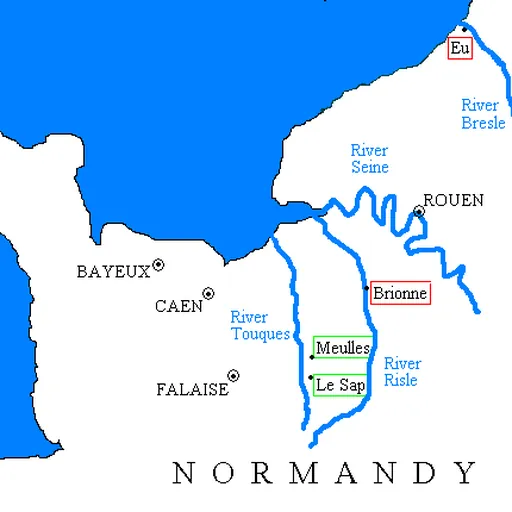
Origins He was originally from Meulles or nearby Le Sap, in Calvados, Normandy. He was a younger son of Gilbert, Count of Brionne and of Eu, in Normandy.
Career Together with his eldest brother Richard FitzGilbert, in 1066 Baldwin participated in the Norman Conquest of England.
Following the successful siege of the Saxon city of Exeter, William the Conqueror appointed Baldwin castellan of the newly built royal castle there, Rougemont Castle. He also appointed him hereditary Sheriff of Devon, a position he held until his death. Exeter Castle was thenceforth the official seat of the Sheriff of Devon. King William I also granted him the very large feudal barony of Okehampton in Devon, at the caput of which he built Okehampton Castle.
English landholdings Baldwin's fiefdom in Devon was the largest in that county, listed in the Domesday Book of 1086 as comprising 176 holdings, mostly manors or estates, except the first two listed holdings which consisted of groups of houses in Exeter and Barnstaple. He is listed in the Domesday Book as "Baldvinus Vicecomes", literally translated as "Baldwin the Viscount", a Norman title signifying that he had an administrative responsibility over the county of Devon, which office had become almost synonymous with the Sheriff of Devon, an Anglo-Saxon office. For this reason Baldwin is commonly known as "Baldwin the Sheriff". These landholdings comprised the feudal barony of Okehampton, later held by the Courtenay family, later also feudal barons of Plympton and Earls of Devon.
Marriage and children His first wife was named Albreda, whom Orderic Vitalis refers to as a daughter of the aunt of William the Conqueror, presumably niece of his mother Herleva. In the Domesday Book, his wife appears as Emma. He had three sons who all died childless, and two daughters: Following the deaths of his three sons without heirs, his daughter Adeliza was his ultimate sole heiress.
Don’t just read it —
keep it.
Full-length biographies made to live with: read them, listen on the way to work, watch them tonight.
- E-book
- Audio
- Video
Instant download · yours to keep · every purchase keeps this site free
Important facts
People in Baldwin FitzGilbert's life
Named in this biography and alive at the same time
Related people
Same field, nearest in time


Contemporaries
People whose lives overlapped Baldwin FitzGilbert's



Frequently asked questions
Who was Baldwin FitzGilbert?
11th-century Norman nobleman
When was Baldwin FitzGilbert born?
Baldwin FitzGilbert was born in 1022.
When did Baldwin FitzGilbert die?
Baldwin FitzGilbert died in 1090.
What was Baldwin FitzGilbert's occupation?
Baldwin FitzGilbert was a feudatory.
Sources & further reading
· Wikipedia: Baldwin FitzGilbert
· DBpedia: Baldwin FitzGilbert
Cite this page
APA: Biography.guide. (2026). Baldwin FitzGilbert. https://biography.guide/baldwin-fitzgilbert/
MLA: "Baldwin FitzGilbert." Biography.guide, https://biography.guide/baldwin-fitzgilbert/.
Chicago: "Baldwin FitzGilbert." Biography.guide. https://biography.guide/baldwin-fitzgilbert/.
Data last updated: 2026-09-20 · Spot an error? Report a correction.
Page generated 2026-09-27 05:10 UTC