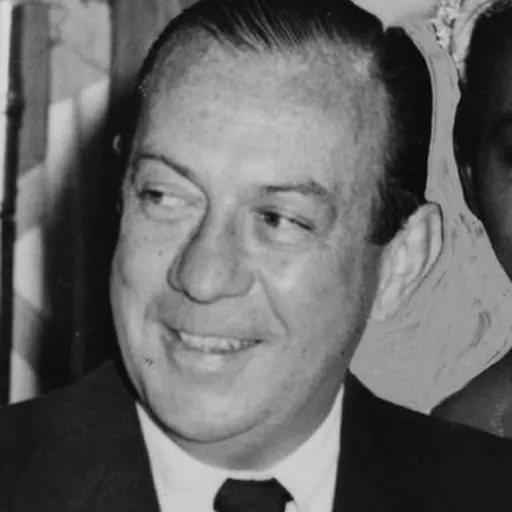
About Robert Ferdinand Wagner Jr.
Lived 1910 – 1991 (aged 80). Robert Ferdinand Wagner Jr. was an American diplomat, politician, lawyer and mayor.
Robert Ferdinand Wagner II (April 20, 1910 – February 12, 1991) was an American diplomat and politician who served three terms as mayor of New York City, from 1954 to 1965. When running for his third term, he broke with the Tammany Hall leadership, ending the clubhouse's reign in city politics. He also served as United States Ambassador to Spain and in a number of other offices.
Early life and career
Wagner was born in Yorkville, Manhattan, the son of Margaret Marie (McTague) and German-born United States Senator Robert Ferdinand Wagner. He attended Taft School and graduated from Yale University in 1933, where he was on the business staff of campus humor magazine The Yale Record and became a member of Scroll and Key (as was John Lindsay, his successor as mayor). He attended Harvard Business School and the Graduate School of International Studies in Geneva. He graduated from Yale Law School in 1937. After the war, he served as city tax commissioner, commissioner of housing and buildings, and chairman of the City Planning Commission. He was Borough President of Manhattan from 1950 to 1953. He also served as delegate to numerous Democratic conventions and was the Democratic nominee for the U.S. Senate in 1956.
Mayor New York City Comptroller Lazarus Joseph usually sided in the New York City Board of Estimate with Mayor Vincent R. Impellitteri during Impelliterri's term in office but supported Wagner for the Democratic nomination for mayor in the 1953 primary election, calling him a "sure winner".
Wagner's nomination and election as New York City mayor in 1953 caused a rift in the Democratic Party and instigated a long-standing feud between Eleanor Roosevelt and Carmine DeSapio, Boss of Tammany Hall. Roosevelt was a Wagner supporter and DeSapio supported Wagner reluctantly until 1961, when Wagner ran for a third term on an anti-Tammany platform, which eventually helped end DeSapio's leadership.
During Wagner's mayoralty, he built public housing and schools, created the City University of New York system, established the right of collective bargaining for city employees, and barred housing discrimination based on race, creed, or color. He was the first mayor to hire many people of color in city government. His administration also saw the development of Lincoln Center and brought Shakespeare to Central Park. In 1957, after the Dodgers and Giants left New York City, he appointed a commission to determine whether New York City could host another National League baseball team, eventually leading to the Mets franchise being awarded to New York City. He did greet Queen Elizabeth II later in 1957. He also rearranged his schedule to meet with the Little Rock Nine and give them a tour of New York City Hall.
In 1956, Wagner ran on the Democratic and Liberal tickets for U.S. Senator from New York, but lost to Republican nominee Jacob Javits.
Wagner meets with president John F. Kennedy in the Oval Office, 1962
Like his father, Wagner was aligned with Tammany Hall for much of his career. But when he sought a third term in 1961, Wagner broke with DeSapio and won the Democratic primary anyway, beginning the decline of machine politics in New York City.
In February 1962, Wagner quit the New York Athletic Club because it barred African Americans and Jews from membership.
The New York Preservation Archive Project has called Wagner's contribution to preservation "complex". He saved Carnegie Hall from demolition in 1960, but was also mayor when the original Penn Station was demolished, beginning on October 28, 1963. In 1965, Wagner signed the law that created the New York City Landmarks Preservation Commission.
In 1965, Wagner decided not to run for a fourth term. In 1969, he ran for mayor again, but lost the Democratic primary. In 1973, he talked with the city's five Republican county chairmen about running for mayor as a Republican, but the negotiations collapsed.
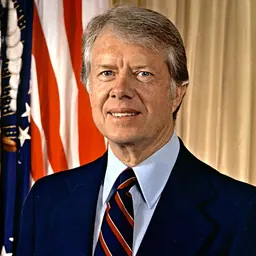
Ambassador After deciding not to run for a fourth term in 1965, Wagner served as ambassador to Spain from June 1968 to March 1969. In 1969, he ran for a fourth term but decisively lost the Democratic primary to Mario Procaccino. He also briefly ran in 1973, but withdrew before the primary. In 1978, President Jimmy Carter appointed Wagner as his representative to the Vatican, where the College of Cardinals had recently elected John Paul II.
Death and legacy Wagner died in Manhattan of heart failure in 1991, aged 80, while being treated for bladder cancer. His funeral mass was offered by Cardinal William Wakefield Baum at St. Patrick's Cathedral, and he was buried at Calvary Cemetery in Maspeth, Queens. "Wagner was buried beside the graves of his father, United States Senator Robert F. Wagner, and mother, Margaret, and first wife, Susan Edwards Wagner, and not far from the grave of New York's Governor Al Smith."
The Robert F. Wagner Graduate School of Public Service at New York University is named in his honor, as is Robert F. Wagner Jr. Park in Battery Park City and the Robert F. Wagner Jr. Secondary School for Arts and Technology in Long Island City.
Wagner's papers, photographs, artifacts and other materials are housed at the New York City Municipal Archives and at La Guardia and Wagner Archives.
Don’t just read it —
keep it.
Full-length biographies made to live with: read them, listen on the way to work, watch them tonight.
- E-book
- Audio
- Video
Instant download · yours to keep · every purchase keeps this site free
Important facts
Family & relationships
People in Robert Ferdinand Wagner Jr.'s life
Named in this biography and alive at the same time



Related people
Same field, nearest in time

Contemporaries
People whose lives overlapped Robert Ferdinand Wagner Jr.'s






Frequently asked questions
Who was Robert Ferdinand Wagner Jr.?
American diplomat and politician (1910–1991)
When was Robert Ferdinand Wagner Jr. born?
Robert Ferdinand Wagner Jr. was born on 20 April 1910 in Manhattan.
When did Robert Ferdinand Wagner Jr. die?
Robert Ferdinand Wagner Jr. died on 12 February 1991 in Manhattan.
What was Robert Ferdinand Wagner Jr.'s occupation?
Robert Ferdinand Wagner Jr. was a diplomat, politician, lawyer and mayor.
What nationality was Robert Ferdinand Wagner Jr.?
Robert Ferdinand Wagner Jr. was American.
Sources & further reading
· Wikipedia: Robert Ferdinand Wagner Jr.
· DBpedia: Robert F. Wagner Jr.
Cite this page
APA: Biography.guide. (2026). Robert Ferdinand Wagner Jr.. https://biography.guide/robert-ferdinand-wagner-jr/
MLA: "Robert Ferdinand Wagner Jr.." Biography.guide, https://biography.guide/robert-ferdinand-wagner-jr/.
Chicago: "Robert Ferdinand Wagner Jr.." Biography.guide. https://biography.guide/robert-ferdinand-wagner-jr/.
Data last updated: 2026-09-24 · Spot an error? Report a correction.
Portrait: Wikimedia Commons · author & licence
Page generated 2026-09-27 05:08 UTC