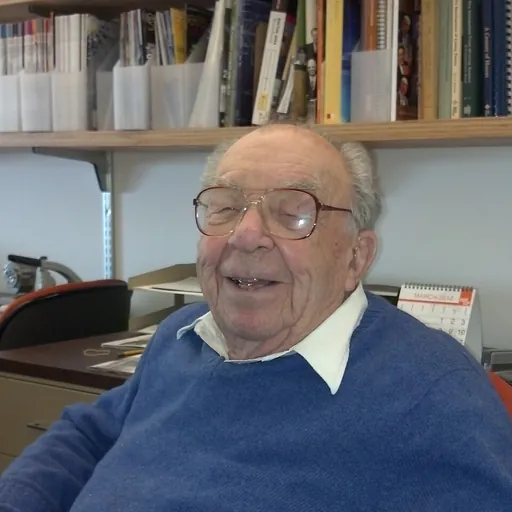
Robert Fano
Italian-American computer scientist
About Robert Fano
Lived 1917 – 2016 (aged 98). Robert Fano was an American computer scientist, engineer, university teacher, electrical engineer and electrotechnician, known for Fano's inequality, Pointwise mutual information and Project MAC.
Roberto Mario "Robert" Fano (11 November 1917 – 13 July 2016) was an Italian-American computer scientist and professor of electrical engineering and computer science at the Massachusetts Institute of Technology. He became a student and working lab partner to Claude Shannon, whom he admired zealously and assisted in the early years of information theory.
Early life and education Fano was born in Turin, Italy in 1917 to a Jewish family and grew up in Turin. Fano's father was the mathematician Gino Fano, his older brother was the physicist Ugo Fano, and Giulio Racah was a cousin. Fano studied engineering as an undergraduate at the School of Engineering of Torino (Politecnico di Torino) until 1939, when he emigrated to the United States as a result of anti-Jewish legislation passed under Benito Mussolini. He received his S.B. in electrical engineering from MIT in 1941, and upon graduation joined the staff of the MIT Radiation Laboratory. After World War II, Fano continued to complete his Sc.D. in electrical engineering from MIT in 1947. His thesis, titled "Theoretical Limitations on the Broadband Matching of Arbitrary Impedances", was supervised by Ernst Guillemin.
Career Fano's career spans three areas: microwave systems, information theory, and computer science.
Fano joined the MIT faculty in 1947 to what was then called the Department of Electrical Engineering. Between 1950 and 1953, he led the Radar Techniques Group at Lincoln Laboratory. He was elected to the American Academy of Arts and Sciences in 1958, to the National Academy of Engineering in 1973, and to the National Academy of Sciences in 1978.
Fano was known principally for his work on information theory. He developed Shannon–Fano coding in collaboration with Claude Shannon, and derived the Fano inequality. He also invented the Fano algorithm and postulated the Fano metric.
In the early 1960s, Fano was involved in the development of time-sharing computers. From 1963 until 1968 Fano served as the founding director of MIT's Project MAC, which evolved to become what is now known as the MIT Computer Science and Artificial Intelligence Laboratory. He also helped to create MIT's original computer science curriculum.
In 1976, Fano received the Claude E. Shannon Award for his work in information theory.
Fano retired from active teaching in 1984,
Don’t just read it —
keep it.
Full-length biographies made to live with: read them, listen on the way to work, watch them tonight.
- E-book
- Audio
- Video
Instant download · yours to keep · every purchase keeps this site free
Important facts
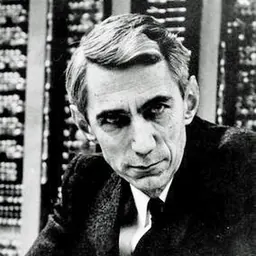
People in Robert Fano's life
Named in this biography and alive at the same time






Related people
Same field, nearest in time



Contemporaries
People whose lives overlapped Robert Fano's

Frequently asked questions
Who was Robert Fano?
Italian-American computer scientist (1917–2016)
When was Robert Fano born?
Robert Fano was born on 11 November 1917 in Turin.
When did Robert Fano die?
Robert Fano died on 13 July 2016 in Naples.
What was Robert Fano's occupation?
Robert Fano was a computer scientist, engineer, university teacher, electrical engineer and electrotechnician.
What was Robert Fano known for?
Robert Fano was known for Fano's inequality, Pointwise mutual information, Project MAC, Sequential decoding and Shannon–Fano coding.
What nationality was Robert Fano?
Robert Fano was American.
Sources & further reading
Cite this page
APA: Biography.guide. (2026). Robert Fano. https://biography.guide/robert-fano/
MLA: "Robert Fano." Biography.guide, https://biography.guide/robert-fano/.
Chicago: "Robert Fano." Biography.guide. https://biography.guide/robert-fano/.
Data last updated: 2026-09-20 · Spot an error? Report a correction.
Portrait: Wikimedia Commons · author & licence
Page generated 2026-09-27 04:57 UTC