
About Robert Duff
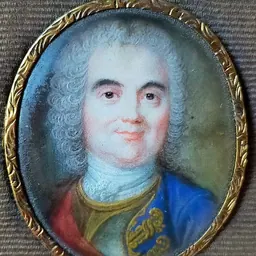
Lived 1721 – 1787 (aged 65–66). Robert Duff was a British naval officer.
Vice-Admiral Robert Duff ( – 6 June 1787) was a Royal Navy officer and colonial administrator who served in the War of the Austrian Succession, Seven Years' War and American War of Independence. He briefly served as colonial governor of Newfoundland.
Family and early life Duff was born c. 1721, among the youngest of more than thirty children of Patrick Duff of Craigston in Aberdeenshire (about 7 miles (11 km) west of Aberdeen, just north-northeast of Westhill ), by Craigston's second wife. Little is known about his early life, but a story that does survive attests to his father's fecundity and possibly also to Robert's own spirited approach. Walking in his garden the father, Patrick Duff, came across a small boy and enquired 'And wha's laddie are you?' to which his son, the future Admiral Robert Duff, replied 'Dinna ye ken your ain son Robbie, ye auld fool!'. Robert joined the navy and was listed a lieutenant by 9 March 1739. He was advanced to commander on 4 December 1744, and by 1746 was in command of the bomb vessel , serving off the Scottish coast. Duff received the command of the 44-gun on 23 October, and remained in her off the Irish and English coasts until the signing of the Treaty of Aix-la-Chapelle in 1748 that ended the War of the Austrian Succession.
Seven Years' War
Duff's next ship was the 50-gun , which he joined in 1755. He spent several years cruising, either independently or as part of the main fleet, and in 1758 was part of Commodore Richard Howe's squadron defending the expeditions against St Malo, Cherbourg and St Cas. He became senior officer of a small squadron stationed off Brittany in 1759, watching the French fleet in Morbihan, while a fleet under Edward Hawke blockaded Brest, France. While at anchor in Quiberon Bay on 20 November, his scouts reported a large French fleet to the south of Belle Île. Duff hurried his squadron, consisting of four 50-gun ships and four frigates, out to sea while the French chased them. Before they could be caught, the main fleet under Hawke came up and overran the French, defeating them in the decisive Battle of Quiberon Bay.
Duff was then appointed to the 80-gun and went out with her to the West Indies with Rear-Admiral George Brydges Rodney's fleet. Duff saw action at the capture of Martinique during January and February 1762, but owing to his seniority, he refused to serve as Rodney's flag-captain, and was sent home. In 1764 he married Helen Duff, the daughter of his cousin, the first Earl of Fife. Duff was promoted to rear-admiral of the blue on 31 March 1775, and in April was sent out as commander-in-chief at Newfoundland. His posting was brief, in 1776 he became rear-admiral of the white and in September 1777 he was appointed to the command of the Mediterranean Fleet, with the 60-gun as his flagship.
American War of Independence By now a rear-admiral of the red, he supported the British forces defending Gibraltar from Don Antonio Barcelo's fleet when the siege there broke out in 1779, but had limited forces at his disposal and he was recalled early in 1780. He had been promoted to vice-admiral of the blue on 29 January 1778, and was advanced to vice-admiral of the white later that year, but held no further command after his return to England in 1780.
Later years and death His portrait was painted by Sir Joshua Reynolds for Greenwich Hospital. Increasingly ill with gout during his later years, he died at Queensferry on 6 June 1787, his death being attributed to an attack of gout in the stomach. He had a number of children by his marriage to Helen Duff: Jean (1765-1839), in 1791 married her cousin (Robert's nephew) James Clerk-Rattray of Edinburgh, later Baron of the Exchequer A son (b.1766, dsp) Robert William (b.1767, grandfather of Robert Duff) A child (b. 1775, d. young) Adam (1775–1840) James Alexander Duff (1777–1800)
Another of Robert Duff's relations, his grandnephew George Duff, achieved distinction in the navy. He was part of Horatio Nelson's fleet, and was assigned to command the inshore squadron watching the enemy in Cádiz prior to the Battle of Trafalgar. He commanded the 74-gun during the battle, and was killed during the fighting.
Don’t just read it —
keep it.
Full-length biographies made to live with: read them, listen on the way to work, watch them tonight.
- E-book
- Audio
- Video
Instant download · yours to keep · every purchase keeps this site free
Important facts
People in Robert Duff's life
Named in this biography and alive at the same time


Related people
Same field, nearest in time



Contemporaries
People whose lives overlapped Robert Duff's




Frequently asked questions
Who was Robert Duff?
Royal Navy admiral (1721-1787)
When was Robert Duff born?
Robert Duff was born in 1721.
When did Robert Duff die?
Robert Duff died on 6 June 1787 in South Queensferry.
What was Robert Duff's occupation?
Robert Duff was a naval officer.
What nationality was Robert Duff?
Robert Duff was British.
Sources & further reading
· DBpedia: Robert Duff (Royal Navy officer)
Cite this page
APA: Biography.guide. (2026). Robert Duff. https://biography.guide/robert-duff/
MLA: "Robert Duff." Biography.guide, https://biography.guide/robert-duff/.
Chicago: "Robert Duff." Biography.guide. https://biography.guide/robert-duff/.
Data last updated: 2026-09-26 · Spot an error? Report a correction.
Page generated 2026-09-27 05:13 UTC