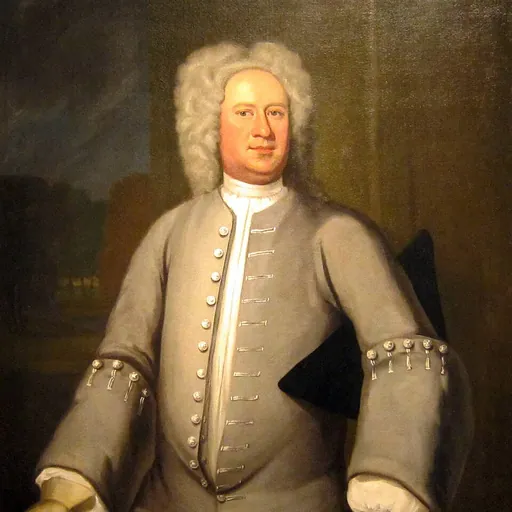
About Robert Carter I
Lived 1663 – 1732 (aged 69). Robert Carter I was an American entrepreneur and politician.
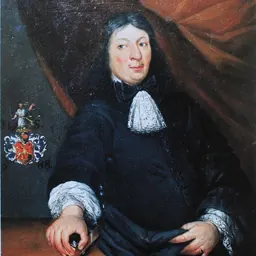
Robert Carter I ( – 4 August 1732) was an American planter, merchant, and colonial administrator who served as the acting governor of Virginia from 1726 to 1727. An agent for the Northern Neck Proprietary, Carter emerged as the wealthiest settler in the British colony of Virginia and received the sobriquet "King Carter" from his contemporaries connoting his autocratic approach and political influence. He also served as speaker of the House of Burgesses and president of the Virginia Governor's Council.
Born around 1664 at Corotoman in Lancaster County, Carter received a classical education and studied the tobacco trade in London. After returning to Virginia, he was elected a burgess in 1691 and represented the electoral constituency of Lancaster County consecutively during the 1695 to 1699 assemblies. He served as Speaker from 1696 to 1697 and in 1699 and Treasurer of Virginia from 1699 to 1705. Appointed to the Governor's Council by Francis Nicholson in 1699, Carter opposed Nicholson's policies in 1704 and influenced the governor's removal in 1705.
Carter was appointed agent of the Northern Neck Proprietary in 1702 though lost the lease to his political opponent, Edmund Jenings, in 1711. He regained the proprietary in 1722 and was involved in the dismissal of Alexander Spotswood. In 1726, he was designated President of the Governor's Council and appointed Acting Governor when his predecessor died in office. Afflicted with gout in later life, Carter died on August 4, 1732, at Corotoman.
Early life and education Robert Carter I was born around 1664 at Corotoman in Lancaster County, Virginia. His mother was Sarah Ludlow Carter, John Carter's fourth wife, who died in 1668. His father died the following year, bequeathing most of his landholdings to Carter's elder half-brother, John Carter Jr., under primogeniture. Carter inherited in Lancaster County, one-third of his personal estate, and several of his father's theology books. They had five children, three of whom survived infancy, including John. Following her death in 1699, Carter married the widow Elizabeth "Betty" Landon Willis, the daughter of Thomas Landon, in 1701. They had five daughters and five sons, seven of whom reached adulthood. thumb
Career At age 28, shortly after his elder half-brother, John Carter Jr., died, Robert Carter entered the General Assembly of Virginia as a Burgess representing Lancaster County. He would serve part-time in 1690–1691, and then for five consecutive years (1695 through 1699) before being promoted (by the British Privy Council on the recommendation of Governor Francis Nicholson) to the Governor's Council (also the higher chamber of the Virginia General Assembly). While in the House of Burgesses, Carter served on two important committees (for Elections and Privileges and for Examination of Propositions and Grievances). In the session which began in September 1696, Carter defeated four other burgesses for the position of Speaker, and also served as Speaker for the October 1687 session, but was not re-elected in a five-candidate field in September 1698. However, the House of Burgesses appointed him as the colony's treasurer, thus giving him responsibility of monies raised by assembly-levied taxes in the colony, and assembly-mandated spending. Meanwhile, Carter also became a vestryman of Lancaster County's Christ Church Parish in 1690, and the following year became one of the justices of the peace for Lancaster County (the justices jointly in that era also administering the county, with social services provided by the vestry). He would also command the militias of Lancaster and adjacent Northumberland Counties, and secured appointment as the naval officer of the Rappahannock River region (which secured customs duties). The latter was a cousin of the Lords Culpeper, from whom the Fairfaxes had inherited their Virginia holdings. When Carter became agent for Fairfax's interests again in 1722 (holding that position for a decade, until 1732), in addition to forwarding land rents back to Lord Fairfax, he secured for his children and grandchildren about in the Northern Neck, as well as additional land in Virginia west of the Blue Ridge Mountains.{citation needed} Thus, when Carter died, he held at least .
When Lord Fairfax saw Carter's obituary in the London monthly The Gentleman's Magazine, he was astonished to read of the immense personal wealth acquired by his resident land agent. Rather than name another Virginian to the position, Fairfax made arrangements to have his cousin, Colonel William Fairfax, move to Virginia to act as land agent, with the paid position of customs inspector (tax collector) for the Potomac River district. Fairfax himself then visited his vast Northern Neck Proprietary from 1735 to 1737, and he moved there permanently in 1747.
Family and descendants Carter endowed each of his sons who reached marriageable age in his lifetime with significant plantations. Robert Carter II, whom his father called "Robin," would die of a sudden illness months before his father, but his Nomini Hall plantation was inherited by his son, Robert Carter III (1728–1804), who like his grandfather served on the Governor's Council. Charles Carter (1707–1764) would exchange the land he had inherited for other property and built Cleve Hall in King George County, which he represented for many years in the House of Burgesses. Landon Carter received Sabine Hall from his father and represented Richmond County in the House of Burgesses, as well as (in 1742) inherited some of property from his elder half brother John, and served as guardian for those underage nephews Charles Hill Carter, Edward Hill Carter and Robert Carter Nicholas, all of whom would later serve in the Virginia General Assembly. Another brother, George Carter, remained in England, where he practiced law but did not marry (nor take possession of his Virginia inheritance). Carter had five children with his first wife, Judith Armistead: Sarah Carter (born c. 1690, died in infancy)
Carter had ten children with his second wife, Elizabeth "Betty" Landon Willis (Credenhill, Herefordshire, 1684–Williamsburg, July 3, 1719), of whom seven reached adulthood: Anne Carter (1702–1743), married Benjamin Harrison IV Robert E. Lee (1807–1870), Confederate States Army general Robert Randolph Carter (1825–1888), Confederate States Army first lieutenant John Page (1743–1808), 13th Governor of Virginia Mann Page (1749–1781), Virginia delegate to the Continental Congress in 1777 Thomas Nelson Page (1853–1922), U.S. ambassador to Italy during the Woodrow Wilson administration William Nelson Page (1854–1932), American civil engineer and industrialist James "Gentleman Jim" Robinson, one of the wealthiest African Americans in the Manassas area. His homestead was located between the lines of the Confederate and Union armies during two major battles of the Civil War.
Notable relatives: Jimmy Carter (1924–2024), the 39th U.S. President is descended from Robert "King" Carter's uncle, Thomas Carter, who settled in Virginia in 1635.
Don’t just read it —
keep it.
Full-length biographies made to live with: read them, listen on the way to work, watch them tonight.
- E-book
- Audio
- Video
Instant download · yours to keep · every purchase keeps this site free
Important facts
Family & relationships
People in Robert Carter I's life
Named in this biography and alive at the same time





Related people
Same field, nearest in time
Contemporaries
People whose lives overlapped Robert Carter I's



Frequently asked questions
Who was Robert Carter I?
American politician (1663-1732)
When was Robert Carter I born?
Robert Carter I was born on 4 August 1663 in Corotoman.
When did Robert Carter I die?
Robert Carter I died on 4 August 1732 in Lancaster County.
What was Robert Carter I's occupation?
Robert Carter I was an entrepreneur and politician.
What nationality was Robert Carter I?
Robert Carter I was American.
Sources & further reading
Cite this page
APA: Biography.guide. (2026). Robert Carter I. https://biography.guide/robert-carter-i/
MLA: "Robert Carter I." Biography.guide, https://biography.guide/robert-carter-i/.
Chicago: "Robert Carter I." Biography.guide. https://biography.guide/robert-carter-i/.
Data last updated: 2026-09-23 · Spot an error? Report a correction.
Portrait: Wikimedia Commons · author & licence
Page generated 2026-09-27 05:05 UTC