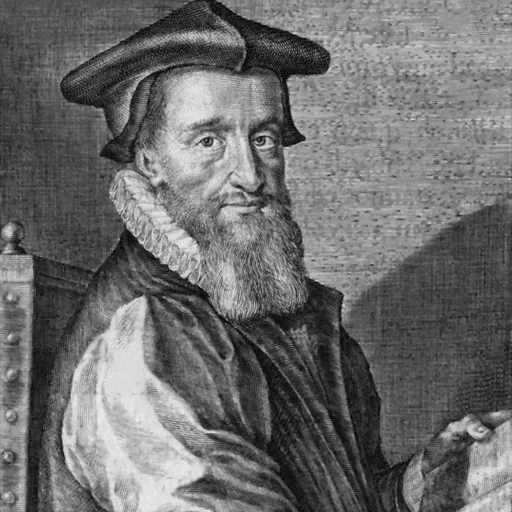
Robert Abbot
Anglican clergyman and academic, Master of Balliol College, Oxford and Bishop of Salisbury
About Robert Abbot
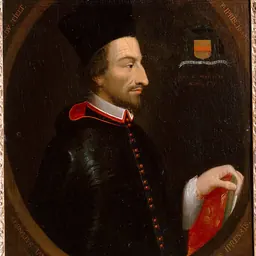
Lived 1560 – 1618 (aged 57–58). Robert Abbot was an English theologian, presbyter and university teacher.
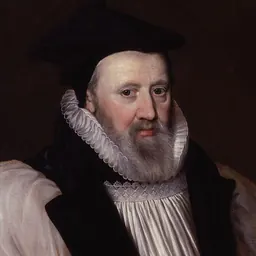
Robert Abbot (1560 – 2 March 1618) was an Anglican bishop, academic and polemical writer. He served as Master of Balliol College, Oxford, Regius Professor of Divinity, and Bishop of Salisbury from 1615. Among his four younger brothers, George became Archbishop of Canterbury and Maurice became Lord Mayor of London.
Life He was born in Guildford, the elder brother of George Abbot the future archbishop. Both brothers were educated at the Royal Grammar School, Guildford, and Balliol College, Oxford. He early distinguished himself as a preacher, and a sermon which he preached at Paul's Cross gained for him the living of Bingham, Nottinghamshire, to which he was presented by John Stanhope.
King James appointed Abbot one of the chaplains in ordinary. In 1609, he was elected master of Balliol College. In 1613 he became Regius Professor of Divinity at Oxford and attacked the writings of Petrus Bertius, a Dutch Remonstrant, on the topic of falling from grace. Subsequently, he made a broader attack based on orthodox Calvinism and Augustine of Hippo on the spreading ideas of Jacobus Arminius. In 1615 he attacked John Howson and William Laud, implying Catholic sympathies, and wrapping in those terms the further implication that Laud was Arminian. Howson retorted that Abbot and his brother George were both Puritans. In speaking of secret methods by which certain persons were attempting to undermine the Protestant Reformation, Abbot was clearly referencing Laud, who was present for the lecture. Laud, stung, wrote to his friend Richard Neile, Bishop of Lincoln, complaining that "he was fain to sit patiently at the rehearsal of this sermon, though abused almost an hour together, being pointed at as he sat" and asking whether he ought to take public notice of the insult.
Abbot obtained the see of Salisbury and his brother George consecrated him as bishop. On his departure from the university, he delivered a farewell oration in Latin which was much admired. Comparing the merits of the two Abbot brothers, Thomas Fuller remarks that
Abbot died in Salisbury, being one of five bishops who succeeded to the see of Salisbury within the space of six years.
Works Abbot's writings were mainly against the Roman Catholic Church; he also attacked Arminianism.
In 1594, Abbot appeared as a writer with A Mirror of Popish Subtilties (1594) which was designed as a refutation of the arguments advanced by Nicholas Sander and Robert Bellarmine against the Protestant theory of the sacraments. Antichristi Demonstratio [A Demonstration of Antichrist] (1603), was against Bellarmine once more. It was admired by the new king James I, who ordered material from his own Paraphrase on the Apocalypse to be printed with it in a second edition of 1608. Abbot was concerned to refute Bellarmine's reading of the Book of Revelation as literal and innovative (by comparison with the tradition of Nicholas of Lyra on Revelation 13), and to attack what would be identified later as the futurist approach in the tradition of Francisco Ribera. Abbot's own reading was typically historicist and concerned to argue for the Pope as Antichrist.
His A Defence of the Reformed Catholic of Mr. William Perkins (3 vols, 1606–1609), won Abbot royal favour and a promise of preferment. It was an intervention defending the late William Perkins from an attack by the Catholic priest William Bishop. The work responded to a royal commission and prompting from Richard Bancroft, and in the first part covered the ground of the Gunpowder Plot. who was married to Sir Nathaniel Brent; their daughter Margaret Brent was married to Edward Corbet, rector of Great Haseley, and the latter presented some of the bishop's manuscripts to the Bodleian Library. His second wife was the widow Bridget Cheynell, mother of Francis Cheynell. This second marriage is said to have displeased his brother, the archbishop, who regarded it as an infringement of the apostolic injunction that a bishop should be the husband of one wife.
Don’t just read it —
keep it.
Full-length biographies made to live with: read them, listen on the way to work, watch them tonight.
- E-book
- Audio
- Video
Instant download · yours to keep · every purchase keeps this site free
Important facts
People in Robert Abbot's life
Named in this biography and alive at the same time



Related people
Same field, nearest in time

Contemporaries
People whose lives overlapped Robert Abbot's




Frequently asked questions
Who was Robert Abbot?
Anglican clergyman and academic, Master of Balliol College, Oxford and Bishop of Salisbury (1560–1618)
When was Robert Abbot born?
Robert Abbot was born in 1560 in Guildford.
When did Robert Abbot die?
Robert Abbot died in 1618 in Salisbury.
What was Robert Abbot's occupation?
Robert Abbot was a theologian, presbyter and university teacher.
What nationality was Robert Abbot?
Robert Abbot was English.
Sources & further reading
· DBpedia: Robert Abbot (bishop)
Cite this page
APA: Biography.guide. (2026). Robert Abbot. https://biography.guide/robert-abbot/
MLA: "Robert Abbot." Biography.guide, https://biography.guide/robert-abbot/.
Chicago: "Robert Abbot." Biography.guide. https://biography.guide/robert-abbot/.
Data last updated: 2026-09-21 · Spot an error? Report a correction.
Portrait: Wikimedia Commons · author & licence
Page generated 2026-09-27 04:59 UTC