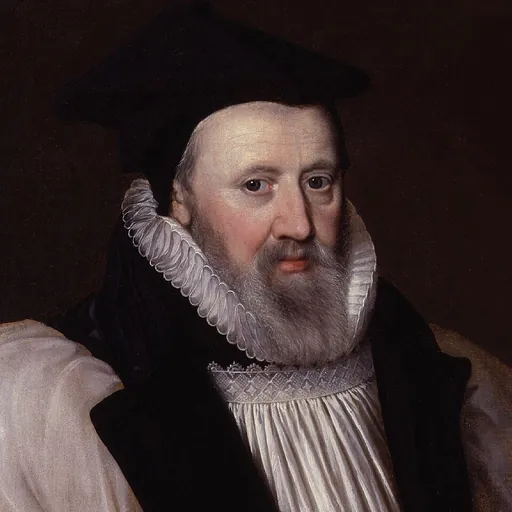
About George Abbot
Lived 1562 – 1633 (aged 70). George Abbot was an English archbishop, diplomat, translator, bible translator, anglican priest and theologian.
George Abbot (29 October 15624 August 1633) was an English bishop who was Archbishop of Canterbury from 1611 to 1633. He also served as the fourth chancellor of the University of Dublin, from 1612 to 1633.
Chambers Biographical Dictionary describes him as " sincere but narrow-minded Calvinist". Among his five brothers, He was a translator of the King James Version of the Bible.
Life and career
Early years Born at Guildford in Surrey, where his father Maurice Abbot (died 1606) was a cloth worker, He later studied and then taught under many eminent scholars, including Thomas Holland, at Balliol College, Oxford, was chosen Master of University College in 1597, and appointed Dean of Winchester in 1600. He was three times Vice-Chancellor of the University and took a leading part in preparing the authorised version of the New Testament. In 1608, he went to Scotland with George Home, 1st Earl of Dunbar to arrange for a union between the churches of England and Scotland. He so pleased King James in this affair that he was made Bishop of Lichfield and Coventry in 1609 and was translated to the see of London a month afterwards.
Archbishop of Canterbury On 4 March 1611, Abbot was raised to the position of Archbishop of Canterbury by King James I. As archbishop, he defended the apostolic succession of Anglican bishops and the validity of the church's priesthood in 1614. In consequence of the Nag's Head Fable, the archbishop invited certain Roman Catholics to inspect the register in the presence of six of his episcopal colleagues, the details of which inspection were preserved. It was agreed by all parties that:
Despite his defence of the catholic nature of the priesthood, his Puritan instincts frequently led him not only into harsh treatment of Roman Catholics but also into courageous resistance to the royal will, such as when he opposed the scandalous divorce suit of the Lady Frances Howard against Robert Devereux, 3rd Earl of Essex, and again in 1618 when, at Croydon, he forbade the reading of the Declaration of Sports listing the permitted Sunday recreations. He was naturally, therefore, a promoter of the match between the king's daughter, Princess Elizabeth, and Frederick V, Elector Palatine, and a firm opponent of the projected marriage of the new Prince of Wales (later Charles I) and the Spanish Infanta, Maria Anna. This policy brought upon the archbishop the hatred of William Laud (with whom he had previously come into collision at Oxford) and the king's court, although the king himself never forsook Abbot. His enemies maintained that the fatal issue of this accident disqualified him for his office and argued that, though the homicide was involuntary, the sport of hunting that had led to it was one in which no clerical person could lawfully indulge.
The king had to refer the matter to a commission of ten, though he said that "an angel might have miscarried after this sort". The commission was equally divided, and the king voted in Abbot's favour, though also signing a formal pardon or dispensation.
Later career After this, Abbot seldom appeared at the council, chiefly because of his infirmities. In 1625, he attended the king constantly; however, in his last illness, he performed the coronation ceremony of King Charles I as king of England. His refusal to license the assize sermon preached by Robert Sibthorp at Northampton on 22 February 1627, in which cheerful obedience was urged to the king's demand for a general loan, and the duty proclaimed of absolute non-resistance even to the most arbitrary royal commands, led Charles to deprive him of his functions as primate, putting them in commission. However, the need to summon parliament soon brought about a nominal restoration of the archbishop's powers. His presence was unwelcome at court, and he lived from that time on retirement, leaving Laud and his party in undisputed ascendancy. He died at Croydon on 4 August 1633 and was buried at Guildford, his native place, where he had endowed Abbot's Hospital with lands valued at £300 a year. The newest edition, edited by the current Master of the Abbot's Hospital, was published by Goldenford Publishers Ltd on 20 June 2011, to commemorate the 400th anniversary of his enthronement as Archbishop of Canterbury.
Abbot had an extensive private library of over 8000 volumes, most of which he left to Lambeth Palace Library. Books bearing his armorial stamp can still be found in libraries today.
Guildford remembers Abbot with his hospital and a statue in the High Street. The George Abbot School in Burpham and a pub in the High Street are named after him. His tomb can be found in Holy Trinity Church. notes = When Abbot was serving as a bishop his arms would be displayed impaled with the arms of the diocese and topped with a mitre.
Don’t just read it —
keep it.
Full-length biographies made to live with: read them, listen on the way to work, watch them tonight.
- E-book
- Audio
- Video
Instant download · yours to keep · every purchase keeps this site free
Important facts
People in George Abbot's life
Named in this biography and alive at the same time


Related people
Same field, nearest in time


Contemporaries
People whose lives overlapped George Abbot's




Frequently asked questions
Who was George Abbot?
Archbishop of Canterbury
When was George Abbot born?
George Abbot was born on 19 October 1562 in Guildford.
When did George Abbot die?
George Abbot died on 5 August 1633 in Croydon.
What was George Abbot's occupation?
George Abbot was an archbishop, diplomat, translator, bible translator, anglican priest and theologian.
What nationality was George Abbot?
George Abbot was English.
Sources & further reading
· DBpedia: George Abbot (bishop)
Cite this page
APA: Biography.guide. (2026). George Abbot. https://biography.guide/george-abbot-archbishop/
MLA: "George Abbot." Biography.guide, https://biography.guide/george-abbot-archbishop/.
Chicago: "George Abbot." Biography.guide. https://biography.guide/george-abbot-archbishop/.
Data last updated: 2026-09-22 · Spot an error? Report a correction.
Portrait: Wikimedia Commons · author & licence
Page generated 2026-09-27 05:03 UTC