About Robert A. Raguso
Born 1965. Robert A. Raguso is a researcher.
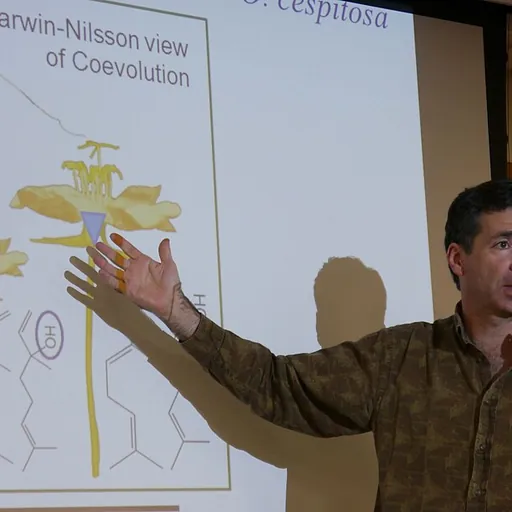
Robert A. Raguso (born January 30, 1965) is an American biologist and professor at Cornell University in the Department of Neurobiology and Behavior. He has expanded the field of chemical ecology by introducing and pioneering floral scent as a key component of plant-pollinator communication, with special focus on hawkmoths and Clarkia plants.
Life Robert Andrew Raguso was born on January 30, 1965, in Englewood, New Jersey. At age 5, Raguso was introduced to his first cecropia moth by Campbell Norsgaard, a film maker and naturalist, as a part of the "Broader Impacts" activities advocated by the National Science Foundation. This encounter sparked Raguso's interest in moths which has continued for 50 years. Raguso started his research career as a high schooler during the summers of 1982 and 1983, working as a technician in the laboratory of Columbia University professor Darcy Kelley, who taught summers at the Marine Biological Laboratory in Woods Hole, Massachusetts.
Raguso's interests expanded from moths to butterflies, and his love for the biological diversity of Lepidoptera led him to study butterflies with Professor Charles Remington at Yale University. During the summer of 1985, Raguso expanded his biological interests and pursued field research at a variety of destinations. At Mountain Lake Biological Station in the Southern Appalachians of Virginia, Raguso developed a lifelong fascination with pollination while studying nectar variance and risk aversion by bees with Professors Beverly Rathcke (later a key figure in his graduate years) and Leslie Real. Raguso also traveled to Laguna Encantada near Catemaco in Veracruz, Mexico, where he initiated a butterfly survey with Professors Carol C. Horvitz and Doug Schemske Raguso also completed a senior honors thesis on the biodiversity of interior Colias butterfly populations, which had been separated anywhere from 8 to 12,000 generations due to the retreat of the Laurentide Ice Sheet. Through this work, Raguso laid a critical foundation for further research involving floral volatiles.
In 1996, Raguso embarked on postdoctoral studies at the University of Arizona, guiding his research interests back to hawkmoths under the mentoring of Professors John Hildebrand and Lucinda McDade. Funded through the Center for Insect Science, Raguso worked after sunset with Mark Willis in the Arizona-Sonora Desert Museum, piecing together the multimodal feeding behavior—a combination of visual and olfactory stimuli—of hawkmoths when visiting Datura flowers. Further postdoctoral studies involved mapping floral volatiles onto phylogenetic relationships, particularly in the context of hawkmoth pollination disappearing and reappearing repeatedly in three plant lineages. He is cited for behavioral studies of insects, flowers, plant chemical ecology, and integrating physiology and evolutionary theory to understand the mechanistic basis of pollination. To date, his research has resulted in over 150 peer-reviewed scientific publications and over 7,000 citations by his peers.
Raguso's laboratory studies signal evolution from the standpoints of both the producer (plants) and receiver (insects). In each of several study systems, he and his students have dissected the importance of plant volatile organic compounds in pollination and coevolution between species. He has a long-standing interest in plants in the evening primrose family (Onagraceae), including Oenothera and Clarkia species. From the insect perspective, Raguso has focused on hawkmoths (especially Manduca species) and has investigated their use of floral scent, humidity, and carbon dioxide produced in flowers. Manduca perceive these cues and use them opportunistically. In addition to flowering plants, Raguso has published on mosses and fungi that use color and scent to trick flies into dispersing their spores to rotting substrates. His research has been supported by the National Science Foundation, National Geographic Society, and the Andrew W. Mellon Foundation.
Raguso has been an invited lecturer at universities, public gardens, and classes. In addition to his work at Cornell, Raguso teaches a field course on volatile analysis at Rocky Mountain Biological Laboratory and has been a visiting instructor for a variety of ecological and behavioral courses in Chile, Costa Rica, Sweden, Spain, and Germany. Raguso is the co-founder of the Gordon Research Conference on Floral Volatiles. Raguso is a Fulbright senior fellow, Raguso has two children with his wife, Dr. Laurel Hester, assistant provost at Keuka College, with whom he currently resides in Ithaca, New York.
Don’t just read it —
keep it.
Full-length biographies made to live with: read them, listen on the way to work, watch them tonight.
- E-book
- Audio
- Video
Instant download · yours to keep · every purchase keeps this site free
Important facts
People in Robert A. Raguso's life
Named in this biography and alive at the same time




Related people
Same field, nearest in time



Contemporaries
People whose lives overlapped Robert A. Raguso's

Frequently asked questions
Who is Robert A. Raguso?
researcher
When was Robert A. Raguso born?
Robert A. Raguso was born on 30 January 1965.
What is Robert A. Raguso's occupation?
Robert A. Raguso is a researcher.
Sources & further reading
Cite this page
APA: Biography.guide. (2026). Robert A. Raguso. https://biography.guide/robert-a-raguso/
MLA: "Robert A. Raguso." Biography.guide, https://biography.guide/robert-a-raguso/.
Chicago: "Robert A. Raguso." Biography.guide. https://biography.guide/robert-a-raguso/.
Data last updated: 2026-09-23 · Spot an error? Report a correction.
Portrait: Wikimedia Commons · author & licence
Page generated 2026-09-27 05:05 UTC