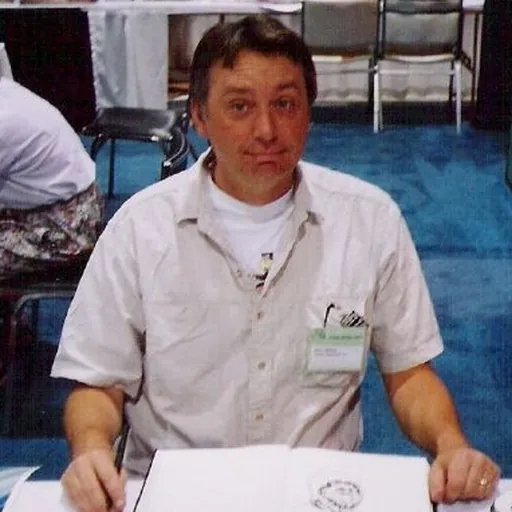
About Rick Veitch
Born 1951. Rick Veitch is an American comics artist and comics writer.
Richard Veitch (; born May 7, 1951) is an American comics artist and writer who has worked in mainstream, underground, and alternative comics.
Biography Rick Veitch is a native of the small town of Bellows Falls, Vermont. One of six children, he was raised Catholic. One of his elder brothers was the writer Tom Veitch, his first collaborator in comics. In an interview, Veitch recalled visiting the WPA muralist Stephan J. Belaski to ask his advice on becoming an artist. "He just said, 'Don't do it, kid.'" Winning honorable mention in a "draw a monster" contest hosted by Ed "Big Daddy" Roth, for Drag Cartoons when he was in seventh grade reassured him that he was on the right path.
Today, Veitch lives in West Townshend, Vermont with his wife Cindy. His sons Ezra Veitch and Kirby Veitch are also artists, contributing to Eureka Comics.
Career Early career While still in high school, Veitch and his brother Tom created the comic strip Crazymouse, which ran regularly in The Vermont Cynic. He made his professional debut in 1972, illustrating the underground comix horror parody Two-Fisted Zombies published by Last Gasp and written by Tom. Studying under veteran cartoonists Joe Kubert, Ric Estrada and Dick Giordano, he was part of the school's first graduating class in 1978, along with his future long-time collaborators Stephen R. Bissette and John Totleben. While still at school Veitch began his professional career in mainstream comics, contributing over a dozen short stories to DC’s combat title, Our Army at War.
Out of school, Veitch contributed to Heavy Metal. His next major project was an adaptation of the Steven Spielberg film 1941 with Bissette.
During the 1980s, Veitch became known as a distinctive fantasy artist and writer for Marvel's Epic Comics line, for which he created three graphic novels, Abraxas and the Earthman serialized in Epic Illustrated; Heartburst published as a standalone graphic novel; and The One.
During this period Veitch contributed numerous short comics to Epic Illustrated. He also worked with Alan Moore on Miracleman, published by Eclipse Comics. He illustrated the story that graphically depicted the birth of the superhero's child in Miracleman #9 (July 1986). With Moore and Bissette, Veitch collaborated on the original version of The Mirror of Love, published in a 1988 anthology by AARGH (Artists Against Rampant Government Homophobia). Moore later revised the text and published it with new illustrations by José Villarrubia.
The One
Originally published as a six-issue comic book limited series, The One was an ambitious and bizarre fantasy-adventure involving monstrous superheroes, the Cold War, and spiritual evolution. Published between 1985 and 1986, The One presaged both Alan Moore's Watchmen (1986–1987) and Frank Miller's The Dark Knight Returns (1986) in its revisionist approach to superheroics. As Moore would later write:
Swamp Thing Veitch's highest-profile title in the 1980s was DC Comics' Swamp Thing. His friends Totleben and Bissette had both illustrated the series since Alan Moore took over as writer. Veitch joined the team for issue #37 (cover dated June 1985), in which Moore's popular character John Constantine was introduced, and appeared regularly after issue #50.
When Moore left the Swamp Thing series after issue #64, Veitch took over as writer, dividing art duties with Alfredo Alcala. His Swamp Thing stories took a similar approach to Moore's, combining horror-fantasy, ecological concerns, and an encyclopedic knowledge of DC Comics fantasy characters; he gradually turned his attention from the DC Universe to history and mythology. Veitch concocted a plot device—a mystical piece of amber called The Claw of Aelkhund that gives him the power of time travel. This allowed Veitch to introduce his hero to a variety of legendary figures, from Jonah Hex, Bat Lash, and Tomahawk, to Sgt. Rock and Etrigan the Demon. While thrilling to many readers, this approach ultimately hit a bump that derailed the series.
Personally inclined towards metaphysics, Veitch submitted a script for issue #88 titled "Morning of the Magician" that moved DC to censorship. Set in Jerusalem, the principal characters include three evil Magi, several demons, the Holy Grail, Mother Mary, Joseph of Arimathea, and Mary Magdalene, here imagined as an active prostitute whose clients include the DC Silver Age hero Golden Gladiator. At the climax of the story, Swamp Thing meets Jesus Christ.
Although DC initially had approved Veitch's initial script for "Morning of the Magician," the story was scrapped by DC President, Jenette Kahn, who deemed it too inflammatory. "The subject was handled with integrity and respect," she wrote. "but we believe that the story concept itself would be offensive to many of our readers." The story arc remained unpublished for several years until it was announced during New York Comic Con 2025 that Veitch's final four issues of Swamp Thing would be published in 2026 under DC's Black Label imprint.
The King Hell Heroica After leaving DC, Veitch turned to the alternative comics field, where the success of the Teenage Mutant Ninja Turtles (TMNT) had provided the impetus for a black-and-white independent comics boom. After doing a Teenage Mutant Ninja Turtles storyline for Mirage Studios, "The River", he began creating his own titles again, published by the Mirage spin-off Tundra Publishing. Tundra was edited by TMNT creators Kevin Eastman and Peter Laird. Another friend Dave Sim, had found success publishing his own comics featuring Cerebus the Aardvark. Veitch decided to follow suit, creating his own publishing imprint, King Hell Press.
Operating without the editorial restraint he encountered at mainstream publishers, Veitch used his new imprint to published a series of graphic novels. The first of these was Brat Pack (1990–91), a dark satire on superhero sidekicks. A precursor to The Boys, Brat Pack was the subject of a 400-page work of cultural analysis.
Veitch followed Brat Pack with The Maximortal (1992), a phantasmagoric riff on Superman. He returned to the latter character with a new series inaugurated in 2017, Boy Maximortal. The series has been called his masterpiece. In a 2020 interview, Veitch calls Maximortal "kind of the illegitimate love child of S. Clay Wilson and Curt Swan.". Veitch has since reprinted these graphic novels along with other revisionist works under the collective title, The King Hell Heroica.
Rare Bit Fiends Also for King Hell Press, Veitch created a series of strips centered on dreams titled Roarin' Rick's Rare Bit Fiends, a reference to Winsor McCay's classic newspaper comic, Dream of the Rarebit Fiend. The series first appeared as backup features in other comics. In 1994 King Hell inaugurated a Rare Bit Fiends comic series, with contributions by Neil Gaiman, Dave Sim, Don Simpson, Moebius, Paul Pope, and others. The original series also reproduced dream comics submitted by readers. King Hell published 21 issues of Rare Bit Fiends. The trade paperback reprint editions, collected in volumes, also include essays by Veitch speculating on the nature of dreaming. In 2016, Veitch launched Sun Comics to publish new issues of Maximortal and Rare Bit Fiends.
The New Millennium During the 1990s, Veitch became interested in the Internet as an alternative to traditional comics distribution. In 1998, with Steve Conley, he created the "online convention" site Comicon.com, a combination message board, news portal, and web host for comics creators. Sold to Dynamic Forces in 2012, Comicon.com remains a vital site, which its editors liken to a perpetual comic book convention.
In the early 2000s, Veitch became a regular artist on Moore's America's Best Comics line published by Wildstorm, co-creating and then illustrating the graphically innovative "Greyshirt" serial. Debuting in Tomorrow Stories, and later spun off as an independent series, Greyshirt was an homage to Spirit, created by Will Eisner. Inking on The Big Lie was by Gary Erskine, who had collaborated earlier with Veitch on the satirical comic Army@Love (Vertigo, 2007–2009).
Recent work
In 2013, Veitch teamed up with Steve Conley, the creator of Astounding Space Thrills, The Middle Age, and other webcomics to found Eureka Comics, specializing in creating comics for learning and literacy. Clients include PBS, Wired, Vermont Folklife Center, University of Quebec, the University of Vermont, and the International Monetary Fund. For McGraw Hill Education, Eureka Comics produced The Outliers, a three book series, pioneering the use of modern graphic novel storytelling techniques to teach math to middle schoolers.
Don’t just read it —
keep it.
Full-length biographies made to live with: read them, listen on the way to work, watch them tonight.
- E-book
- Audio
- Video
Instant download · yours to keep · every purchase keeps this site free
Important facts
People in Rick Veitch's life
Named in this biography and alive at the same time







Related people
Same field, nearest in time



Contemporaries
People whose lives overlapped Rick Veitch's


Frequently asked questions
Who is Rick Veitch?
American comic artist
When was Rick Veitch born?
Rick Veitch was born on 7 May 1951 in Bellows Falls.
What is Rick Veitch's occupation?
Rick Veitch is a comics artist and comics writer.
What nationality is Rick Veitch?
Rick Veitch is American.
Sources & further reading
Cite this page
APA: Biography.guide. (2026). Rick Veitch. https://biography.guide/rick-veitch/
MLA: "Rick Veitch." Biography.guide, https://biography.guide/rick-veitch/.
Chicago: "Rick Veitch." Biography.guide. https://biography.guide/rick-veitch/.
Data last updated: 2026-09-20 · Spot an error? Report a correction.
Portrait: Wikimedia Commons · author & licence
Page generated 2026-09-27 04:57 UTC