
About Richard Tuttle
Born 1941. Richard Tuttle is an American sculptor, painter, visual artist, illustrator, draftsperson and installation artist.
Richard Dean Tuttle (born July 12, 1941) is an American postminimalist artist known for his small, casual, subtle, intimate works. His art makes use of scale and line. His works span a range of formats, from sculpture, painting, drawing, printmaking, and artist’s books to installation and furniture. He lives and works in New York City, Abiquiú, New Mexico, and Mount Desert, Maine.
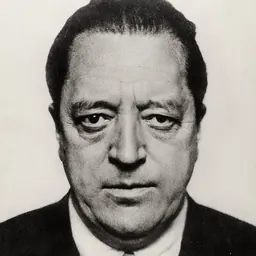
Biography Tuttle was born in Rahway, New Jersey and raised in nearby Roselle. He studied art, philosophy and literature at Trinity College in Hartford, Connecticut from 1959 to 1963. were followed by making palm-size paper cubes with cut-out designs and shaped wood reliefs that seemed like a twist on geometric abstraction. Beginning in the mid-1960s, he began to create eccentrically-shaped painted wood reliefs, followed by ideograms made of galvanized tin, and unstretched, shaped canvases dyed in offbeat colors. Tuttle had a survey exhibition in 1975 at the Whitney Museum of American Art. The exhibit was controversial and the show's curator Marcia Tucker lost her job as a result, after a scathing review by Hilton Kramer. Kramer, then art critic for The New York Times, wrote, referring to Ludwig Mies van der Rohe's dictum "less is more", "in Mr. Tuttle's work, less is unmistakably less ... One is tempted to say, where art is concerned, less has never been as less than this". According to art critic Christopher Knight of the Los Angeles Times, Tuttle's Wire pieces, which the artist made in 1971 and 1972, "collectively rank as his most distinctive contribution to art history". In 1983, Tuttle made Monkey's Recovery for a Darkened Room (Bluebird), a wall relief of branches, wire, cloth, string and wood scraps, which he says formally relates to Jan van Eyck's Crucifixion and Last Judgement diptych. The illustration from the suite 5 Loose Leaf Notebook Drawings from 1980 to 1982, in the collection of the Honolulu Museum of Art, demonstrates how the suites challenge viewers to contemplate the distinction between fine art and trash. His works in the 1990s consisted mostly of smaller-sized work, followed by bodies of low-relief wall-bound pieces that integrate painting, sculpture, and drawing. Tuttle has always "privileged newness, not found or weathered elements that refer to past lives and experiences," Sharon Butler wrote in a Two Coats of Paint review of "Days, Muses and Stars," his 2019 expansive multiple-gallery exhibition at Pace. "The distinctive feature of his aesthetic endeavor is his reverence for the present. His objects, though they may convey a sense of wabi-sabi precariousness, are invariably made of pristine materials that reflect the proximate experience of making." Tuttle's work has been extremely influential on a younger generation that has embraced the casualism that he pioneered.
Textile works During a residency at The Fabric Workshop and Museum in 1978, Tuttle embraced the silkscreen printing process and the idea of fabric to make a series of clothing — Shirts in 1978 and Pants in 1979. I Don't Know, Or The Weave of Textile Language, on view at the Tate Modern in 2014, was made for the museum's turbine hall and is Tuttle's largest to date spanning nearly 40 feet in length. Featuring the textiles he designed and fabricated, the work is suspended from the ceiling in contrast to the hall’s industrial architecture. and three Whitney Biennial exhibitions (1977, 1987, 2000).
In 2018, The Phillips Collection presented Richard Tuttle: It Seems Like It’s Going To Be, an exhibition “…that combines his 41-verse poem with 41 works that he created for each verse.”
From March 25 – July 10, 2022, the Bard Graduate Center exhibited Richard Tuttle: What Is the Object?. The exhibit encouraged “visitors to view, pick up, and hold 75 items drawn from Tuttle’s own collection, ranging from metal work and decorative sculptures to vintage fabrics and antique curios.” The exhibit was accompanied by a catalog edited by Peter N. Miller, ).
Collections The Centre Georges Pompidou, the Hirshhorn Museum and Sculpture Garden, the Honolulu Museum of Art, Kunsthaus Zug (Zug, Switzerland), Kunstmuseum Winterthur (Winterthur, Switzerland), the Metropolitan Museum of Art, the National Gallery of Art (Washington, D.C.); Serralves (Porto, Portugal), the Stedelijk Museum Amsterdam, the Tate Modern, and the Whitney Museum of American Art (New York City) are among the public collections holding work by Richard Tuttle. In 2012, he was elected to the National Academy and in 2013 he was invited to become a member of the American Academy of Arts and Letters.
He presented a lecture in collaboration with his poet wife, Mei-Mei Berssenbrugge, through the Visiting Artists Program at the School of the Art Institute of Chicago in April 2009.
Art market and gallery representation In New York, Tuttle is represented by Pace Gallery. In London, the artist is represented by Modern Art, first exhibiting with the gallery in 2009. Tuttle is represented by Galerie Schmela in Düsseldorf, Galerie Greta Meert in Brussels, and by the Annemarie Verna Galerie in Zürich.
In 2002, a tin wall piece called Letters (The 26 Series) (1966) sold at auction for $1 million.
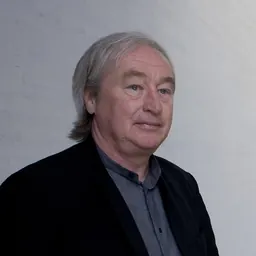
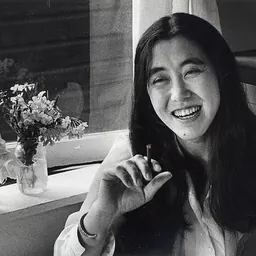
Personal life Tuttle is married to the poet Mei-mei Berssenbrugge. For their residence in Abiquiú, New Mexico, they commissioned architect Steven Holl to design a 1,300-square-foot guest cottage, built between 2001 and 2005.
Don’t just read it —
keep it.
Full-length biographies made to live with: read them, listen on the way to work, watch them tonight.
- E-book
- Audio
- Video
Instant download · yours to keep · every purchase keeps this site free
Important facts
People in Richard Tuttle's life
Named in this biography and alive at the same time




Related people
Same field, nearest in time


Contemporaries
People whose lives overlapped Richard Tuttle's



Frequently asked questions
Who is Richard Tuttle?
American sculptor and draftsperson (born 1941)
When was Richard Tuttle born?
Richard Tuttle was born on 12 July 1941 in Rahway.
What is Richard Tuttle's occupation?
Richard Tuttle is a sculptor, painter, visual artist, illustrator, draftsperson and installation artist.
What nationality is Richard Tuttle?
Richard Tuttle is American.
Sources & further reading
Cite this page
APA: Biography.guide. (2026). Richard Tuttle. https://biography.guide/richard-tuttle/
MLA: "Richard Tuttle." Biography.guide, https://biography.guide/richard-tuttle/.
Chicago: "Richard Tuttle." Biography.guide. https://biography.guide/richard-tuttle/.
Data last updated: 2026-09-20 · Spot an error? Report a correction.
Page generated 2026-09-27 05:10 UTC