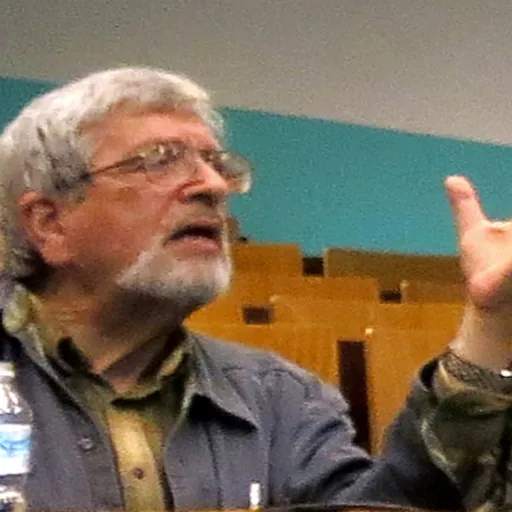
Richard Taruskin
American musicologist, music critic and choral conductor
About Richard Taruskin
Lived 1945 – 2022 (aged 77). Richard Taruskin was an American conductor, musicologist and choir director.
Richard Taruskin (April 2, 1945 – July 1, 2022) was an American musicologist. His analyses combined cultural, historical, political, and sociological perspectives with rigorous source study and sparked debate. He focused on 18th-to-21st-century Russian music but also researched 15th- and 20th-century music, analysis, modernism, musical nationalism, and performance theory. He is best known for the six-volume Oxford History of Western Music. born on April 2, 1945 in New York, was raised in an intellectual family by onetime piano teacher Beatrice (née Filler) and lawyer Benjamin Taruskin, an amateur violinist with whom he enjoyed Metropolitan Opera radio broadcasts. where he directed the Collegium Musicum and, from the late 1970s to the late 1980s, played viola da gamba with the Aulos Ensemble.
Russian music During his Ph.D., he worked with Paul Henry Lang, a pioneer of sociocultural music history in Music in Western Civilization.
Following his 1981 debut, Opera and Drama in Russia as Preached and Practiced in the 1860s,
Polemics His sharp, often polemical criticism targeted Elliott Carter, Carl Orff, and Sergei Prokofiev a volume featuring his influential critique of historically informed performance, and The Danger of Music and Other Anti-Utopian Essays.
"The Dark Side of the Moon" (The New Republic, 1988) called fascism's legacy an "inherent" facet of modernism's "anti-democratic" legacy, shown by claims of Stravinsky's sympathy for Benito Mussolini, Arnold Schoenberg's "fealty" to social stratification, and Anton Webern's welcoming the Nazis to Vienna. The reprint (Danger of Music, 2009) called fascism's legacy an "inseparable" facet of "lofty" modernism's legacy. In 2013, musicologist Ben Earle similarly called modernism "essentially anti-liberal".
"; or, I Didn't Know I Was Such a Pessimist until I Wrote This Thing" (1989 lecture; Danger of Music, 2009 with comment) bucks what he saw as the standard narrative history of 19th-to-20th-century classical music: "linear" progress toward "autonomy". It typified his quasi-straw men against lore, and he commented in 2008 that he found it "schematic and insufficiently nuanced", pointing its use as a "general framework" for his "detailed" 2005 History.
"The Pastness of the Present" (1988) held that claims of direct connection to the past can mask the present. Conversely, Stravinsky and the Russian Traditions: A Biography of the Works through Mavra (1996) showed Stravinsky's extensive use of Russian folk music and the historical reasons for its lack of acknowledgment.
"No Ear for Music: The Scary Purity of John Cage" (New Republic, 1993) argued that stiff rigidity underlaid Cage's zaniness and identification with Erik Satie. In 1997, he received the AMS's Otto Kinkeldey Award and was elected to the American Philosophical Society in 1998. His essays continued to treat cultural, political, and social aspects of music, including John Adams' fraught opera The Death of Klinghoffer (1991), which, amid the September 11 attacks and a cancelled production, he said played on jejune fantasies of terrorism.
History The Oxford History of Western Music (2005), his sole fulfilled solo commission, was envisioned as a college text and expanded on music history lectures he had given since the late 1960s, filling six volumes. Billed as an authoritative, synoptic history framed by the looming end of the "literate tradition", it was described as both bold and conceptually old. It relied on (sometimes extensive) musical analysis and narrative history but aimed to center discourses and reception in "attempt at a true history".
The preface, a polemic against "neo-Hegelian art history" like Carl Dahlhaus's "pseudo-dialectical" Foundations of Music History, aimed to probe "social and political affairs" for "actual causes of aesthetic and stylistic evolution". It called the work of modernist theorist Theodor W. Adorno "preposterously overrated" and new musicology Adornoian.
The first volume, covering Music from the Earliest Notations to the Sixteenth Century, told a story "both authoritative and transporting" based on "facts and impressions from histories, visual art and architecture", and was called perhaps "the best overall introduction to 'early music' available" upon his death. With José Ortega y Gasset's "dehumanization" concept, it distinguished French from German forms of musical modernism and tied musical modernism (and Ortega) to fascism, and Stravinsky to Mussolini.
Later career, retirement, and death In 2006, he received second Deems Taylor and Otto Kinkeldey awards, and provided direct and useful feedback on The Rest Is Noise to music critic Alex Ross, who took from him the idea that "love should never devolve into worship". In 2012, Princeton University held a conference, After the End of Music History, in his honor. In 2017, he received the Kyoto Prize in Arts and Philosophy in Music. He died from esophageal cancer at a hospital in Oakland, California, on July 1, 2022, aged 77.
Publications Sources:
Books
Republished in 1993, Rochester: University of Rochester Press
Chapters
Articles
Review articles
Don’t just read it —
keep it.
Full-length biographies made to live with: read them, listen on the way to work, watch them tonight.
- E-book
- Audio
- Video
Instant download · yours to keep · every purchase keeps this site free
Important facts
People in Richard Taruskin's life
Named in this biography and alive at the same time





Related people
Same field, nearest in time



Contemporaries
People whose lives overlapped Richard Taruskin's


Frequently asked questions
Who was Richard Taruskin?
American musicologist, music critic and choral conductor (1945-2022)
When was Richard Taruskin born?
Richard Taruskin was born on 2 April 1945 in New York City.
When did Richard Taruskin die?
Richard Taruskin died on 1 July 2022 in Oakland.
What was Richard Taruskin's occupation?
Richard Taruskin was a conductor, musicologist and choir director.
What nationality was Richard Taruskin?
Richard Taruskin was American.
Sources & further reading
Cite this page
APA: Biography.guide. (2026). Richard Taruskin. https://biography.guide/richard-taruskin/
MLA: "Richard Taruskin." Biography.guide, https://biography.guide/richard-taruskin/.
Chicago: "Richard Taruskin." Biography.guide. https://biography.guide/richard-taruskin/.
Data last updated: 2026-09-22 · Spot an error? Report a correction.
Portrait: Wikimedia Commons · author & licence
Page generated 2026-09-27 05:02 UTC