
About Richard Glazar
Lived 1920 – 1997 (aged 77). Richard Glazar was a Czech writer, engineer and management engineer, known for Treblinka.
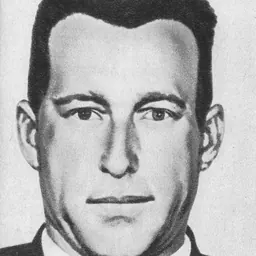
Richard Glazar (29 November 1920 – 20 December 1997) was a Czech-Jewish inmate of the Treblinka extermination camp in German-occupied Poland during the Holocaust. One of a small group of survivors of the camp's prisoner revolt in August 1943, Glazar described his experiences in an autobiographical book, Trap with a Green Fence: Survival in Treblinka.
Early life and family Glazar was born Richard Goldschmid in Prague, Czechoslovakia, to a Jewish-Czech family who spoke both Czech and German. His father served in the Austro-Hungarian Army before independence. His parents divorced in 1932, and his mother married a wealthy leather merchant, Quido Bergmann, who already had two children, Karel and Adolf. Karel died in the Austrian Mauthausen-Gusen concentration camp on 17 May 1942. Adolf went in October 1939 to Denmark with the Youth Aliyah organization, escaped in October 1943 to Sweden (Denmark was occupied by Nazi Germany in 1940–1945). In 1944–1945, he served as a volunteer in the Free Czechoslovak Army in the United Kingdom and France, and was later awarded the Czechoslovak War Cross. He later earned the degree of B.Sc. in dairy technology at the Agriculture University of Denmark. Richard and Adolf met after World War II and continued to have contact until the end of Richard's life.
Glazar's father died of pneumonia in the Soviet Union, to which he had escaped from the Nisko reservation in the General Government of occupied Poland; some 1,100 Czech Jews had been deported there by the Nazis in 1939. Glazar's mother survived both Auschwitz and Bergen-Belsen, and was the only member of his family left when he returned to Prague in 1945.
Treblinka Glazar wrote his story down after the war, and had part of it published in 1967 in a Czech magazine, Mezinárodní politika. An English translation, Trap with a Green Fence: Survival in Treblinka, was published in 1995 by Northwestern University Press.
In Shoah, Glazar described his arrival at Treblinka:
New arrivals at Treblinka were ordered to strip, then herded into gas chambers disguised as communal showers; exhaust gas was pumped in instead of water. Glazar was instead selected for forced labor along with a friend, Karel Unger. He described in his book the packing of victims' clothes for shipment to Germany, and how the gold from teeth was extracted and, together with coins and jewelry, added to the German loot. Food brought by the victims helped sustain both the SS and the Ukrainian guards, along with inmates who would steal it at the unloading ramp.
It was this knowledge that drove them to try to escape. The first escape attempt was planned for January 1943 and was code-named "The Hour". The idea was that at a specified time, all those working for the camp would attack the SS and Ukrainian guards, steal their weapons, and attack the camp Kommandantur. Unfortunately, this did not proceed, as typhus broke out, and many inmates either died, were hospitalized, or were too sick to participate. The escape that actually worked was less violent and ambitious: on 2 August 1943, men broke out through a damaged gate during a prisoner's revolt. Most of the escapees were arrested close to the camp, but Glazar and Unger fled from the area and made their way across Poland.
While on the run, they were arrested by a forester, but managed to convince him that they were Czechs working for "Organisation Todt" (a Nazi construction and engineering group in Poland). Both men were later sent to Mannheim in Germany, to work for Heinrich Lanz as immigrant workers, using falsified papers.
Life after the war Following the end of the war, when Glazar and Unger were liberated by the Americans, Glazar attended the trials of many of the Nazis associated with Treblinka, including Franz Stangl. Glazar also went on to study in Prague, Paris and London, and received a degree in economics. In 1968 he and his family moved to Switzerland after the invasion of Czechoslovakia by the armies of the Warsaw Pact.
Death Glazar helped Michael Peters, the founder of the Aktion Reinhard Camps (a network of private Holocaust researchers), build a model of Treblinka. Glazar died by suicide on 20 December 1997, by jumping out of a window in Prague after the death of his wife, leaving the model unfinished.
Don’t just read it —
keep it.
Full-length biographies made to live with: read them, listen on the way to work, watch them tonight.
- E-book
- Audio
- Video
Instant download · yours to keep · every purchase keeps this site free
Important facts
People in Richard Glazar's life
Named in this biography and alive at the same time

Related people
Same field, nearest in time




Contemporaries
People whose lives overlapped Richard Glazar's





Frequently asked questions
Who was Richard Glazar?
Czech-bon survivor of Treblinka extermination camp (1920-1997)
When was Richard Glazar born?
Richard Glazar was born on 29 November 1920 in Prague.
When did Richard Glazar die?
Richard Glazar died on 20 December 1997 in Prague.
What was Richard Glazar's occupation?
Richard Glazar was a writer, engineer and management engineer.
What was Richard Glazar known for?
Richard Glazar was known for Treblinka.
What nationality was Richard Glazar?
Richard Glazar was Czech.
Sources & further reading
Cite this page
APA: Biography.guide. (2026). Richard Glazar. https://biography.guide/richard-glazar/
MLA: "Richard Glazar." Biography.guide, https://biography.guide/richard-glazar/.
Chicago: "Richard Glazar." Biography.guide. https://biography.guide/richard-glazar/.
Data last updated: 2026-09-20 · Spot an error? Report a correction.
Page generated 2026-09-27 05:10 UTC