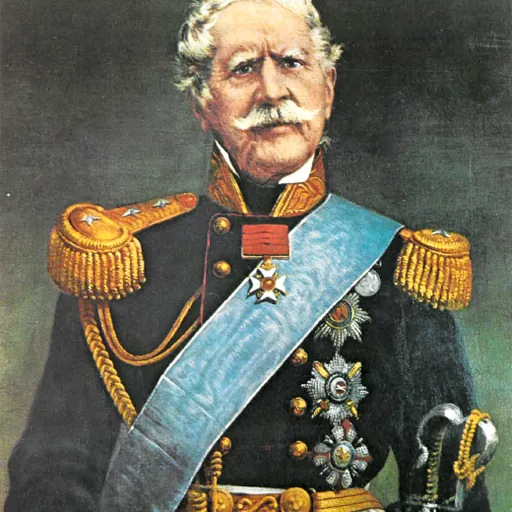
Richard Church
British and Greek general and Greek politician
About Richard Church
Lived 1784 – 1873 (aged 88–89). Richard Church was a Greek and British politician, military personnel and staatsrat.
General Sir Richard Church ( 23 February 1784 – 20 March 1873) was an Anglo-Irish military officer in the British Army and commander of the Greek forces during the last stages of the Greek War of Independence after 1827. After Greek independence, he became a general in the Hellenic Army and a member of the Greek Senate.
Early life and career
He was the second son of Matthew Church, an Anglo-Irish, Quaker merchant in the North Mall area of Cork, Ireland, and Anne Dearman, an English woman originally from Braithwaite, Yorkshire. At the age of 16, he ran away from home and enlisted in the British Army. For this violation of its principles he was disowned by the Society of Friends, but his father bought him a commission, dated 3 July 1800, in the 13th (Somersetshire) Light Infantry. He served in the demonstration against Ferrol, Spain, and in the expedition to Egypt under Sir Ralph Abercromby in 1801, where he took part in the Battle of Abukir and the taking of Alexandria. After the expulsion of the French from Egypt, he returned home, but he was posted back to the Mediterranean in 1805 among the forces sent to defend the island of Sicily. He accompanied the expedition which landed in Calabria and fought a successful battle against the French at the Battle of Maida on 4 July 1806. Church was present on this occasion as captain of a recently raised company of Royal Corsican Rangers. His zeal attracted the notice of his superiors, and he had begun to show his capacity for managing and drilling foreign levies. His Corsicans formed part of the garrison of Capri from October 1806 till the island was taken by an expedition directed against it by Joachim Murat, in September 1808, at the very beginning of his reign as king of Naples. Church, who had distinguished himself in the defence, returned to Malta after the capitulation.
In the summer of 1809 he sailed with the expedition sent to occupy the French-occupied Ionian Islands. Here he increased the reputation he had already gained by forming a Greek regiment in British pay. On 19 November 1812 he became Lieutenant-Colonel of the unit, by then renamed The Duke of York's Greek Light Infantry Regiment (1811 – 24 February 1816). Having got the experience of managing foreign troops, he commanded the regiments made up from Greeks he recruited himself in 1813, when he formed a second regiment composed of 454 Greeks (2nd Regiment Greek Light Infantry) to occupy Paxoi islands. These regiments included many of the men who were afterwards among the leaders of the Greeks in the War of Independence including Theodoros Kolokotronis, with whom he kept a friendship and correspondence. Church commanded this regiment at the taking of the island of Santa Maura (Lefkada), on which occasion his left arm was shattered by a bullet. and died at Athens in 1873.
Family
Sir Richard Church married Marie-Anne, daughter of Sir Robert Wilmot, 2nd Baronet of Osmaston in Worthing, on 17 Aug 1826 #tag:ref|There are also references such as the 1911 Encyclopædia Britannica which mention that his wife was "Elizabeth Augusta Wilmot-Horton, who survived him till 1878".
Death
He died after an illness on Thursday, and he was buried at the First Cemetery of Athens at public expense on . #tag:ref|Primary while gave a speech in English.
Don’t just read it —
keep it.
Full-length biographies made to live with: read them, listen on the way to work, watch them tonight.
- E-book
- Audio
- Video
Instant download · yours to keep · every purchase keeps this site free
Important facts
People in Richard Church's life
Named in this biography and alive at the same time
Related people
Same field, nearest in time
Contemporaries
People whose lives overlapped Richard Church's

Frequently asked questions
Who was Richard Church?
British and Greek general and Greek politician
When was Richard Church born?
Richard Church was born in 1784 in Cork.
When did Richard Church die?
Richard Church died in 1873 in Athens.
What was Richard Church's occupation?
Richard Church was a politician, military personnel and staatsrat.
What nationality was Richard Church?
Richard Church was Greek and British.
Sources & further reading
· DBpedia: Richard Church (general)
Cite this page
APA: Biography.guide. (2026). Richard Church. https://biography.guide/richard-church-politician/
MLA: "Richard Church." Biography.guide, https://biography.guide/richard-church-politician/.
Chicago: "Richard Church." Biography.guide. https://biography.guide/richard-church-politician/.
Data last updated: 2026-09-27 · Spot an error? Report a correction.
Portrait: Wikimedia Commons · author & licence
Page generated 2026-10-04 11:35 UTC