
About Richard C. Casey
Lived 1933 – 2007 (aged 74). Richard C. Casey was an American lawyer and judge.
Richard Conway Casey (January 19, 1933 – March 22, 2007) was an American lawyer who served as a United States district judge of the United States District Court for the Southern District of New York from 1997 to 2007. Casey gained national prominence for his unusual personal characteristics, such as being completely blind throughout his federal service and for his aggressive questioning during a 2004 trial considering the constitutionality of the Partial-Birth Abortion Ban Act of 2003.
Early life and education Casey was born on January 19, 1933, in Ithaca, New York. He graduated from the College of the Holy Cross in Worcester, Massachusetts, with a Bachelor of Science in political science in 1955. As an undergraduate at Holy Cross, he was a member of the Knights of Columbus and wrote a senior thesis on the judicial philosophy of Chief Justice Fred Vinson. He was also in the Naval Reserve Officers Training Corps (ROTC) while at Holy Cross.
After graduation, Casey earned his Bachelor of Laws from the Georgetown University Law Center in 1958. He then joined the United States Army (1958; 1961–1962) and the New York Army National Guard (1958–61). He went to basic training at Fort Dix, New Jersey as a private and then served in the New York National Guard at the 142nd Tank Battalion in Freeport, New York. At Georgetown, Casey was particularly influenced by prominent lawyer Edward Bennett Williams.
After law school, Casey worked as a legal investigator for the New York County District Attorney's office before becoming an Assistant United States Attorney for the Southern District of New York (1959–1963). From 1963 to 1964, he served as counsel for the Special Commission of the State of New York where he helped prosecute public corruption cases. From 1964 until his nomination in 1997, Casey worked in private practice with the New York City law firm of Brown & Wood.
Federal judicial service Casey was a United States District Judge of the United States District Court for the Southern District of New York. Casey was nominated by President Bill Clinton on July 16, 1997, to a seat vacated by Charles S. Haight, Jr. He was confirmed by the United States Senate on October 21, 1997, and received commission on October 24, 1997. He died on March 22, 2007.
Blindness In 1964, Casey was diagnosed with retinitis pigmentosa. His condition deteriorated into total blindness in 1987. His blindness does not seem to have slowed his career or personal ambition. At his Senate confirmation hearing, Casey expressed confidence in his ability to effectively judge the credibility of witnesses despite his loss of sight. He used a guide dog in court, and he was assisted by computers that read documents aloud.
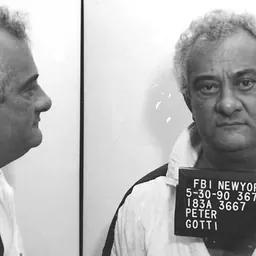
Notable cases Casey sentenced Gambino crime family boss Peter Gotti to 25 years in prison on July 28, 2005, seven months after a federal jury found Gotti guilty of conspiring to murder government informant and former Gambino underboss Sammy Gravano. Gotti had earlier been convicted by United States District Court for the Eastern District of New York judge Frederic Block for money laundering and racketeering.
NAF v. Ashcroft Casey presided over one of the three constitutional challenges to the 2003 Partial-Birth Abortion Ban Act, National Abortion Federation v. Ashcroft. A coalition led by NAF argued that the statute was unconstitutional under the Supreme Court's 2000 decision in Stenberg v. Carhart because the Act explicitly excluded a "health exception". The Bush administration argued that the courts should defer to a congressional finding of fact that this particular abortion procedure is never medically necessary to protect the health of a mother.
Casey had granted a temporary restraining order prohibiting enforcement of the Act on November 6, 2003, the day after it was signed into law. The trial began on March 29, 2004, and lasted 16 days.
Casey made headlines throughout the trial by his aggressive questioning. He repeatedly asked witnesses—mostly doctors who perform abortions—about the possibility that fetuses feel pain during abortion, and whether patients are truly informed of that possibility. For example, the following is from an exchange during the redirect examination of Dr. Timothy Johnson:
On August 26, 2004, Casey entered a judgment
The Bush administration appealed to the Second Circuit Court of Appeals, which affirmed the judgment. In a related case, Gonzales v. Carhart, the Supreme Court reversed a similar Eighth Circuit Court of Appeals decision and upheld the federal Partial-Birth Abortion Ban Act as constitutional, at least on a facial challenge.
Don’t just read it —
keep it.
Full-length biographies made to live with: read them, listen on the way to work, watch them tonight.
- E-book
- Audio
- Video
Instant download · yours to keep · every purchase keeps this site free
Important facts
People in Richard C. Casey's life
Named in this biography and alive at the same time





Related people
Same field, nearest in time



Contemporaries
People whose lives overlapped Richard C. Casey's



Frequently asked questions
Who was Richard C. Casey?
United States federal judge (1933–2007)
When was Richard C. Casey born?
Richard C. Casey was born on 19 January 1933 in Ithaca.
When did Richard C. Casey die?
Richard C. Casey died on 22 March 2007.
What was Richard C. Casey's occupation?
Richard C. Casey was a lawyer and judge.
What nationality was Richard C. Casey?
Richard C. Casey was American.
Sources & further reading
Cite this page
APA: Biography.guide. (2026). Richard C. Casey. https://biography.guide/richard-c-casey/
MLA: "Richard C. Casey." Biography.guide, https://biography.guide/richard-c-casey/.
Chicago: "Richard C. Casey." Biography.guide. https://biography.guide/richard-c-casey/.
Data last updated: 2026-09-20 · Spot an error? Report a correction.
Page generated 2026-09-27 05:26 UTC