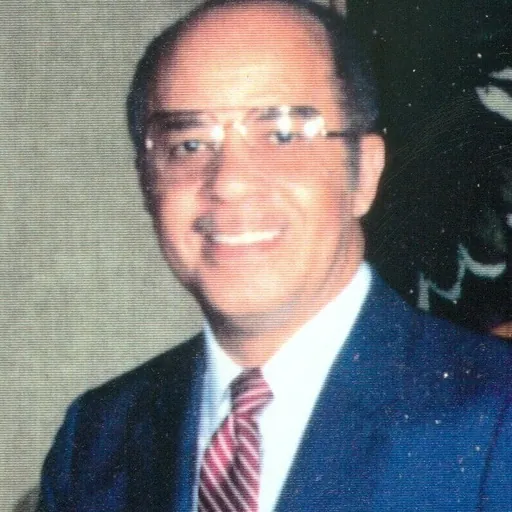
About Richard Arrington, Jr.
Born 1934. Richard Arrington, Jr. is an American zoologist, politician, entomologist, biochemist, soldier and major.
Richard Arrington Jr. (born October 19, 1934 in Livingston, Alabama) was the first African American mayor of the city of Birmingham, Alabama (U.S.) and the second African American on the City Council. He served on the council for two terms from 1971 to 1979 and was mayor of the city for 20 years from 1979 to 1999. While in office as mayor and on the City Council, Arrington worked to end police brutality, rebuild the city's economy, and promote equality for all minorities. Throughout his political career, Arrington faced racial harassment and multiple investigations by the FBI and IRS for the changes he made to the city. He replaced David Vann as mayor and, upon retiring after five terms in office, installed then-City Council president William A. Bell as interim mayor. Bell went on to lose the next election to Bernard Kincaid. Arrington majored in biology at Miles and excelled in the classroom and as a leader, rising to the presidency of his chapter of the Alpha Phi Alpha fraternity. He was also an officer in the Honor Society and the Thespian Club. He graduated cum laude in 1955. and, at the urging of President Lucius Pitts, returned to Miles as acting Dean and Director of the Summer School. While there, Barbara struggled in the mostly white community. The family faced isolation along with fears for their children: Tony, Kenneth, and Kevin. A year later, Richard Arrington Jr. met Rachel Reynolds at his work whom he married soon after. As Arrington continued in his political career, Rachel supported him in his dream for a unified Birmingham. He placed third among 29 at-large candidates and faced five opponents in a runoff election for three remaining seats. Arrington earned a majority of the Black vote and won his seat easily, becoming, after Arthur Shores (who had been appointed to a vacant seat by Mayor George Siebels in 1968), the second African American to serve on the council. He won his first seat on the council due to the large African American voter turnout encouraged by the Jefferson County Progressive Democratic Council and the Alabama Christian Movement for Human Rights. Arrington's second run for City Council was smoother due to the young politician winning a seat without a runoff. For his fourth run for office in 1991, Arrington faced a federal investigation into his personal and political life which earned him a strong albeit mixed presence in the local media. Even with the investigation, Arrington easily won a fourth term.
Policies and accomplishments Richard Arrington Jr. worked to rebuild Birmingham's economy and infrastructure. Decades after the Great Depression, the industrial city still faced large numbers of unemployment. He worked to bring banking and finance companies as well as expanding the city's solely steel industry to other fields. Richard Arrington with staff at the headquarters for his mayoral campaign at 2130 1st Avenue North in Birmingham, Alabama.
Political challenges Richard Arrington Jr. faced many challenges, but his greatest was the investigation led by the Federal Bureau of Investigation (FBI) and the Internal Revenue Service, Criminal Division (IRS), which lasted throughout his political career. The FBI, led by their racial counterintelligence program (COINTELPRO), launched their investigation into Arrington on January 26, 1972, shortly after he became a member of the Birmingham City Council. The mayor denied taking any money from Brown, stating that he only met with him to encourage him to open an office in Birmingham. After multiple checks into the business of the funeral home, the results showed that no illegal business was being done. In November 1985, the FBI concluded that there was no probable cause in Arrington's case, but the investigation still continued. thumb Mayor Richard Arrington looking at a newspaper in his office at city hall in Birmingham, Alabama in 1979.In April 1989, Robert Mousallem, a real estate developer, came to see Arrington at his home. There, he confessed that the FBI and U.S. Attorney Frank Donaldson had tried to get him to frame the mayor for bribery and corruption for the past three years. In exchange for his help, Donaldson promised Mousallem immunity. The goal was for him to buy property in areas where there were zoning issues and ask the African American politicians for help in rezoning. Then, two FBI agents, Robert A. Hood and James Vaules, would go undercover with Mousallem to gain the mayor's trust and eventually encourage him to take the bribe. The FBI called off Mussallem's attempt to bribe the mayor after other African American politicians declined the bribe. In September 1989, Mousallem was convicted of bribery, conspiracy, and tax evasion and later shot to death, which was ruled an accident. On July 21, 1989, the City of Birmingham filed a complaint to the United States Senate Judiciary Committee about the racial harassment of the FBI and IRS towards Arrington and other African American leaders in the city.
In 1990, the FBI and IRS began looking into Arrington again. Many of Arrington's records, including charities he had donated to, were subpoenaed by a federal grand jury. Marjorie Peters, a city consultant, was convicted of defrauding the city. The press, along with the U.S. Attorney Frank Donaldson, painted her as conspiring with the mayor. An ex-partner of Arrington testified in Peters' case that he had bribed the mayor for city contracts. In 1993, however, Peters conviction was overturned and Arrington's logs showed he never met with his ex-partner.
In 1992, Arrington refused to give up his personal logs to the investigation, claiming the logs would give the FBI, IRS, and U.S. Attorney the ability to fabricate a more believable story and conviction. On January 23 of that year, the mayor was sent to prison for two days at Maxwell Airforce Base in Montgomery, Alabama for his refusal to give up his records. Once U.S. Attorney Frank Donaldson was asked to step down in March 1992, Arrington gave up his records and promised full cooperation to Donaldson's replacement, Jack Selden. The resulting investigation found no evidence of the mayor taking bribes or being involved in illegal activity.
Don’t just read it —
keep it.
Full-length biographies made to live with: read them, listen on the way to work, watch them tonight.
- E-book
- Audio
- Video
Instant download · yours to keep · every purchase keeps this site free
Important facts
People in Richard Arrington, Jr.'s life
Named in this biography and alive at the same time



Related people
Same field, nearest in time



Contemporaries
People whose lives overlapped Richard Arrington, Jr.'s




Frequently asked questions
Who is Richard Arrington, Jr.?
American mayor
When was Richard Arrington, Jr. born?
Richard Arrington, Jr. was born on 19 October 1934 in Livingston.
What is Richard Arrington, Jr.'s occupation?
Richard Arrington, Jr. is a zoologist, politician, entomologist, biochemist, soldier and major.
What nationality is Richard Arrington, Jr.?
Richard Arrington, Jr. is American.
Sources & further reading
· Wikipedia: Richard Arrington, Jr.
· DBpedia: Richard Arrington Jr.
Cite this page
APA: Biography.guide. (2026). Richard Arrington, Jr.. https://biography.guide/richard-arrington-jr/
MLA: "Richard Arrington, Jr.." Biography.guide, https://biography.guide/richard-arrington-jr/.
Chicago: "Richard Arrington, Jr.." Biography.guide. https://biography.guide/richard-arrington-jr/.
Data last updated: 2026-09-22 · Spot an error? Report a correction.
Portrait: Wikimedia Commons · author & licence
Page generated 2026-09-27 05:04 UTC