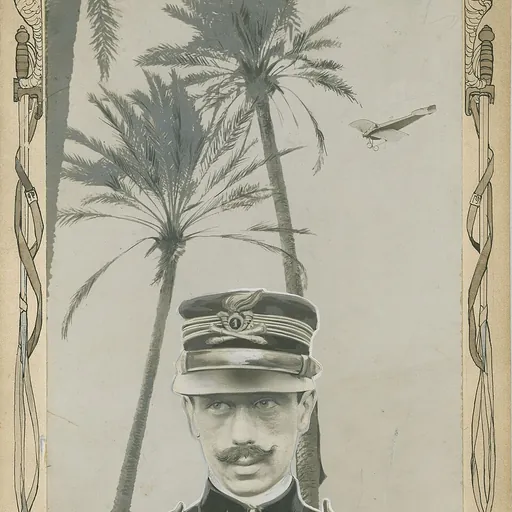
About Riccardo Moizo
Lived 1877 – 1962 (aged 84). Riccardo Moizo was an Italian politician and military personnel.
Riccardo Moizo (22 August 1877 – 27 February 1962) was an Italian aviation pioneer in the early part of the 20th century (in which he was one of the founders of the Regia Aeronautica) and a general during World War II. He was Commander-General of the Carabinieri from 1935 to 1940 and the last High Commissioner of the Province of Ljubljana in 1943; from 1939 to 1943 he was also a member of the Italian Senate.
Biography
Early years He was born in Saliceto, province of Cuneo, on 22 August 1877, the son of Francesco Moizo and Ermenegilda Barberis. He enlisted in the Royal Italian Army on 14 October 1894, entering the Royal Military Academy of Artillery and Engineers in Turin, graduating on 4 July 1897 with the rank of artillery second lieutenant, after which he attended the School of Application of Artillery and Engineers. He was promoted to lieutenant on 1 September 1899, and at the end of the courses he was assigned to the 7th Coastal Artillery Brigade. Between October 1905 and August 1908 he attended the courses of the Army War School in Turin, at the end of which he was sent to Rome, at the headquarters of the Staff Officer Corps; on May 13, 1909 he was transferred to Turin and assigned to the staff of the I Army Corps. On 10 August of the same year he was promoted to captain and assigned to the 3rd Fortress Artillery Regiment until 2 June 1910, when he was transferred to the 1st Mountain Artillery Regiment, while continuing to serve at the command of the I Army Corps.
While in Turin he developed an interest in the world of aviation; attracted by the novelty of the aircraft, he attended a piloting course, being assigned to the Specialists Engineers Battalion on November 17, 1910. He moved to Rome where he began to follow the course to become an airplane pilot on the Centocelle airfield, which he completed at the Malpensa airfield, where on May 31, 1911 he obtained the airplane pilot license, followed on August 1 by the military pilot license. In that same month, flying on a Nieuport monoplane, he participated in the great maneuvers of the Royal Italian Army held in Monferrato, the first in Italy that saw the participation of aircraft, then still used only for reconnaissance.
Interwar years
Left almost blind, he spents several months recovering and returned to service in August 1919, assigned to the staff of the 8th Army with headquarters in Udine. He then returned to the air service; from November 1919 he served at the command of the Air Service of Rome, later becoming high commander of the Air Service and general director of Military Affairs of the Air Force Commissioner from January 1923; after the establishment of the Regia Aeronautica, he was transferred to the new armed force with the rank of Air Brigade General (air commodore). Between May 1923 and October 21 of the same year he was Commander-General of the Air Force, later replaced by Aldo Finzi. On December 30, 1923 he was transferred back to the Army at his request, with the rank of colonel, commanding the 6th Heavy Field Artillery Regiment from February 24, 1924 and the 3rd Heavy Field Artillery Regiment from November 1, 1926. He was promoted to brigadier general on February 21, 1929 and served at the artillery command of the Army Corps of Rome. On November 16, 1930 he became Inspector for the mobilization of the 21st Territorial Military Division of Rome, and on September 16, 1931 he was placed at the disposal of the designated army command of Florence.
On 1 December 1932 he was promoted to major general and became the first commander of the 6th Territorial Military Division of Milan, which in February 1934 became the 58th Infantry Division Legnano, and from 16 September 1934 he commanded the 1st Cavalry Division Eugenio di Savoia. On November 30, 1935 he was appointed Commander-General of the Carabinieri; during his tenure the Carabinieri Corps expanded considerably, and during the Second Italo-Ethiopian War the 3rd Carabinieri Division was established in southern Italy, which participated in operations in Ethiopia with truck-mounted units. After the proclamation of the Empire in East Africa, he set up Carabinieri commands and units in the newly conquered territories, and did the same after the conquest of Albania in 1939, incorporatine the Royal Albanian Gendarmerie in the Carabinieri.
On 1 October 1936 he was promoted to lieutenant general and on 25 March 1939 he was appointed Senator of the Kingdom. He was assigned to the Commission of Internal Affairs and Justice and later, from 23 January 1940, to that of the Armed Forces, dealing almost exclusively with issues related to the Carabinieri.
World War II and later years
In 1940 he supervised the general mobilization of the Carabinieri following the entry of the Kingdom of Italy in World War II. On 27 August of the same year he left the post of Commander General of the Royal Carabinieri Corps, being replaced by General Remo Gambelli.
On the eve of his final retirement, on 12 August 1943 he was appointed High Commissioner of the Province of Ljubljana by the new Badoglio government, but the worsening of the military situation did not give him time to exercise his powers, as the province had been declared a zone of operations. At the proclamation of the Armistice of Cassibile on 8 September 1943, Ljubljana was occupied by German forces, who put Moizo under house arrest where he remained until 10 October, with his formal dismissal being confirmed by the Italian Social Republic on 1 October. He was then allowed to return to Italy and moved to Camogli, where he remained until February 1944, when he learned he was being investigated and moved to Saliceto, his hometown, where he went into hiding. On March 1, following the arrest of his wife, he decided to turn himself in. He was then detained in the prisons of Verona, Venice and Brescia and tried by the Special Tribunal for the Defense of the State with the accusation of having favored the disbandment of the Italian troops in the province of Ljubljana after the armistice, but was acquitted and released on 6 October 1944.
He subsequently made contact with the National Liberation Committee through General Raffaele Cadorna, but the end of the Second World War came before he could have any employment within the CLN. He lost his post as senator due to a sentence by the High Court of Justice for the sanctions against Fascism delivered on February 6, 1945, but presented an appeal which was accepted by the Supreme Court of Cassation on June 9, 1947, when he retired to private life. He died in Rome on February 27, 1962.
Don’t just read it —
keep it.
Full-length biographies made to live with: read them, listen on the way to work, watch them tonight.
- E-book
- Audio
- Video
Instant download · yours to keep · every purchase keeps this site free
Important facts
People in Riccardo Moizo's life
Named in this biography and alive at the same time


Related people
Same field, nearest in time




Contemporaries
People whose lives overlapped Riccardo Moizo's



Frequently asked questions
Who was Riccardo Moizo?
Italian politician (1877–1962)
When was Riccardo Moizo born?
Riccardo Moizo was born on 27 August 1877 in Saliceto.
When did Riccardo Moizo die?
Riccardo Moizo died on 27 February 1962 in Rome.
What was Riccardo Moizo's occupation?
Riccardo Moizo was a politician and military personnel.
What nationality was Riccardo Moizo?
Riccardo Moizo was Italian.
Sources & further reading
Cite this page
APA: Biography.guide. (2026). Riccardo Moizo. https://biography.guide/riccardo-moizo/
MLA: "Riccardo Moizo." Biography.guide, https://biography.guide/riccardo-moizo/.
Chicago: "Riccardo Moizo." Biography.guide. https://biography.guide/riccardo-moizo/.
Data last updated: 2026-09-22 · Spot an error? Report a correction.
Portrait: Wikimedia Commons · author & licence
Page generated 2026-09-27 05:02 UTC