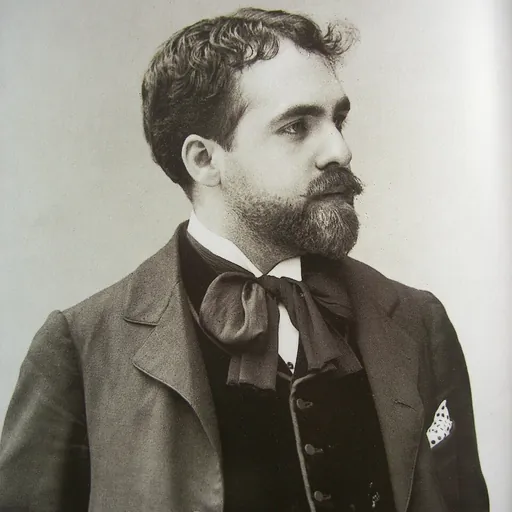
About Reynaldo Hahn
Lived 1874 – 1947 (aged 72). Reynaldo Hahn was a French and Venezuelan conductor, composer, choreographer, music critic and pianist.
Reynaldo Hahn de Echenagucia (9 August 1874 – 28 January 1947) was a French composer, conductor, music critic, and singer of Venezuelan birth. He is best known for his songs – mélodies – of which he wrote more than 100.
Hahn was born in Caracas but his family moved to Paris when he was a child, and he lived most of his life there. Following the success of his song "Si mes vers avaient des ailes" (If my verses had wings), written when he was aged 14, he became a prominent member of fin de siècle French society. Among his closest friends were Sarah Bernhardt and Marcel Proust. After the First World War, in which he served in the army, Hahn adapted to new musical and theatrical trends and enjoyed successes with his first opérette, Ciboulette (1923) and a collaboration with Sacha Guitry, the musical comedy Mozart (1926). During the Second World War Hahn, who was of Jewish descent, took refuge in Monaco, returning to Paris in 1945 where he was appointed director of the Opéra. He died in Paris in 1947, aged 72.
Hahn was a prolific composer. His vocal works include secular and sacred pieces, lyric scenes, cantatas, oratorios, operas, comic operas, and operettas. Orchestral works include concertos ballets, tone poems, incidental music for plays and films. He wrote a range of chamber music, and piano works. He sang as well as played his own songs, and made recordings as a soloist and accompanying other performers. After his death, his music was largely neglected until the late 20th century, which saw increasing interest and frequent performances of his songs and piano work, as well as much of his orchestral music and some of his stage works.
Life and career Early years Reynaldo Hahn de Echenagucia was born in Caracas, Venezuela, on 9 August 1874, the youngest child of Carlos (né Karl) Hahn (1822–1897) and his wife Elena María née de Echenagucia (1831–1912). Carlos Hahn, the eldest son of a Jewish family in Hamburg, emigrated to Venezuela in 1845 at the age of twenty-two, making a highly successful business career there. When his friend and associate Antonio Guzmán Blanco became president of the country in 1870, Carlos became Blanco's financial adviser. He was brought up speaking fluent German, Spanish and (having a British nanny) English.
When Blanco's first term of office came to an end in 1877, the Hahn family left Venezuela and settled in Paris, where they had relations and well-connected friends. Among the family's Parisian friends was Princess Mathilde, niece of Napoleon I; at a musical soirée in her drawing room, the young Hahn made his public debut as a singer at the age of six. He began composition lessons with an Italian teacher when he was eight. He went on to study piano with Émile Decombes, harmony with Albert Lavignac and Théodore Dubois, and composition with Charles Gounod and Jules Massenet. Massenet in particular became Hahn's lifelong friend and mentor. As a young man Massenet had won France's top musical scholarship, the Prix de Rome, but Hahn could not emulate him: only French nationals were eligible, and the Hahns had not taken French citizenship. Besides, Massenet counselled, with rich parents Hahn did not need the scholarship as his less affluent colleagues did. Through Massenet, Hahn met Camille Saint-Saëns, with whom he studied privately in addition to his Conservatoire lessons. Hahn's fellow students
While still a student Hahn had an early success with his mélodie "Si mes vers avaient des ailes" (If my verses had wings) to a poem by Victor Hugo. The song was among a set of Hahn's mélodies published by the leading music publisher Hartmann et Cie in 1890. Le Figaro took it up – "We feel we must reproduce this graceful piece which obviously denotes a delicate and original musician" – and devoted half a broadsheet page to printing the words and music.
Hahn dedicated "Si mes vers avaient des ailes" to his sister Maria, who had married the painter Raimundo de Madrazo y Garreta. At their house Hahn met many of the leading figures in the arts, including Alphonse Daudet, for whose play L'obstacle the teenaged Hahn composed incidental music. The play was presented at the Théâtre du Gymnase in December 1890. Daudet called Hahn's music his "chère musique préférée" (dear favourite music). At the Daudets' house in 1893 the singer Sybil Sanderson premiered Hahn's Chansons grises, settings of poems by Paul Verlaine. The poet was present and was moved to tears by Hahn's settings of his verse. Stéphane Mallarmé was also present, and wrote:
Le pleur qui chante au langage Du poète, Reynaldo Hahn tendrement le dégage Comme en l'allée un jet d'eau. The weeping that sings in the words Of the poet, Reynaldo Hahn tenderly releases it Like a fountain on the pathway.
In the early 1890s Hahn worked on his first opera L'île du rêve, "a Polynesian idyll", written at Massenet's behest. During this period he met Marcel Proust for the first time, at Madeleine Lemaire's salon on 22 May 1894. As far as is known, the 19-year-old Hahn's romantic attachments before then had been intimate but platonic relationships with the famous Parisienne beauties Cléo de Mérode and Liane de Pougy. Until this point, he had been uneasy to the point of hostility about homosexuality and homosexuals, but the two men quickly began an intense love affair, Proust's only real liaison. Proust wrote, "Everything I have ever done has always been thanks to Reynaldo." The music scholar James Harding writes about the fictional Vinteuil Sonata: "It was Hahn who suggested to Proust the famous petite phrase which recurs symbolically throughout À la recherche du temps perdu and which is none other than a haunting theme from Saint-Saëns's D minor violin sonata". Hahn was also the inspiration for the eponymous protagonist of Proust's early unfinished novel Jean Santeuil .
Hahn completed his studies at the Conservatoire satisfactorily but "without producing sparks in examinations and competitions", as his biographer Jacques Depaulis puts it. and Hahn left at the same time as his mentor.
1896 to 1913 In 1896 Proust wrote the words and Hahn the music for Portraits de peintres for reciter and piano, premiered at the house of Madeleine Lemaire, where they had met. Later in that year Hahn formed another of his closest friendships: he had long admired the actress Sarah Bernhardt, and at the end of 1896 he met her and quickly became part of her inner circle of friends and helpers. He frequently visited her in her dressing room during and after performances, lunched with her at her Paris townhouse, travelled with her to London and on tour, and composed music for her productions.
L'île du rêve was premiered in 1898, when thanks to Massenet's influence the Opéra-Comique staged the piece, with a fine cast, conducted by André Messager. The press notices were hostile, While it was in rehearsal Paris was agog at the Zola trial in the continuing Dreyfus affair. The affair sharply divided French opinion; Hahn, like Proust and Bernhardt, was in the Dreyfusard camp. The anti-Semitic overtones of the anti-Dreyfusard campaign disturbed him deeply, but his devotion to France was unshaken.
In December 1902 Hahn's second opera, La Carmélite, described as "a musical comedy", with a libretto by Catulle Mendès, was premiered at the Opéra-Comique. Emma Calvé played the main role of Louise de La Vallière, Messager was once again the conductor, and the piece was lavishly mounted, His first published set of songs was Chansons grises (Songs in Grey, 1890), which included a setting of Verlaine's "La bonne chanson" (The good song) that the poet preferred to Fauré's well known version of it. The commentator James Day observes that the songs in the set display "a maturity quite remarkable in a sixteen-year-old – and an empathy with the poet quite unexpected in a musician of any age".
After Chansons grises Hahn composed further song cycles over the next 25 years. Rondels (1898–99), with words by Charles d'Orléans, Théodore de Banville and Catulle Mendès, was an example of the composer's fascination with the past, setting original and modern versions of the old rondel verse form. For Les feuilles blessées (The Injured Leaves, 1901–1906) Hahn turned to a contemporary poet, Jean Moréas, known for his symbolist verse. In 1907 Hahn returned to older forms with Chansons et madrigaux (Songs and madrigals), setting words by d'Orléans, Jean-Antoine de Baïf and others, in a cycle of six songs for four voices. Love Without Wings (1911) is a set of three verses in English by Mary Robinson, and Hahn again set English texts in Five Little Songs (1915), with verses by Robert Louis Stevenson. Grove lists a final cycle, Chansons espagnoles (Spanish songs, 1947).
Operas, opérettes and musical comedies Hahn completed five operas, and left an incomplete one. The first, L'Île du rêve, an "idylle polynésienne" in three acts, has a libretto by André Alexandre and Georges Hartmann, adapted from Pierre Loti's semi-autobiographical 1880 novel Rarahu or Le Mariage de Loti set in Tahiti. It ran for seven performances in 1898, and was revived at Cannes in 1942, conducted by the composer, Henri Büsser considered the work "charming … very musical"; it is through-composed and there are no set-piece numbers. Hahn makes use of leitmotifs, following the example of Massenet.
La Carmélite (1902), a period piece set in the reign of Louix XIV, made little impact, although its conductor, Messager, who was musical director at Covent Garden as well as at the Opéra Comique, considered staging it in London; the idea was not realised. Neither of Hahn's next two operas – Nausicaa (1919, libretto by René Fauchois) and La Colombe de Bouddha (Buddha's Dove, 1921), a one-act work with words by André Alexandre – was written for Paris, and neither was staged there. The former was given at the Opéra de Monte-Carlo, and the latter at the Théâtre du Casino municipal de Cannes, where Hahn conducted frequently.
Le Marchand de Venise (1935) was the most successful of Hahn's serious operas. It was well received; Büsser wrote: blockindent|Le Marchand de Venise revealed a remarkable dramatic art, not only by its design, but by the study of the characters of each character. Shylock, the merchant of Venice, disturbs us and moves us". After the opera had its American premiere, the critic Herbert Kupferberg described it as "charming and dramatic", and called for a recording. The piece has been revived by the Opéra-Comique (1979) and at the Grand Théâtre Massenet, Saint-Étienne (2015). Hahn left an unfinished opera, Le Oui des jeunes filles (The Maidens' Consent), which Büsser completed; it was given by the Opéra-Comique company in June 1949.
Ciboulette, Hahn's first venture into opérette, was his most successful and enduring. In a study of opérette, James Harding writes that Hahn's score, though in the tradition of earlier composers, specifically Lecocq, "rejuvenates the old technique with a singular brightness of melody and adroit combinations of voice and instrument". and after Hahn's death there were revivals at the Opéra-Comique in 1953, 2013 and 2014. When the work was first given in London, eighty years after the Paris premiere, the critic Michael Kennedy wrote, "I cannot imagine why it is not in the regular international repertoire, for in many respects it is the equal of Fledermaus and The Merry Widow … there is not a weak number in the piece". Hahn wrote two more opérettes, which were well received without rivalling the success of Ciboulette: Brummell (1931) and Malvina (1935).
Next to Ciboulette, Hahn's biggest box-office success was the "comédie musicale" Mozart, written with Sacha Guitry. Harding describes the piece as "a slim tracery of eighteenth-century allusion gilded by Sacha's unerring wit". Printemps had a great success in the title role, but the piece was successfully revived later with other stars: 1951 with Jeanne Boitel, 1952 with Graziella Sciutti and 2009 and 2011 with Sophie Haudebourg.
Orchestral and concertante Among the best known of Hahn's orchestral works is the suite Le Bal de Béatrice d'Este (1905), for a small ensemble of wind instruments, harps, piano and percussion. Evoking a 15th-century Italian court entertainment it displays Hahn's abilities as a pasticheur. Grove describes it as a divertissement,
Hahn wrote two concertos for soloist and conventional orchestral forces. The Violin Concerto (1928) is the larger-scale of the two. The opening movement, marked "Décidé", is richly scored, moving between strongly rhythmical and lyrical passages. The central movement, "Chant d'amour", subtitled "Souvenir de Tunis" evokes the heat and languor of North Africa. In 2002 a Gramophone reviewer wrote that it "hovers between dance and delirium". The finale opens gently, before accelerating into a lively concluding dance. Reviewing the first performance, Paul Bertrand wrote in Le Ménestrel, "This Concerto is, in fact, from a purely musical point of view, a miracle of taste, of delicacy, and it is at the same time marvellously suited to highlighting all the qualities of the performer and to earning him the greatest success". The Piano Concerto (1931) is a lighter-weight piece; the second movement lasts less than three minutes.
For the theatre, Hahn composed incidental music for more than 20 productions between 1890 and 1939, employing a variety of forces, from mezzo-soprano and children's chorus or soloists and two pianos to full orchestra. Playwrights ranged from Daudet and Hugo to Racine, and Miguel Zamacois. In 1934 he wrote scores for a film adaptation of La Dame aux Camélias and Léonce Perret's Sapho. As well as the 1912 Diaghilev ballet Le Dieu bleu, he supplied original ballet or other dance scores for five other theatrical productions between 1892 and 1939. Despite the evocations of Hinduism in the plot of Le Dieu bleu, Hahn did not seek to include orientalist elements and retained his typical salon style music. and musical analysts have noted the older composer's influence in several of Hahn's chamber works. In the Piano Quintet (written in 1922 and published the following year) there are stylistic and thematic echoes of Fauré, particularly in the C-sharp minor slow movement, although in a 2001 analysis Francis Pott also notes the influence of Dvořák, while Blay detects a strong affinity to César Franck. The Piano Quartet (1946), a late work, is in three movements, and alternates serene passages and more turbulent sections. Like the Violin Sonata, it is a concise work, taking a little over 20 minutes in performance. The sonatine is a full-scale piano sonata but, like that of Ravel's, Hahn was daunted by any possible comparison with Beethoven's late piano sonatas, and preferred the more modest title. Other solo piano works are in unusual forms, such as the Portraits de peintres (1896), written to be played between spoken verses, or Le Rossignol éperdu (The Distraught Nightingale), Hahn's most extensive piano work, composed between 1902 and 1910 and published in 1913, consisting of 53 short pieces, grouped into four sections. Hahn wrote five works for piano four hands and four for two-piano duet. Hahn made numerous recordings, singing and accompanying himself not only in his own songs, but also numbers by Mozart, Gounod, Chabrier, Massenet, Bizet and Offenbach. In the mid-20th-century, singers who made recordings of numerous Hahn songs included Jacques Jansen and Géori Boué.
Hahn's complete piano music for two players has been recorded by Kun-Woo Paik and Hüseyin Sermet. In the 21st century Earl Wild's complete set of Le Rossignol éperdu (2001), has been followed by further such sets from Cristina Ariagno (2011), Billy Eidi (2015) and Yoonjung Han (2019). In 2015 a four-disc CD set entitled "Hahn: Intégrale Piano Music", played by Alessandro Deljavan was released on the Aevea label.
Of Hahn's stage works, Ciboulette was recorded by EMI in 1983, with a cast headed by Mesplé in the title role, and José van Dam (Duparquet) and Nicolai Gedda (Antonin). The work was recorded again in 2013 at the Opéra-Comique, conducted by Laurence Equilbey; audio and video versions were published. In 2020 Hervé Niquet conducted the first recording of L'île du rêve, released on the Bru Zane label. among later recordings of music from the piece, the complete score was recorded by RTF Radio Lyrique in 1959, with a cast headed by Boué, conducted by Pierre-Michel Le Conte. A recording of a 1963 broadcast of Brummell conducted by Cariven was released as a CD set in 2018. A recording of a 1971 ORTF broadcast of Ô mon bel inconnu was issued on CD, and a new recording starring Véronique Gens was released by Bru Zane in February 2021.
Notes, references and sources
Don’t just read it —
keep it.
Full-length biographies made to live with: read them, listen on the way to work, watch them tonight.
- E-book
- Audio
- Video
Instant download · yours to keep · every purchase keeps this site free
Important facts
People in Reynaldo Hahn's life
Named in this biography and alive at the same time



Related people
Same field, nearest in time



Contemporaries
People whose lives overlapped Reynaldo Hahn's
Frequently asked questions
Who was Reynaldo Hahn?
Venezuelan-French composer (1874-1947)
When was Reynaldo Hahn born?
Reynaldo Hahn was born on 9 August 1874 in Caracas.
When did Reynaldo Hahn die?
Reynaldo Hahn died on 28 January 1947 in Paris.
What was Reynaldo Hahn's occupation?
Reynaldo Hahn was a conductor, composer, choreographer, music critic and pianist.
What nationality was Reynaldo Hahn?
Reynaldo Hahn was French and Venezuelan.
Sources & further reading
Cite this page
APA: Biography.guide. (2026). Reynaldo Hahn. https://biography.guide/reynaldo-hahn/
MLA: "Reynaldo Hahn." Biography.guide, https://biography.guide/reynaldo-hahn/.
Chicago: "Reynaldo Hahn." Biography.guide. https://biography.guide/reynaldo-hahn/.
Data last updated: 2026-09-22 · Spot an error? Report a correction.
Portrait: Wikimedia Commons · author & licence
Page generated 2026-09-27 05:03 UTC