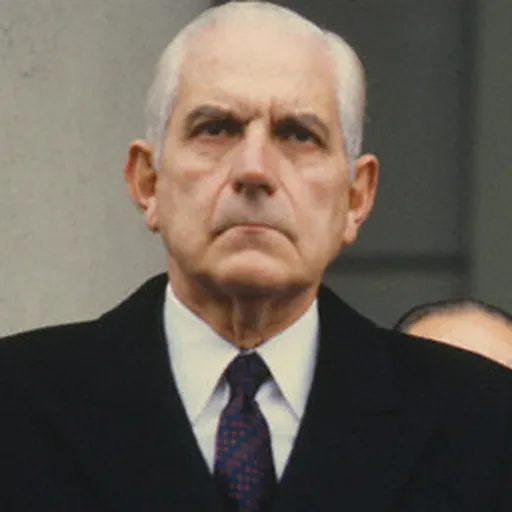
About Reynaldo Bignone
Lived 1928 – 2018 (aged 90). Reynaldo Bignone was an Argentine politician, military officer and military personnel.
Reynaldo Benito Antonio Bignone (21 January 1928 – 7 March 2018) was an Argentine general who served as the de facto President of Argentina from 1 July 1982 to 10 December 1983, the last president to serve under the National Reorganization Process. In 2010, he was sentenced to 25 years in prison for his role in the kidnapping, torture, and murder of persons suspected of opposing the government during the Dirty War, and would receive additional convictions and eventually a life sentence in the time afterwards as well.
Economic policy Bignone chose Domingo Cavallo to head the Argentine Central Bank and Jose Maria Dagnino Pastore a liberal as Economy Minister. While Pastore was a liberal, he wanted to move away from free market economic policies and wanted to adopt protectionist economic policies like it was at the time of Ramón Castillo, Arturo Rawson, Pedro Pablo Ramírez and Edelmiro Julián Farrell. Cavallo inherited a foreign debt installment guarantee program that shielded billions of private debt from the collapse of the peso, costing the treasury billions. He instituted controls over the facility, such as the indexation of payments, but this move and the rescission of Circular 1050 threw the banking sector against him; Cavallo and Dagnino Pastore were replaced in August.
Bignone's new president of the Central Bank, Julio González del Solar, undid many of these controls, transferring billions more in private foreign debt to the Central Bank, though he stopped short of reinstating the hated "1050."
Six years of intermittent wage freezes had left real wages close to 40% lower than during Perón's tenure, leading to growing labor unrest. Bignone's decision to restore limited rights of speech and assembly, including the right to strike, led to increased strike activity. Saúl Ubaldini, the new leader of the reinstated CGT, Argentina's largest labor union, was particularly active. Bignone's new Economy Minister, Jorge Wehbe, a banking executive with previous experience in the post, reluctantly granted two large, mandatory wage increases in late 1982. On September 13, 1982, Economy Minister Jorge Wehbe launched a "price controls" that "put the products of 675 companies under government control" due to "the need to "protect real wages," threatened by a "monopolistic industrial structure." Calls for immediate elections led, likewise, to frequent demonstrations at the President's executive offices, the Casa Rosada. One such protest, on 16 December, led to the death of a demonstrator.
Careful to avoid the appearance of endorsement of any one candidate (a mistake made by a previous dictator, General Pedro Aramburu, in 1958), Bignone oversaw the shredding of documents and other face-saving measures, such as generous new wage guidelines. The economy, which had contracted by around 12% in the eighteen months before he took office, managed a recovery of around 4% during Bignone's eighteen-month term. Following a brief, though intense campaign and tight polls, election night resulted in a 12-point margin for the UCR's Alfonsín over Justicialist nominee Ítalo Lúder. Tied to repressive measures he signed in 1975, he could not avoid suspicion of a gentleman's agreement with Bignone for the sake of preventing future investigations.
Bignone published a memoir about his brief tenure, El último de facto (2003). It was condemned for his marginalizing of Dirty War abuses. In January 1999, the courts reopened trials related to the taking of children from disappeared women and placing them in families with ties to the government. In 2003 people in Argentina were outraged by comments of Bignone and two other generals defending their actions during the Dirty War, expressed in the film documentary, Escadrons de la mort: l'ecole francaise (2003); this was directed by French journalist and filmmaker Marie-Monique Robin. President Nestor Kirchner "ordered the military to bring charges against the three for justifying the crimes of the dictatorship."
Convictions and imprisonment
Bignone was granted house arrest in October 2006, given his advanced age. He was arrested in March 2007 and taken into custody at a military base outside Buenos Aires as part of an investigation into past human rights abuses, including the atrocities at the Posadas Hospital and trafficking of infants born to and abducted from the roughly 500 pregnant women who were among the disappeared. These were ruled to have no statute of limitations owing their nature as crimes against humanity.
On 20 April 2010, Bignone was sentenced to 25 years in prison for his involvement in the kidnapping, torture and murder of 56 people, including guerrilla fighters, at the extermination center operating in the Campo de Mayo military complex. Following this sentence, Bignone was reported to have been jailed. On 14 April 2011, Bignone was sentenced to life in prison for crimes against humanity.
On 29 December 2011 Bignone received an additional 15-year prison sentence for crimes against humanity for setting up a secret torture center inside a hospital during the 1976 military coup. On 5 July 2012, Bignone was sentenced to 15 years in prison for his participation in a scheme to steal babies from parents detained by the military regime and place them with friends of the regime. According to the court decision, Bignone was an accomplice "in the crimes of theft, retention and hiding of minors, as well as replacing their identities." On 27 May 2016, Bignone was convicted for his role in Operation Condor, which included the murders of 105 people, among them 45 Uruguayans, 22 Chileans, 13 Paraguayans and 11 Bolivians living in exile. He was sentenced to 20 years in prison. Following this sentence, it was again reported that Bignone had been jailed. In 2017, Bigone's sentence was increased to life imprisonment, which he was still serving at the time of his death in March 2018.
Death
Bignone died of congestive heart failure in Buenos Aires on the morning of 7 March 2018 at the age of 90; he had recently been admitted to the military hospital with a hip fracture.
Don’t just read it —
keep it.
Full-length biographies made to live with: read them, listen on the way to work, watch them tonight.
- E-book
- Audio
- Video
Instant download · yours to keep · every purchase keeps this site free
Important facts
People in Reynaldo Bignone's life
Named in this biography and alive at the same time





Related people
Same field, nearest in time




Contemporaries
People whose lives overlapped Reynaldo Bignone's




Frequently asked questions
Who was Reynaldo Bignone?
president of Argentina
When was Reynaldo Bignone born?
Reynaldo Bignone was born on 21 January 1928 in Morón.
When did Reynaldo Bignone die?
Reynaldo Bignone died on 7 March 2018 in Buenos Aires Province.
What was Reynaldo Bignone's occupation?
Reynaldo Bignone was a politician, military officer and military personnel.
What nationality was Reynaldo Bignone?
Reynaldo Bignone was Argentine.
Sources & further reading
Cite this page
APA: Biography.guide. (2026). Reynaldo Bignone. https://biography.guide/reynaldo-bignone/
MLA: "Reynaldo Bignone." Biography.guide, https://biography.guide/reynaldo-bignone/.
Chicago: "Reynaldo Bignone." Biography.guide. https://biography.guide/reynaldo-bignone/.
Data last updated: 2026-09-22 · Spot an error? Report a correction.
Portrait: Wikimedia Commons · author & licence
Page generated 2026-09-27 05:04 UTC