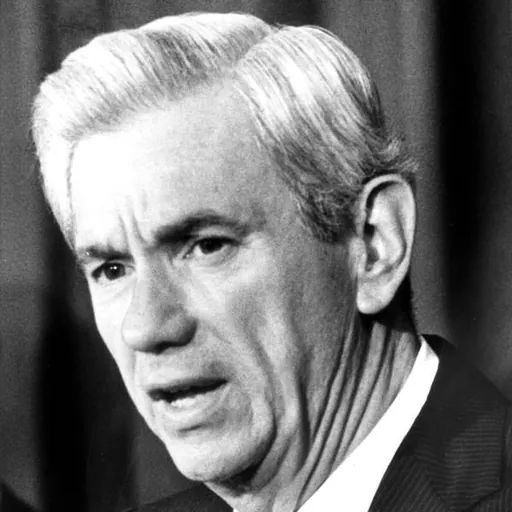
About Reubin Askew
Lived 1928 – 2014 (aged 85). Reubin Askew was an American politician, lawyer, governor and jurist.
Reubin O'Donovan Askew (September 11, 1928 – March 13, 2014) was an American politician, who served as the 37th governor of Florida from 1971 to 1979. A member of the Democratic Party, he served as the 7th U.S. trade representative from 1979 to 1980 under President Jimmy Carter. He led on tax reform, civil rights, and financial transparency for public officials, maintaining an outstanding reputation for personal integrity. Askew was the keynote speaker at the 1972 Democratic National Convention and declined an offer to serve as George McGovern's running mate in the 1972 presidential election.
Askew served as the United States trade representative from 1979 to 1981. He sought the Democratic nomination in the 1984 presidential election but withdrew early in the race. After leaving public office, Askew taught at the public universities of Florida.
Early life and education Askew was born in Muskogee, Oklahoma, the youngest of the six children of Leon G. Askew and Alberta (O'Donovan) Askew. His parents divorced when he was just two, primarily because of what Askew said was his father's "serious drinking problem."
In 1937, his mother moved with Reubin to Pensacola, Florida. Askew's middle name, O'Donovan, was his mother's maiden name. His signature used the double initial (O'D.) in her honor.
In 1944, Askew was initiated as a member of Escambia Chapter Order of DeMolay, the Masonic organization for young men. He graduated from Pensacola High School in 1946. Later that year, Askew entered the Army as a paratrooper, serving for two years in the 82nd Airborne; in 1948 he was discharged in the rank of sergeant.
Askew attended Florida State University, where he was a brother of Delta Tau Delta and Alpha Phi Omega. At Florida State, Askew was elected as student body president, beginning his long career in politics. He graduated from Florida State University in 1951 with a B.S. degree in public administration. He later completed law school at the University of Florida Levin College of Law.
Career During the Korean War, Askew served in the U.S. Air Force from 1951 to 1953, as a military intelligence officer. He oversaw the program for taking and analyzing airplane reconnaissance photographs of Western Europe. He felt uncomfortable with this task since he believed it violated existing treaties.
In 1955, Askew returned to Pensacola, where he formed a law firm with David Levin. The firm was called Levin & Askew, and now is named Levin Papantonio Law Firm.
Legislative career
In 1956, Askew was elected Assistant County Solicitor of Escambia County, Florida, as a Democrat. In 1958, he was elected to the Florida House of Representatives, representing Escambia County. After serving two terms in the House, in 1962 Askew was elected to the Florida Senate from the 2nd district, also representing Escambia He was reelected to a redistricted seat encompassing both Escambia and Santa Rosa counties in 1966, and again in 1967 and 1968 being unopposed in 1968.
From 1969 to 1970, he served as president pro tempore of the Senate. In 1971 he received the Legion of Honor from the International Supreme Council of the Order of DeMolay.
Askew emerged as a progressive lawmaker: he supported reapportionment in the state legislature in order to recognize changes in population distribution and increase representation for urban counties, which had a higher population than rural ones. The state houses had been apportioned by geographic county, resulting in inequities that did not represent current state conditions. Urban areas were underrepresented in the legislature. As was typical of many states, rural legislators had resisted reapportionment in order to retain power.
Askew opposed legal racial segregation and the continuing disenfranchisement of black voters. They had been disenfranchised since the turn of the century, when Florida had passed a new constitution with provisions for voter registration and elections that effectively blocked blacks from the polls. Passage of the Voting Rights Act of 1965 authorized the federal government to exercise oversight over jurisdictions in which classes of voters were historically underrepresented in voter rolls and voting patterns; African Americans were helped to re-enter the political system.
Governorship
Askew won the Democratic nomination for governor in 1970. Secretary of State of Florida Thomas Burton Adams, Jr., was his running-mate for lieutenant governor. In its endorsement of the Askew-Adams ticket, the Miami Herald reported that Askew had "captured the imagination of a state that plainly deserves new leadership." During the campaign, the incumbent Republican governor, Claude R. Kirk Jr., ridiculed his opponent Askew as "a momma's boy who wouldn't have the courage to stand up under the fire of the legislators" and a "nice sweet-looking fellow chosen by liberals...to front for them." Such rhetoric helped to reinvigorate the Democratic coalition. Mike Thompson, who managed the 1970 Republican gubernatorial primary campaign waged by state representative L. A. "Skip" Bafalis, sat out the general election between Kirk and Askew. Thompson later said that the often acerbic Kirk had demolished "the coalition of Republicans and conservative Democrats who elected him in 1966. ... The trail from Tallahassee to Palm Beach is littered with the bodies of former friends, supporters, and citizens -- all of whom made the fatal mistake of believing the words of Claude Kirk."
With 57% of the vote, Askew and Adams unseated Kirk and Lieutenant Governor Ray Osborne. From 1887 to 1969, the Florida Constitution did not provide for a lieutenant governor. The change allowed the top two positions to be filled by running mates from the same political party.
In 1974, Askew was re-elected, with J. H. Williams as his running mate. He is one of seven Florida governors to have been elected for two terms (the others were LeRoy Collins, Bob Graham, Lawton Chiles, Jeb Bush, Rick Scott, and Ron DeSantis). Askew was the first governor to serve two full four-year terms.
Through his two terms, Askew worked on tax reform. In 1971, he gained passage of the state's first corporate income tax. which Governor Askew signed despite personally believing that the death penalty was appropriate only in rare cases. Afterward the Supreme Court accepted new state death-penalty laws in Gregg v. Georgia. Immediately after the ruling, which effectively reinstated the use of the death penalty in the United States, Governor Askew began signing death warrants. Executions were not resumed until the administration of his successor, Bob Graham.
Based on issues related to the cases of two life-sentenced inmates, Wilbert Lee and Freddie Pitts, Askew ordered a new investigation, which found they had been wrongfully convicted of murder in 1963. Askew participated in part of the inquiry and in 1975 pardoned both inmates, who had been removed from death row after the Supreme Court's decision halting capital punishment.
Presidential politics Askew's national stature in the Democratic Party grew, and in 1972, he was the keynote speaker at the Democratic National Convention in Miami Beach. For the 1972 presidential election, he was offered the vice presidential slot on the Democratic ticket with presidential nominee George McGovern, but he turned it down. He later accepted an appointment under President Jimmy Carter as chairman of the Advisory Committee on Ambassadorial Appointments.
Trade representative
Limited to two terms as governor by the Florida Constitution, Askew looked for his next opportunity. In 1979, he accepted President Jimmy Carter's invitation to serve as United States Trade Representative, continuing until Carter's term ended in January 1981. Askew was the first trade representative who held the title United States Trade Representative, not Special Trade Representative, as his predecessors were called.
1984 presidential campaign
Askew joined a Miami law firm and at the same time began to organize a bid for the 1984 Democratic presidential nomination. He announced his candidacy on February 23, 1983, after making visits to all 50 states. The first serious presidential candidate from Florida, Askew never gained traction within the national Democratic Party. Although progressive on civil rights, he was generally more conservative than other candidates. Askew was against abortion, believing life began at conception, and favored a constitutional amendment to overturn Roe v. Wade. On other issues, he supported the ERA but was against gay rights, supported a nuclear freeze but opposed arms control, supported both gun control and the death penalty, and called for pulling American Marines out of Beirut but supported President Ronald Reagan's invasion of Grenada. Askew withdrew on March 1, 1984, after he finished last in the New Hampshire primary.
1988 U.S. Senate campaign
In 1987, Askew declared his candidacy for the U.S. Senate. But in May 1988, he withdrew from the contest, citing the need for perpetual fundraising. At the time of his withdrawal, he had lead in the polls. He endorsed Congressman Buddy McKay afterwards. Three days after dropping out, he resigned from his law firm, reportedly due to discontent from partners who had raised large amounts of money for Askew.
Post-political career After his governorship, Askew became a member of the Non-Group, an influential group of Miami-Dade business and civic leaders.
In 1994, Askew was named to the founding class of the Florida DeMolay Hall of Fame.
The Reubin O'D. Askew School of Public Administration and Policy at Florida State University was named for him. It offers courses in government at several Florida universities. From 1999 until his death, Askew gave a graduate seminar at the school, on topics of state and local government as well as international trade.
Death Askew died at a hospital in Tallahassee, Florida, on March 13, 2014, aged 85, from complications of pneumonia and a stroke.
Legacy and honors Askew was named one of the "Top 50 Floridians of the 20th Century" for his "Tax reform, racial justice and honesty in government." Interstate 110 in Pensacola is named the Reubin O'Donovan Askew Parkway. It is the only I-10 spur route in Florida. The main terminal at Pensacola International Airport is named the Reubin O'Donovan Askew Terminal. He was designated a Great Floridian by the Florida Department of State in 1998. The program recognizes the achievements of Floridians, living and deceased, who have made major contributions to the progress and welfare of the state.
Electoral history 2nd Florida Senate District election (Democratic primary), 1962
Reubin O'Donovan Askew – 14,454 (99.99%) Scattering – 1 (0.01%)
2nd Florida Senate District election, 1968
Reubin O'Donovan Askew – 49,404 (74.77%) Lou Smith – 16,670 (25.23%)
Democratic primary for governor, 1970 Earl Faircloth – 227,413 (29.96%) Reubin O'Donovan Askew – 206,333 (27.18%) John Mathews – 186,053 (24.51%) Chuck Hall – 139,384 (18.36%)
Democratic primary for Governor runoff Reubin O'Donovan Askew – 447,025 (57.68%) Earl Faircloth – 328,038 (42.32%)
1970 Florida gubernatorial election Reubin O'Donovan Askew/Thomas Burton Adams, Jr. (D) – 984,305 (56.88%) Claude Roy Kirk, Jr./Ray Osborne (R, ) – 746,243 (43.12%)
Democratic primary for governor, 1974 Reubin O'Donovan Askew (Inc.) – 579,137 (68.83%) Ben Hill Griffin, Jr. – 137,008 (16.28%) Thomas Burton Adams, Jr. – 85,557 (10.17%) Norman Bie – 39,758 (4.73%)
1974 Florida gubernatorial election Reubin O'Donovan Askew (Inc.)/J. H. Williams (D) – 1,118,954 (61.20%) Jerry Thomas/Mike Thompson – 709,438 (38.80%)
1984 United States presidential election (Democratic primaries) Walter Mondale – 6,952,912 (38.34%) Gary Hart – 6,504,842 (35.87%) Jesse Jackson – 3,282,431 (18.10%) John Glenn – 617,909 (3.41%) George McGovern – 334,801 (1.85%) Unpledged – 146,212 (0.81%) Lyndon LaRouche – 123,649 (0.68%) Reubin O'Donovan Askew – 52,759 (0.29%) Alan Cranston – 51,437 (0.28%) Ernest Hollings – 33,684 (0.19%) Ronald Reagan (write-in) – 10,096 (0.06%)
Don’t just read it —
keep it.
Full-length biographies made to live with: read them, listen on the way to work, watch them tonight.
- E-book
- Audio
- Video
Instant download · yours to keep · every purchase keeps this site free
Important facts
People in Reubin Askew's life
Named in this biography and alive at the same time
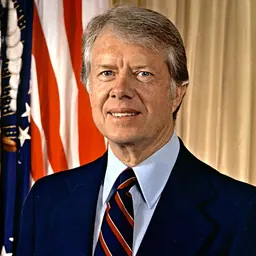







Related people
Same field, nearest in time




Contemporaries
People whose lives overlapped Reubin Askew's


Frequently asked questions
Who was Reubin Askew?
American politician (1928-2014)
When was Reubin Askew born?
Reubin Askew was born on 11 September 1928 in Muskogee.
When did Reubin Askew die?
Reubin Askew died on 13 March 2014 in Tallahassee.
What was Reubin Askew's occupation?
Reubin Askew was a politician, lawyer, governor and jurist.
What nationality was Reubin Askew?
Reubin Askew was American.
Sources & further reading
Cite this page
APA: Biography.guide. (2026). Reubin Askew. https://biography.guide/reubin-askew/
MLA: "Reubin Askew." Biography.guide, https://biography.guide/reubin-askew/.
Chicago: "Reubin Askew." Biography.guide. https://biography.guide/reubin-askew/.
Data last updated: 2026-09-23 · Spot an error? Report a correction.
Portrait: Wikimedia Commons · author & licence
Page generated 2026-09-27 05:04 UTC