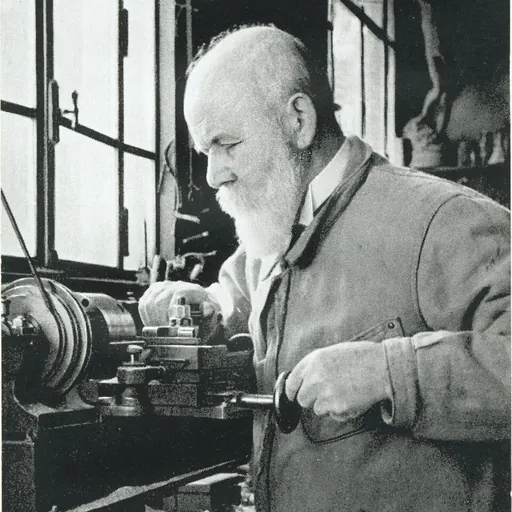
About René Thury
Lived 1860 – 1938 (aged 77). René Thury was a Swiss engineer and design engineer, known for High voltage direct current.
The Thury system The war of the currents was won by alternating current because transmission of power at high voltage could use transformers to easily convert between voltages. Marcel Deprez explored early transmission using direct current but avoided transformers by placing generators and loads in series Like Brush's dynamos, current is kept constant, and when increasing load demands more pressure, voltage is increased.
In 1889, the system was first put into service in Italy by the Acquedotto de Ferrari-Galliera company. Earlier the company had built a water supply for Genoa from the Gorzente River, and was interested whether turbines for electrical generation might address their long-standing problem of reducing excess pressure. The first turbine of was installed at Galvani station, which turned the two Thury 6-pole dynamos that each produced 1000 to 1100 volts at 45 amperes. In order to keep the same current, their speed varies from 20 to 475 rpm, regulated by changing the flow through the water turbine. The circuit supplied 15 motors along the line stretching to Genoa, including a motor at the railway station, and motor transformers at Central Electric Lighting Station in Genoa. Additional generation plants followed providing lighting as well as motive power to a number of mills, factories and railway repair shops.
An example of the mechanical voltage conversion employed was described for the lighting of Sampierdarena Train Station. The Thury system powered a motor which drove via belts twelve Siemens and two Technomasio dynamos for the station's lights. Genoa's Thury system was progressively upgraded to transmit 630 kW at 14 kV DC over a circuit distance of 120 km, using later dynamos capable of producing 2.5 megawatts (5000 volts at 500 amperes) using double commutators to reduce the voltage on each commutator.
Thury systems were installed over the next few years at several sites: 1889 first station at 6 kV supplying Genoa from Gorzente River hydro turbines. 1897 in La Chaux-de-Fonds (14 kV) 1899 between St-Maurice and Lausanne (22 kV, 3.7 megawatts) 1906 Lyon-Moutiers project (final capacity: 20 megawatts, 125 kV, 230 km) 1911 Metropolitan Electric Supply Company, London, 100-ampere 5,000-volt generators
The Moutiers-Lyon system transmitted 20 megawatts of hydroelectric power a distance of , including 6 miles (10 km) of underground cable. The system used eight series-connected generators with dual commutators for a total voltage of 150,000 volts between the poles. The system was steadily upgraded from 4.3 to 20 MW and ran from about 1906 until 1936.
Switzerland - Le Locle
Don’t just read it —
keep it.
Full-length biographies made to live with: read them, listen on the way to work, watch them tonight.
- E-book
- Audio
- Video
Instant download · yours to keep · every purchase keeps this site free
Important facts
People in René Thury's life
Named in this biography and alive at the same time
Related people
Same field, nearest in time

Contemporaries
People whose lives overlapped René Thury's



Frequently asked questions
Who was René Thury?
Electricity transmission pioneer (1860–1938)
When was René Thury born?
René Thury was born on 7 August 1860 in Plainpalais.
When did René Thury die?
René Thury died on 23 April 1938 in Geneva.
What was René Thury's occupation?
René Thury was an engineer and design engineer.
What was René Thury known for?
René Thury was known for High voltage direct current.
What nationality was René Thury?
René Thury was Swiss.
Sources & further reading
Cite this page
APA: Biography.guide. (2026). René Thury. https://biography.guide/rene-thury/
MLA: "René Thury." Biography.guide, https://biography.guide/rene-thury/.
Chicago: "René Thury." Biography.guide. https://biography.guide/rene-thury/.
Data last updated: 2026-09-22 · Spot an error? Report a correction.
Portrait: Wikimedia Commons · author & licence
Page generated 2026-09-27 05:01 UTC