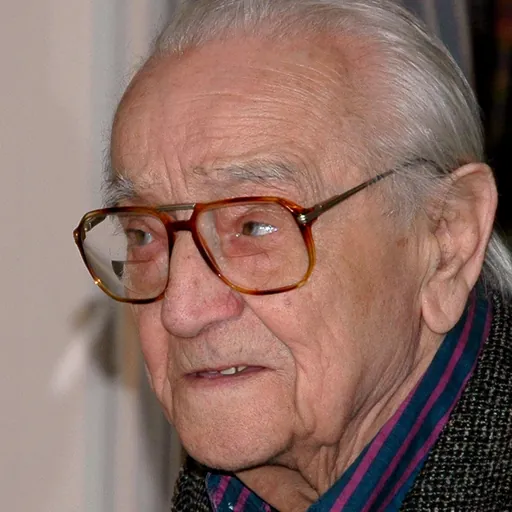
About René Roubíček
Lived 1922 – 2018 (aged 96). René Roubíček was a Czech pedagogue, sculptor, glass artist, designer, teacher and university teacher.
René Roubíček (23 January 1922 – 29 April 2018) was a Czech glass artist, designer, painter, musician and teacher. He was one of the leading figures of 20th century world art glass. As a teacher at the Vocational Glass School in Kamenický Šenov, an artist at the Vocational Glass School in Železný Brod and the head artist of the Borské sklo company, he was at the birth of Czech studio glass.
In the late 1960s he was an external professor at the Academy of Fine Arts in Prague. From 1969 he was a freelance artist and worked with Crystalex, Moser, Lasvit, Preciosa and a number of glassworks. Until the age of 96, he created free sculptures in blown and hand-formed solid, fused and plate glass.
Life 1922–1945 René Roubíček was born on 23 January 1922 in the family of a professional violinist, music teacher and amateur painter Antonín Roubíček. He had an older brother, Antonín, who was also musically gifted and later worked as a laboratory technician in the medical profession and photographer. His mother came from a carpenter's family and took care of the household throughout her life. The household was shared with the Roubíček family by his uncle Jan Tříska, who studied sculpture at the Academy of Fine Arts under Otakar Španiel.
René Roubíček had a visual memory and an ear for music. Together with his brother, he learned to play the piano and later mastered the clarinet, saxophone, guitar, harmonica, bagpipes and electric piano.
He attended the reform primary school where Miloslav Disman taught, and later studied at the Vyšehrad Real Gymnasium, where Jindřich Severa was in charge of art education. He drew since the second grade of primary school. At the age of ten, he exhibited and sold several of his drawings and was even offered a job as a graphic designer in a Prague company, where they had no idea that he was a young boy. At the age of 14, he exhibited his copy of Václav Brožík's painting Celebration at Rubens with 52 figures, Several newspaper articles have been published about his talent. He was also noticed by the then rector of the Academy of Fine Arts in Prague Max Švabinský who invited his parents and offered René to study at the Academy after finishing school.
Universities were closed during the war. Therefore, on the recommendation of Jindřich Severa, he began his studies at the Art and Crafts School (UMPRUM), which was then serving as the main art school. He was admitted to the studio of monumental painting and glass led by prof. Jaroslav Václav Holeček, who came to the Art and Crafts School after the occupation of the Sudetenland from the School of Glass in Nový Bor. In Holeček's studio, Věra Lišková, Stanislav Libenský, Josef Hospodka, Felix Průša, or Miluše Kytková were his classmates. During his studies, Roubíček dealt mainly with engraved, cut, etched and sandblasted glass. He finished his studies in 1944 and in 1945 became a member of the Revolutionary Guard and of the Union of Czech Youth.
1945–1958 After the war, together with Stanislav Libenský and Josef Michal Hospodka, he went to northern Bohemia to substitute the displaced German glassmakers in the glass schools in Nový Bor and Kamenický Šenov and to maintain teaching. They were inspired by the visual style represented by the Družstevní práce publishing house at the time, especially functionalism, by arch. Otto Rothmayer, Josef Sudek or Ladislav Sutnar, and very quickly adopted a modern view of glass. René Roubíček headed the department of engraved and cut glass, but he was the first to deal with the artistic qualities of hot hand-formed glass. He was an inspiring teacher and a capable organizer, and therefore, less than a year after the resumption of teaching, students were able to present their results at an exhibition on the 90th anniversary of the school. Subsequently, they transferred the exhibition to the Družstevní práce shop in Prague and founded the Alumni Production Cooperative, but after the communist takeover in 1948 they were forced to enlist in the army and later it was no longer possible to restore the cooperative. Small-scale production was forcibly suppressed at that time in favour of large national enterprises and heavy industry.
In 1949–1950, René Roubíček completed his studies at the Academy of Arts and Crafts in Prague in the glass studio of Prof. Josef Kaplický with a final thesis and a state examination. Until 1952 he continued as a teacher and artist of the Design centre of cut glass at the Glass School in Kamenický Šenov. The school was closed down in 1952 by decision of the communist authorities. René Roubíček has moved to "Umělecké sklo" (Art Glass) national enterprise in Nový Bor, where he was the chief artist until 1965 and designed applied and decorative glassware for mass production. He is the author of the statement "Glass is the art of today". During the preparation of the World Exhibition Expo 58, glass artists were for the first time given the opportunity of completely free creation.
1958–1970 René Roubíček also worked at the Design centre of the glass school in Železný Brod and collaborated externally with the Central Art Centre for the Glass and Fine Ceramics Industry and later with the Institute of Housing and Clothing Culture (ÚBOK) in Prague. In 1958 he was a founding member of the creative group Bilance, whose theoretician was Karel Hetteš. Since 1961 he was a member of Umělecká beseda.
In 1966, he left his position at Borské sklo when the company was unable to ensure the production of modern designs created in the studios. After the Soviet occupation in 1968 and the return of the rigid communist regime, he resigned from the Communist Party of Czechoslovakia and decided to become a freelance artist in 1969. In the 1970s he was placed on the unofficial list of politically undesirable artists and lost the possibility to exhibit independently in Czechoslovakia. with glassmaker Josef Rozinek and the Crystalex glassworks in Nový Bor (formerly Borské sklo), then with Petr Novotný (Crystalex, Ajeto in Lindava), Moser in Karlovy Vary and with the Swiss glassworks Glasi Hergiswil. and metal sculptures in collaboration with Ivo Šimánek. In addition to IGS Nový Bor, where he has participated eleven times since 1982, René Roubíček has participated in the International Symposium of Engraved Glass in Kamenický Šenov and glass symposia in Frauenau (1982), Lucerne (1983, 1984), Immenhausen (1985) and Glavunion in Teplice (1995). In 1994 he lectured at the Pilchuck Glass Summer School in Seattle (USA), in 1998 he made a lecture tour of Japan, and in 2006 he participated in the Visiting Artist Program at the Museum of Glass in Tacoma, Washington.
While studying at the School of Arts and Crafts, René Roubíček met Miluše Kytková, who originally wanted to study at the Faculty of Arts (closed during the war) and married her in 1948. Miluše Roubíčková was also an important glass artist. In 1966, René Roubíček became a guardian of the designer Bořek Šípek, who was orphaned at the age of 16. Šípek lived with his sister until 1968 and emigrated to Germany after the Warsaw Pact invasion of Czechoslovakia.
René Roubíček lived and worked alternately in Kamenický Šenov and Prague. In Kamenický Šenov, the Roubíček couple bought a house with a garden where they installed their works. In 1995, René Roubíček had a glass gallery built here according to his own design. A company that included teachers and theoreticians of glass art as well as glass artists, painters and sculptors used to meet at their house.
Roubíček died on 29 April 2018 in Prague, at the age of 96. 1985 Ehrenpreis, Zweiter Coburger Glaspreis, Coburg 1997 Prize of the Masaryk Academy of Arts 2014 Special Jury Prize, Coburger Glaspreis, Coburg 2015 Award of the Governor of the Liberec Region 2015 Hall of Fame, International Glass Symposium Nový Bor 2016 Silver Medal of the President of the Senate of the Czech Republic Listed in:
Work 1945–1969 Soon after World War II, René Roubíček began to work with relief cutting of glass, which he conceived in a sculptural manner, removing the mass from a block of glass. He retained the carving's rawness and sculptural bulk. After the cut, strikingly sculptural vessels of asymmetrical shapes from the late 1940s, in which he artistically refined the modern spatial concept of the cutting on a simple shape (Antonín Dvořák (1946) - UPM, vase with a view of the Charles Bridge (1946) - Kamenický Šenov Glass Museum, Vase Prague (1946), a gift from the school to President Edvard Beneš ) and experiments with optical glass, he later devoted himself to free-formed glass made at the glass furnace. His collaboration with the Nový Bor glassworks and with the glass masters Josef Rozinek (later Petr Novotný and Jiří Pačinek, Ajeto glassworks) led René Roubíček to switch from cold glass techniques to blown glass and glass sculptures made by shaping hot coloured glass. Miroslav Klivar describes Roubíček's sculptures as mythical surrealism and sees in them primordial images of psychic-lyrical-poetic visions of natural objects or transparent, mysterious forms of exuberance. In his work, he consistently drew on the properties of glass and modified and refined his original idea while working in the glassworks to achieve the intended effect.
René Roubíček first gained fame for his installation of metal structure, holding blocks of coloured hand-formed cast, engraved and painted glass (Glass - Matter - Shape - Expression) for Expo 58 in Brussels. He dramatically changed the perception of contemporary glass by this object, showed its artistic possibilities and was awarded the Grand Prix. The metal core was made by Jan Žaloudek, a blacksmith from Nový Bor, who later collaborated also in the production of large chandeliers. In 1959 Roubíček made an expanded composition in Prague and called it Glass – the Art of Today. He subsequently exhibited similar bold works in Moscow, Mumbai, Dili and São Paulo. His sculptures from the late 1950s and early 1960s showed the possibilities of using glass in architecture and aroused the interest of architects. Together with Stanislav Libenský and Jan Kotík, he was most credited for overcoming the notion of the servility of glass and of the imaginary border between applied and free art.
In addition to chamber sculptures (Objects, 1964) for the Czech glass exhibition at the Internationale Handwerksmesse in Munich (1964), he was able to create monumental sculptures modelled from flowing glass, hot-wound on a steel rod, cut and shaped with hand tools. In working with glass, he thus approached tachism and gestural painting. Water was an important part of his installation, echoing Roubíček's definition of glass from his students' first exhibition in 1945 as "'halted water'." He thus created, for example, glass columns with a fountain for the São Paulo Art Biennial (1966),
As an artist of the "Borské sklo" company, René Roubíček also designed some stained glass windows in the 1960s (Wall for the ceremonial hall in Ostrava, 1966, produced by the "Vitráže" factory, Nový Bor).
From the end of the 1960s he collaborated with architects and designed large glass chandeliers, in which the overhead light is reflected and mirrored in drops, grapes and lines of glass, for Czech embassies in Sofia (1969), London (arch. J. Šrámek), Washington, D.C. and Brasília. For other buildings abroad, he designed chandeliers with geometric outlines (Riegelsberg Town Hall (arch. B. Focht), Turnhout Water Castle (arch. E van Loven) or adapted lighting to the shape of the given space (staircase chandelier passing through six floors, Maison de la Saar, Paris, Rosengarten Congress Centre in Coburg, etc. His composition Cloud was judged by the communist regime (also in the context of other works by Stanislav Libenský, Jaroslava Brychtová, Vladimír Janoušek or Čestmír Kafka, who somehow reacted to the Warsaw Pact invasion of Czechoslovakia with the common theme "The Fate of Small Nations") as ideologically subversive (the sculpture was spontaneously renamed The Cloud of Bolshevism Descending Over Europe) and his domestic commissions were cancelled for several years. (for 500th Anniversary of his birth, spatial object made of hand-shaped crystal rods on a metal structure, 500 x 400 cm, UPM 1973) he originally created for Poland, but after 1970, as a banned author, he was no longer allowed to export the object The artist reconstructed the object after 1990 and it is now part of the collection of modern art of the National Gallery in Prague.
René Roubíček did not design only chandeliers, but the opportunity to create works other than lighting fixtures out of glass was given to him especially by foreign architects.
Roubíček's free works were created in close collaboration with renowned glass masters directly at the glass furnace. Josef Rozinek in particular was an ideal collaborator, whose craftsmanship directly influenced the realisation of Roubíček's artistic designs. From the 1970s and 1980s comes a large set of stylized blown Heads or Bysts for the European Glass Exhibition in Coburg (1977), considered one of the highlights of Roubíček's work, Fingers for the national glass show in Prague (1984) Roubíček's Clarinettes and other musical instruments are close to works of "new materiality" and pop art. At the turn of the century he returned to engraving and cutting, and to working with flat glass and fused blocks (the series of perforated glass objects Tavenice, after 2000). Between 1995 and 2003 he created a series of about 30 reliefs made of cut glass prisms or fused elements glued to a glass panel (The Picture Gallery), which dissolve light and, when viewed from the back, appear as a painting on glass.
His free cycle Cylinders-Non-Cylinders includes a series of incised and cut cylindrical objects, varied in colour and unexpected shape. His chamber works consist of colorful and irregular bowls made of molten glass, which were created spontaneously and with the participation of the audience directly in the glassworks, or glass objects fused into a mould (Tie, 2008–2010). He is the author of the original Pavel Koutecký glass award for documentary film (since 2007). For his ninetieth birthday, he donated himself a set of glass cups A je dopito (Finished up) (2011). exhibited at the Biennale and then at the request of Meda Mládková at the Kampa Museum. In 2005, he created a glass fountain for the Marriott Hotel in Prague (removed in 2011) and in 2006 a 12-metre glass wall for the Sheraton Hotel in Shanghai. During the celebration of Czech glass and the exhibition Back to the Future the concept for a new glass object, EXPO Squared, was created in collaboration with Preciosa. It was exhibited at Design Days in Dubai and at Expo 2015 in Milan and an almost similar replica was acquired by the Museum of Glass and Costume Jewellery in Jablonec nad Nisou. All the objects were exhibited at the 2007 Frankfurt Fair in the Moser company stand and found buyers. For the company's next anniversary in 2016, he created a new version of his 1957 Jubilee cup. In 2005, he created an original replica of his object from the Expo 58 for the exhibition of the Modern Art collection of the National Gallery in Prague in the Trade Fair Palace. For the celebration of the 160th anniversary of the Glass School in Kamenický Šenov in 2016, he joined in with glass light objects-columns, for which he used common products of the Elas Palme glassworks blown into wooden moulds.
Representation in collections Kunstsammlungen der Veste Coburg Musée des Arts Décoratifs, Paris The Corning Museum of Glass, New York Museum of Glass, Tacoma, Washington The Saxe Collection, San Francisco Koganezaki Glass Museum, Japan Yokohama Museum of Art Stedelijk Museum, Amsterdam Museum Bellerive, Zurich Victoria and Albert Museum, London Ulster Museum, Belfast Pinakotek der Moderne, Munich Akademie der Künste, Berlin Das Europäische Museum für Modernes Glas, Schlosspark, Rosenau Glasmuseum Hentrich, Düsseldorf Glasmuseum Ebeltoft Museum für Kunsthandwerk, Frankfurt am Main Glassworks Museum, Frauenau Badisches landesmuseum, Karlsruhe Musée Cantonal des Beaux-Arts, Lausanne National Gallery in Prague Moravian Gallery in Brno Museum of Decorative Arts, Prague National Museum in Wrocław Museum of Glass and Jewellery in Jablonec nad Nisou North Bohemian Museum p.o., Liberec East Bohemian Museum, Pardubice Homeland History Museum in Olomouc Listed in
Exhibitions Author´s (selection) 1961 Miluše and René Roubíček: Glass, Gallery of Youth, Aleš Hall of the Umělecká beseda, Prague 1967 Miluše and René Roubíček: Glass, Cabinet of Applied Arts, Brno 2000/2001 René Roubíček: Liberated Glass, Koganezaki Glass Museum, Japan 2003 "Masters of European Glassmaking": Miluše and René Roubíček, Museum of Decorative Arts in Prague 2012 René Roubíček: Chandeliers, Glass Museum, Kamenický Šenov 2012/2013 René Roubíček: Glass and Why Not I.!, Museum Kampa - Jan and Meda Mládek Foundation, Prague 2015 Miluše and René Roubíček: Glass, Špilberk Castle, Brno 2022 Miluše & René Roubíčkovi: 100, Museum of Glass and Jewellery in Jablonec nad Nisou 2022 René Roubíček: The Founding Father of Modern Glass, Zdeněk Sklenář Gallery, Prague
Collective (selection) 1952 Art Glass, Museum of Decorative Arts, Prague, Museum of Decorative Arts, Brno 1957 Vetro di Boemia, La Triennale di Milano, Milano 1958 Expo 58, Brussels 1959 Czechoslovak Glass, Moscow Manege 1959 Glass '59, The Corning Museum of Glass, Corning 1960 Czechoslovak Modern Glass, Czechoslovak Cultural Centre, Cairo 1963 Modern Glass in Czechoslovakia, Silesian Museum, Wrocław 1964 Tschechoslowakisches Glas, Grassi - Museum für Angewandte Kunst, Leipzig 1965 Bohemian Glass, Victoria and Albert Museum, London 1965 Tsjekkoslovakisk glass, keramik og tekstiler, Kunstindustrimuseet - The Museum of Decorative Arts and Design, Oslo 1965 Tšekkoslovakian taideteollisuutta / Tjeckoslovakisk konstindustri, Helsingin Taidehalli / Helsingfors Konsthall, Helsinki 1965 La transfiguration de l´art tchèque: Peinture - sculpture - verre - collages, Palais de Congrès de Liège 1966 2e Salon international de Galeries pilotes Lausanne, Palais de Rumine, Lausanne 1966 Tschechoslowakische Kunst der Gegenwart, Akademie der Künste, Berlin 1966 Arte actual Checoslovaco, Museo de Arte Moderno, Ciudad de México 1966 Current Tendencies in Czechoslovak Applied Art and Industrial Art, Municipal House, Prague 1967 Tjeckoslovakisk nutidskonst, Göteborg, Lund, Örebro, Varnamo, Norrköping, Nyköping, Hälsingborg, Stockholm 1967 Expo 67, Montreal 1967 Exhibition of sculptures and glass, Gallery of the Union of Sculptors, Warsaw 1969 50 years of Czech applied art and industrial design, Mánes, Prague, 50 Jahre der Tschechischen angewandten Kunst und industrial design, MAK - Österreichisches Museum für angewandte Kunst / Gegenwartskunst, Wien 1969 L´art tchèque actuel, Renault Champs - Élysées, Paris 1969 Sculpture and the city, Liberec 1970 Expo 70 - Czechoslovakia Pavilion, Osaka 1970 Contemporary Czech Glass, Mánes, Prague 1970 Intents and Wages: 50 Years of Czech Applied Art and Industrial Plastic Art, Silesian Museum, Wrocław 1971 45 zeitgenössische Künstler aus der Tschechoslowakei. Malerei, Plastik, Grafik, Glasobjekte, Baukunst, Köln 1972/1973 Angewandte Kunst aus der ČSSR, Kunsthalle Weimar, Kunsthalle Rostock, Neue Galerie, Berlin 1973 Metamorphosis of Glass, Moravian Gallery in Brno 1974 Hedendaagse ambachtskunst uit Tsjechoslowakije, Bruges 1975 Dix siècles d'art tchèque et slovak, Grand Palais - Galeries nationales, Paris 1977 Arte Checoslovaco - Vidrio, cerámica, joyas y tapices, Sala Cairasco, Las Palmas, Canary Island 1978 Checoslovaquia en las artes del vidrio, la porcelana y la pintura naif, Galerie Arteta, Bilbao 1980 Die Kunst Osteuropas im 20. Jahrhundert, Garmisch-Partenkirchen 1981 Czechoslovakian Glass 1350–1980, The Corning Museum of Glass 1981 Art in Glass, Glass in Art, Fendrick Gallery, Washington D.C. 1981 Glaskunst 81, Orangerie, Kassel 1983 Space 2, Trade Palace, Prague 1983 Czechoslovak Glass: Seven Masters (Brychtová, Cígler, Harcuba, Kopecký, Libenský, Lišková, Roubíček), American Craft Museum New York (curator Meda Mládková) 1984 Czechoslovak Glass '84: Art Glass Creation, Valdštejn Riding Hall, Prague 1985 One Hundred Years of Czech Applied Art: Czech Applied Art 1885-1985 from the Collections of the Museum of Decorative Arts in Prague on the 100th Anniversary of the Museum's Founding, Museum of Decorative Arts, Prague 1985 Zweiter Coburger Glaspreis für moderne Glasgestaltung in Europa, Kunstsammlungen der Veste Coburg, Coburg 1986 Contemporary Czechoslovak Glass in Architecture, University of London, Institute of Education, London, Glynn Vivian Art Gallery, Swansea (Wales), The Billingham Art Gallery, Billingham (Stockton-on-Tees) 1986/1987 Expressions en verre, Musée des Arts décoratifs, Lausanne 1987 Vidre d´art, Hivernacle Barcelona, Barcelona 1989/1990 Verres de Bohême: 1400-1989 chefs-d'œuvre des musées de Tchécoslovaquie, Musée des Arts décoratifs, Paris 1989/1990 Reflex der Jahrhunderte, Grassi - Museum für Angewandte Kunst, Leipzig 1990 Glastec 90, Messe Halle 6, Düsseldorf 1990 Neues Glas in Europa: 50 Künstler - 50 konzepte / New Glass in Europe: 50 Artist - 50 Concepts, Museum Kunstpalast, Düsseldorf 1991 Prague Glass Prize 91, Mánes, Prague 1992 Czech and Slovak Art of the 20th Century, National Museum in Wrocław 1992/1993 La magie du verre: Quinze artistes verriers tchèques, Galerie d'art Annie Chevalley, Montreux (Vevey) 1992/1993 Festival of Czech and Japanese Glass 1992 - 1993, Azabu Museum of Decorative Arts, Tokyo, Village of Glass, Hiroshima, Machida City Museum of Graphic Art Machida, Tokyo, Bohemia Glass Museum Karuizawa, Nagano 1992/1993 Art Discussion 1992, Mánes, Prague 1993 Bohemia. Cristal, Real Fábrica de Cristales, Segovia 1996, 1997, 1998, 2000 Umělecká beseda, Mánes, Prague 1998/1999 Life in the Rhythm of the Atom (Exhibition for the 40th anniversary of Czechoslovak participation in the World Exhibition EXPO 58 in Brussels), Trade Fair Palace, Prague 1999 Glass, The Studio Glass Gallery, London, Broadfield House Glass Museum, Kingswinford, Koganezaki Crystal Park Glass Museum, Shizuoka 2000/2001 Light Transfigured - Contemporary Czech Glass Sculpture, Toyama Shimin Plaza, Toyama, Hiroshima City Museum of Contemporary Art, Kanazu Forest of Creation, Fukui, Odakyu Museum, Tokyo 2002 Glass Behind the Iron Curtain: Czech Design, 1948–1978, The Corning Museum of Glass 2009 Kunst zur Zeit de kalten Krieges, Barockschloss Riegersburg 2009 Connections 2009, Contemporary European Glass Sculpture, Mánes, Prague 2010 New Sensitivity, National Art Museum of China (NAMOC), Beijing 2010 GLASS.KLASIK, Queen Anne's Summer Palace (Belveder), Prague 2011 A Homage to Glass, North Bohemian Museum p.o., Liberec 2012 Generations in Glass (R. Roubíček and B. Šípek), New Town Hall, Prague 2012/2013 All the best! Czech Glass Art, Museum of Decorative Arts, Prague 2013 In Art Freedom, Clam-Gallas Palace, Prague 2015 Design Days Dubai, Expo Milan (Expo squared) 2015/2016 Building the State. Representation of Czechoslovakia in art, architecture and design, Veletržní palác, Prague 2016 Concerto Glassico, Tuscany Palace, Prague 2016 7+1 Masters of Czech Glass, Museum Kampa – Jan and Meda Mládek Foundation, Prague 2017 The Automatic Exhibition: the Czechoslovak Pavilion at Expo 67 in Montreal, Retromuseum, Cheb 2017 No Limits: Contemporary Art Glass from the Czech Republic (International Triennial of Glass and Costume Jewellery 2017), St. Anne's Church, Jablonec nad Nisou 2018 Avant Garde: The Great Game of the Future, Trade Fair Pavilion G, Brno 2018/2019 Two in One: Czech and Slovak Glass Design 1918–2018, Museum of Glass and Costume Jewellery in Jablonec nad Nisou
Don’t just read it —
keep it.
Full-length biographies made to live with: read them, listen on the way to work, watch them tonight.
- E-book
- Audio
- Video
Instant download · yours to keep · every purchase keeps this site free
Important facts
People in René Roubíček's life
Named in this biography and alive at the same time



Related people
Same field, nearest in time


Contemporaries
People whose lives overlapped René Roubíček's
Frequently asked questions
Who was René Roubíček?
Czech designer, glassmaker and university educator (1922-2018)
When was René Roubíček born?
René Roubíček was born on 23 January 1922 in Prague.
When did René Roubíček die?
René Roubíček died on 29 April 2018 in Prague.
What was René Roubíček's occupation?
René Roubíček was a pedagogue, sculptor, glass artist, designer, teacher and university teacher.
What nationality was René Roubíček?
René Roubíček was Czech.
Sources & further reading
Cite this page
APA: Biography.guide. (2026). René Roubíček. https://biography.guide/rene-roubicek/
MLA: "René Roubíček." Biography.guide, https://biography.guide/rene-roubicek/.
Chicago: "René Roubíček." Biography.guide. https://biography.guide/rene-roubicek/.
Data last updated: 2026-09-23 · Spot an error? Report a correction.
Portrait: Wikimedia Commons · author & licence
Page generated 2026-09-27 05:05 UTC