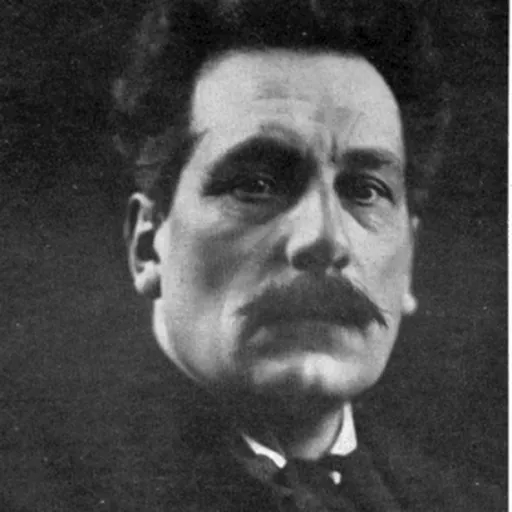
About René Ghil
Lived 1862 – 1925 (aged 62). René Ghil was a French poet.
René François Ghilbert (27 September 1862 – 15 September 1925), known as René Ghil, was a French poet. He was a disciple of Stéphane Mallarmé, a major contributor to the symbolist movement in France, although they later had a falling out over ideological differences. Ghil published a series a short stories which together were called the Traité du Verbe. He worked extensively on a new system of poetic language in reaction to the Decadent Movement and Symbolism. Owing to his widespread use of personal syntax and neological vocabulary, much of Ghil's work was inaccessible, and his own contemporaries labelled it confusing. However, his works gained wider attention after his death.
Early life and education René François Ghilbert was born on 27 September 1862 in Tourcoing. He went to Paris in 1870 to study at Lycée Fontanes, where his classmates included Rodolphe Darzens, Pierre Quillard, Stuart Merrill, André-Ferdinand Hérold, André Fontainas, and Éphraïm Mikhaël. This group of friends subsequently became known as the "Fontanes group".
Literary career
Ghil was a disciple of Stéphane Mallarmé, a major French symbolist poet. Ghil published his first book in 1885. In the same year, he published a series of short stories, which were together called, the Traité du Verbe. His works also included extensive metaphysical references especially to matter, the history of the universe, and human development. According to Joseph Acquisto of the University of Pennsylvania, Ghil worked towards developing an ideal poetic language that would "subsume and supersede all the other arts", by establishing his own system of verbal instrumentation. Ghil's theory was intended to support scientific poetry, which included inert matter, atomic-level concepts, human knowledge, and ways of attaining wisdom. This system established relations among vowels, consonants, colours, music (orchestra), and emotions, which he expanded in a style through versions of the Traité du Verbe. Though it is not clear which or how these scientific principles were applied, Ghil always claimed these observations were based on scientific facts.
Though he initially admired Mallarmé's works, Ghil later became a critic because of their ideological differences. Owing to widespread use of personal syntax and neological vocabulary, much of Ghil's work was inaccessible. Much of Ghil's work was widely criticised and ignored while he was alive. However, it gained attention after this death. According to French literary critics Jean-Pierre Bobillot and Jean-Nicolas Illouz, Ghil's work is highly accomplished, uncompromising, of singular thought, and mature, and deserves to be read today for its insights on poetry, knowledge and the public thing.
Works
Contemporary editions by the author Légende d'âmes et de sangs, Paris, L. Frinzine, 1885 Traité du verbe, avec " Avant-dire " de Stéphane Mallarmé, Paris, Giraud, 1886 Légendes de rêve et de sang, Livre II : Le Geste ingénu, Paris, L. Vanier, 1887 Le Pantoun des pantoun, poème javanais, Paris et Batavia, 1902. Reproduit à l'identique et commenté dans Échelle et papillons – Le Pantoum de Jacques Jouet, Les Belles Lettres, 1998 . Texte sur Gallica De la poésie scientifique, Paris, Gastein-Serge, 1909 La tradition de poésie scientifique, Paris, Société littéraire de France, 1920 Les dates et les œuvres : symbolisme et poésie scientifique, Paris, G. Crès, 1922
Collection Œuvre, Paris, Mercure de France – E. Figuière, 1889–1926, 9 tomes en 14 volumes, comprenant : I. Dire du mieux; I. Le meilleur devenir; II. Le geste ingénu; III. La preuve égoïste; IV. Le vœu de vivre; V. L'ordre altruiste; II. Dire des sangs; I. Le pas humain; II. Le toit des hommes; III. Les images du monde; IV. Les images de l'homme.
Reissues Légende d'Âmes et de Sangs, Plein Chant, 1995. Le Vœu de Vivre & autres poèmes choisis par Jean-Pierre Bobillot, avec CD (lecture par R. Ghil en 1913), Presses universitaires de Rennes, 2004 . De la Poésie scientifique & autres écrits, textes choisis, présentés par Jean-Pierre Bobillot, Ellug, 2008 . Chant dans l'espace & Poèmes séparés, La Termitière, 2012 . Les Dates et les Œuvres. Symbolisme et Poésie scientifique, texte établi, présenté et annoté par Jean-Pierre Bobillot, Ellug, 2012.
Don’t just read it —
keep it.
Full-length biographies made to live with: read them, listen on the way to work, watch them tonight.
- E-book
- Audio
- Video
Instant download · yours to keep · every purchase keeps this site free
Important facts
People in René Ghil's life
Named in this biography and alive at the same time
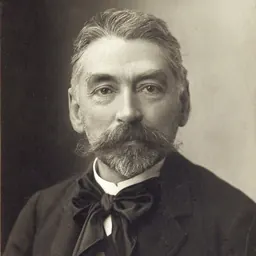
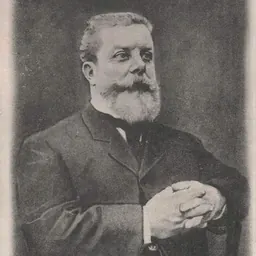


Related people
Same field, nearest in time
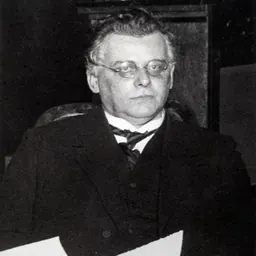
Contemporaries
People whose lives overlapped René Ghil's




Frequently asked questions
Who was René Ghil?
French poet (1862–1925)
When was René Ghil born?
René Ghil was born on 27 September 1862 in Tourcoing.
When did René Ghil die?
René Ghil died on 15 September 1925 in Niort.
What was René Ghil's occupation?
René Ghil was a poet.
What nationality was René Ghil?
René Ghil was French.
Sources & further reading
Cite this page
APA: Biography.guide. (2026). René Ghil. https://biography.guide/rene-ghil/
MLA: "René Ghil." Biography.guide, https://biography.guide/rene-ghil/.
Chicago: "René Ghil." Biography.guide. https://biography.guide/rene-ghil/.
Data last updated: 2026-09-22 · Spot an error? Report a correction.
Portrait: Wikimedia Commons · author & licence
Page generated 2026-09-27 05:04 UTC