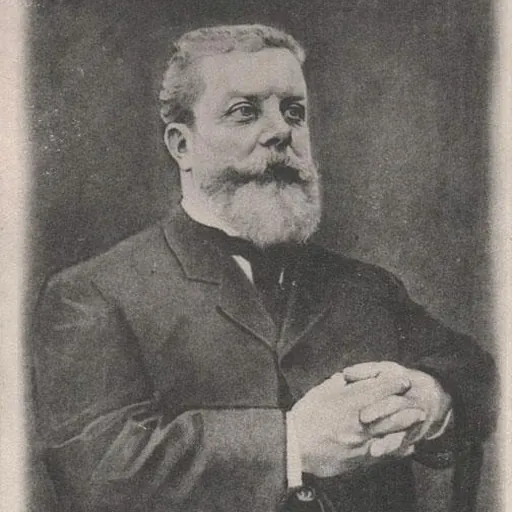
Pierre Quillard
French poet, playwright, translator and journalist
About Pierre Quillard
Lived 1864 – 1912 (aged 47). Pierre Quillard was a French linguist, poet, journalist, translator, playwright and writer.
Pierre Quillard (14 July 18644 February 1912) was a French symbolist poet, playwright, literary critic, philosopher, Hellenist translator, and journalist. As a thinker and anarchist activist, he stood as one of the early proponents of the Armenophile movement in France, notably through his bimonthly publication, Pro Armenia. Later on, he fervently joined the defense of Dreyfus and is regarded as one of the most accomplished intellectuals among the Dreyfusards, testifying on behalf of Émile Zola during his trial.
Within the scope of his aesthetic and political reflections, he advocated for using literature as a revolutionary weapon and sought to delineate a "poetics of the terror attack."
Playing a coordinating role between French anarchists and the Armenian Revolutionary Federation (ARF), Pierre Quillard also served as a witness and compiler of historical sources regarding the Hamidian massacres, a series of atrocities carried out by the Ottoman Empire under Abdul Hamid II. A founding member of the League of Human Rights, he played a central role during its initial period and became its secretary-general in 1911, shortly before his death. He also defended other persecuted groups, such as the colonized inhabitants of the Congo and the Jews of Eastern Europe.
Despite being a significant figure of his generation, he gradually faded into obscurity.
Biography
Poet and playwright Pierre Quillard drawn by Remy de Gourmont in 1896.Pierre Quillard pursued his education at Lycée Condorcet, where his classmates included Éphraïm Mickaël, Stuart Merrill, René Ghil, André Fontainas, Rodolphe Darzens, Georges Vanor, and Jean Ajalbert. He contributed his initial poems to the journal Le Fou and incurred the displeasure of the headmaster for publishing a sonnet that began with the alexandrine, "Un lendemain de fête on a mal aux cheveux" ("The day after a celebration, one has a headache").
Continuing his studies at the Sorbonne, followed by the École pratique des hautes études and the École nationale des chartes, which Quillard joined in 1888 without, however, completing a thesis.
In 1886, he co-founded the magazine La Pléiade with Rodolphe Darzens, Saint-Pol-Roux, and Éphraïm Mikhaël. His first play, "La Fille aux mains coupées" (The Girl with Cut Hands), was published in the same journal alongside René Ghil's "Traité du verbe." His initial collection of poems, "La Gloire du Verbe" (The Glory of the Verb), released in 1890, received praise from Remy de Gourmont as "one of the rare poems of this time where the idea and the word march in harmonious rhythm." Described by a contemporary as a knight with a "clear eye, flavescent beard, raising his head high, the helmet of hair pushed back, revealing a forehead reminiscent of a primitive Flemish painting, with a special feature of a vaguely sarcastic immobility of the upper lip."
Beginning in 1891, he collaborated with the Mercure de France, a relationship that endured until his death. Quillard showed interest in the theater of his time, offering reflections on the subject, particularly in an article titled "De l’inutilité absolue de la mise en scène exacte" ("On the Absolute Uselessness of Exact Staging"), where he proposed "the refusal of restrictive scenic visibility," a technique previously employed in "La Fille aux mains coupées." He was actually part of a group of friends in the literary circles of Paris; he associated with Mallarmé, who was his friend and to whom he wrote, as well as other writers and thinkers of the time. In that context, he was one of the thinkers of Symbolist aesthetics and made innovations in certain literary domains, such as his push towards the exploration of aesthetics and the absolute beauty within Symbolism, a movement he shared with Mallarmé. "[Pierre Quillard, even if he was], a man of the left [...] believed that I had failed the ideal of 'art for art's sake' by celebrating human hope. It was the first crack in my Symbolist friendships."
Anarchism and early political struggles In 1892, Pierre Quillard contributed to the magazine "Entretiens politiques et littéraires", expressing his views on the relationship between anarchism and literature. He advocated for using literature as a revolutionary weapon, stating: "It must be admitted that the explosion of a few dynamite bombs strikes terror into vulgar minds. […] On the contrary, the destructive power of a poem does not disperse at once: it is permanent, and its detonation is certain and continuous; and Shakespeare or Aeschylus prepares as infallibly as the boldest anarchist comrades the collapse of the old world."
In other writings, such as an article about Ravachol shortly after his death, whom he compared to a "Mallarmé of dynamite", Quillard sought to outline a "politics of symbolism". an aesthetic stance shared by other authors of his time. He maintained connections with Stuart Merrill, another anarchist symbolist poet.
In 1893, he moved to Constantinople to teach Latin and French at the Gregory the Illuminator College, run by Catholic Armenians in Pera (Beyoğlu in Turkish). He also taught philosophy and the history of literature at the Central School of Galata, founded by the Armenian Patriarch of Constantinople, Nersès Varjapétian. During his stay, which lasted until 1896, he interacted with numerous Armenians, including the poet and intellectual Arshag Chobanian in 1894. From then on, he became a fervent Armenophile, producing multiple works and articles on the situation of Ottoman Armenians.
The echoes of Ottoman persecutions against the Armenian population of the Ottoman Empire reached Europe. and featured articles by Jean Jaurès, Anatole France, Francis de Pressensé, Georges Clemenceau, and Victor Bérard.
In 1903, he organized a meeting at the Sarah Bernard Theatre to support Armenia and the Armenian Revolutionary Federation (ARF), which was represented there. He declared: "This situation is, in reality, common to all of Turkey, as it is general causes that create among all populations in Turkey an anarchist or revolutionary state of mind that is nothing but the natural resistance of human beings defending their property and their lives. They defend their property against the Turkish regime and their lives against the Hamidian regime."In 1904, during an annual congress bringing together Armenian and Bulgarian representatives, the Armenian Revolutionary Federation decided to assassinate Sultan Abdul Hamid II in response to the Hamidian massacres. Pierre Quillard attended and reported to his anarchist colleagues that the Armenians intended to use "extreme methods." After the death of Christapor Mikaelian while preparing the assassination attempt against the Sultan, Pierre Quillard dedicated a few pages to him in his journal, praising his memory and his 'revolutionary work.' Despite his death, the Armenian Revolutionary Federation (ARF) successfully completed their preparations and, on 21 July 1905, the ARF attempted to assassinate Abdul Hamid II in the Yıldız Mosque attack with the help of a Belgian anarchist, Edward Joris. He was arrested and sentenced to death, prompting Pierre Quillard to use his journal, Pro Armenia, to advocate for his release —a stance shared by his colleague Jean Grave in Les Temps nouveaux. Illustration by Charles Maurin (1857-1914) in Les Temps nouveaux for the special issue 'Meure Biribi!' in which Pierre Quillard participated.
Dreyfus Case and last years In the late 1890s, in 1898, Pierre Quillard was among the founders of the League of Human Rights. In 1910, he participated in the renowned issue of "Les Temps nouveaux" titled "Meure, Biribi!" attacking the Biribi, military penal colonies for refractory soldiers located in North Africa. He was buried in the Père-Lachaise Cemetery in the 26th division. The Armenian Revolutionary Federation sent the following telegram upon his death: Despite being a significant figure of his generation, he gradually faded into obscurity.
Don’t just read it —
keep it.
Full-length biographies made to live with: read them, listen on the way to work, watch them tonight.
- E-book
- Audio
- Video
Instant download · yours to keep · every purchase keeps this site free
Important facts
People in Pierre Quillard's life
Named in this biography and alive at the same time




Related people
Same field, nearest in time
Contemporaries
People whose lives overlapped Pierre Quillard's




Frequently asked questions
Who was Pierre Quillard?
French poet, playwright, translator and journalist (1864–1912)
When was Pierre Quillard born?
Pierre Quillard was born on 14 July 1864 in Paris.
When did Pierre Quillard die?
Pierre Quillard died on 4 February 1912 in Neuilly-sur-Seine.
What was Pierre Quillard's occupation?
Pierre Quillard was a linguist, poet, journalist, translator, playwright and writer.
What nationality was Pierre Quillard?
Pierre Quillard was French.
Sources & further reading
Cite this page
APA: Biography.guide. (2026). Pierre Quillard. https://biography.guide/pierre-quillard/
MLA: "Pierre Quillard." Biography.guide, https://biography.guide/pierre-quillard/.
Chicago: "Pierre Quillard." Biography.guide. https://biography.guide/pierre-quillard/.
Data last updated: 2026-09-22 · Spot an error? Report a correction.
Portrait: Wikimedia Commons · author & licence
Page generated 2026-09-27 05:04 UTC