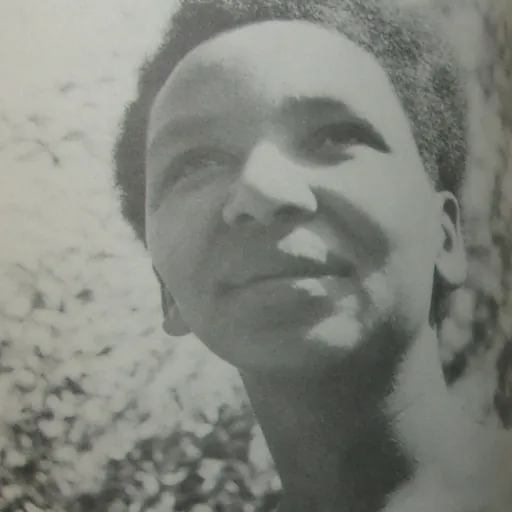
About Rebeka Njau
Born 1932. Rebeka Njau is a Kenyan writer, novelist and playwright.
Rebeka Njaū (née Nyanjega; born 15 December 1932) is a Kenya educator and writer, who was Kenya's first female playwright and a pioneer in the representation of African women in literature. Her writing has addressed topics such as female genital mutilation and homosexuality. Her first novel, Ripples in the Pool, appeared as number 203 in the Heinemann African Writers Series.
Her earliest works were published under the name "Rebecca Njaū", and she also used the pseudonym "Marina Gashe".
Biography
Early life Rebeka Njaū was born in 1932 in the village of Kanyariri, in Kiambu County to the northwest of Nairobi. Her family was Christian and she recalled the division this created with those around them:It was interesting for us, especially in our home, because we were surrounded by people [that] we would call primitive. They circumcised their girls. In our home my parents were Christians. It's like we lived in two countries because we were separated by traditions. We had nothing to do with one another. Her mother's stance against female genital mutilation bought her into contact with the Mau Mau:She was such a brave woman and [the] Mau Mau wanted to kill her. They changed [eventually]—I don't know why. They came to kill her but then on second thought, just before they neared our home, they went back.
Education and career Njaū was one of only 14 girls admitted to Alliance Girls High School in its inaugural year, before attending Makerere University College in Kampala. While at Makerere, she attended the 1962 African Writers Conference.
She returned to Kenya after graduation to teach at Alliance, before co-founding Nairobi Girls School in 1964. She married Elimo Njaū, an artist from Tanzania. Njaū's teaching career came to an end in 1968, and she and her husband then became increasingly involved with the Paa Ya Paa Gallery in Nairobi, before going on to edit Target, the magazine of the National Council of Churches of Kenya.
Her son, Morille Njaū, is an artist and a consultant based in the UK and her daughter Hana Njaū-Okolo is a poet, and published author who lives and works in Atlanta, Georgia. Her nephew was the author Binyavanga Wainaina.
The Scar (1963) The Scar, a one-act play, is considered the first play written by a Kenyan woman when it appeared in Transition journal in March 1963. It was republished in 1965 by Kibo Art Gallery in Marangu, which was run by Elimo Njaū.
The Scar premiered at the Uganda National Theatre in 1963 and went on to be performed in Kenya, Ghana, Tanzania and the USA. The play centres on the issue of female genital mutilation. The main character is Mariana, a former prostitute who tries to help girls escape female genital mutilation, which she regards as a "brutal custom". She advocates for alternative forms of initiation that can empower girls. Mariana is opposed by other women, who claim to be acting on behalf of the community's elders. The play ends with Mariana being shamed for having an illegitimate child and losing her status.
In 1964, a second play by Njaū, In the Round Chain, was performed before being banned by the Ugandan government.
Ripples in the Pool (1975) In 1964, Njaū won a prize in an East African novel competition with her manuscript Alone with the Fig Tree. Following substantial revisions, it was published as Ripples in the Pool by TransAfrica Press in 1975. TransAfrica went bankrupt shortly afterwards, and Njaū contacted Henry Chakava, editor of Heinemann Educational Books East Africa, to see if the novel could be republished. A subedited edition appeared in the African Writers Series in 1978.
At least one reviewer was left confused by the rapid shifts in plot and point of view, but writing in 1982 Frank Birbalsingh concludes: "...it is clear that Njaū is continuing the tradition of social realism, established in the modern African novel by Achebe's Things Fall Apart, updated by Armah's The Beautyful Ones are not yet Born, and made politically significant in the most recent writings of Ngugi wa Thiong'o." Ripples in the Pool is considered the first Kenyan novel, and for many the first African novel, to both portray lesbian relationships and treat lesbianism sensitively. thumb
The Sacred Seed (2003) Njaū's second novel was published in 2003. The Sacred Seed is described by Alex Wanjala as a quasi-autobiographical novel that brings together elements of social realism and the supernatural. He views the novel as Njaū's attempt to expose the malaise in contemporary Kenyan society and its roots in patriarchal relations that stem from both the pre-colonial and colonial periods.
In the words of The Daily Nation, the author "delves into the minds of her characters to reveal the psychological wounds they have suffered under patriarchy and dictatorship and their determination to heal the society. ... The narrator presents the destruction of the resourcefulness of women in the traditional African societies by modern regimes and points to ways women's power can be restored through the demolition of class hierarchies."
In 1964, she published a short story called "Muma" in Présence Africaine 50, although there is confusion over authorship.
She is also the author of The Hypocrite and other Stories (1977), a reworking of traditional oral narratives, and of Kenya Women Heroes and their Mystical Power (1984), which records the overlooked historical contribution of women. According to John Mugubi of Kenyatta University, "The uniqueness and power of Rebeka's style cannot be understated. She has a penchant for subversion of literary conventions in order to drive points home."
Plays
The Scar: A Tragedy in One Act (Transition, 1963; republished by Kibo Art Gallery in 1965; Books Horizon, 2019) In the Round Chain (unpublished, 1964)
Memoirs
Mirrors of my Life (Books Horizon, 2019)
Other non-fiction Kenya Women Heroes and their Mystical Power (with Gideon Mulaki; Risk Publications, 1984)
Don’t just read it —
keep it.
Full-length biographies made to live with: read them, listen on the way to work, watch them tonight.
- E-book
- Audio
- Video
Instant download · yours to keep · every purchase keeps this site free
Important facts
People in Rebeka Njau's life
Named in this biography and alive at the same time




Related people
Same field, nearest in time



Contemporaries
People whose lives overlapped Rebeka Njau's


Frequently asked questions
Who is Rebeka Njau?
Kenyan artist, playwright and novelist
When was Rebeka Njau born?
Rebeka Njau was born on 15 December 1932 in Kanyariri.
What is Rebeka Njau's occupation?
Rebeka Njau is a writer, novelist and playwright.
What nationality is Rebeka Njau?
Rebeka Njau is Kenyan.
Sources & further reading
Cite this page
APA: Biography.guide. (2026). Rebeka Njau. https://biography.guide/rebeka-njau/
MLA: "Rebeka Njau." Biography.guide, https://biography.guide/rebeka-njau/.
Chicago: "Rebeka Njau." Biography.guide. https://biography.guide/rebeka-njau/.
Data last updated: 2026-09-22 · Spot an error? Report a correction.
Portrait: Wikimedia Commons · author & licence
Page generated 2026-09-27 05:02 UTC