
About Raymond Thorold-Smith
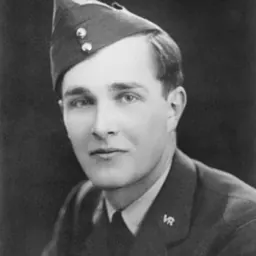
Lived 1918 – 1943 (aged 24). Raymond Thorold-Smith was an airman and military personnel.
Raymond Thorold-Smith, (30 June 1918 – 15 March 1943) was an Australian flying ace who served in the Royal Australian Air Force (RAAF) during the Second World War. He was credited with having shot down at least six aircraft.
From Manly, Thorold-Smith was a university student at the time he joined the RAAF in 1940. Once his flight training was completed, he was sent to the United Kingdom. Posted to No. 452 Squadron in April 1941, he flew intensively on sorties to German-occupied France during the Circus offensive, during which he destroyed a number of German aircraft. By the end of the year, he had been promoted to flight lieutenant and was awarded the Distinguished Flying Cross. In March 1942, he was appointed commander of the squadron and later led it to back to Australia, where it formed part of No. 1 Fighter Wing at Darwin. In March 1943, he failed to return from a sortie to intercept Japanese bombers attacking Darwin and was presumed to have been killed.
Early life Raymond Thorold-Smith was born at Manly, in Sydney, Australia, on 30 June 1918, the son of Joseph Patrick and Beatrice Mary Thorold-Smith. He was schooled locally at Christian Brothers College, before going on to Waverley College in Sydney. For his tertiary education, he went to the University of Sydney, training in medicine. He was active in sports; being a proficient rugby union player, he represented the university in the sport and was also a New South Wales representative, playing one game against Queensland in 1938. He was a lifeguard, as a member of the Queenscliff Surf Life Saving Club. Nicknamed 'Throttle', his initial training was at the RAAF station at Bradfield Park and then Narromine before he proceeded to Canada, for further training at Calgary. Having gained his wings, he was commissioned as a pilot officer in January 1941 and was sent to the United Kingdom to serve in the aerial campaign there. For the early part of 1942, No. 452 Squadron's sorties were mainly in the form of intruder missions involving only a few aircraft at a time to the continent to seek out targets of opportunity; Thorold-Smith made one such sortie on 3 January, shooting up an alcohol distillery at Colleville. The squadron also engaged in fighter sweeps, intended to draw out the Luftwaffe. For the most part it saw little action until the end of February, when it commenced a brief period of intensive operations.
On 17 March 1942, No. 452 Squadron was withdrawn from operations for a rest, shifting to Andreas on the Isle of Man. At this time Thorold-Smith was promoted to squadron leader and appointed commander of the unit, succeeding Truscott, who had been leading the unit since late the previous year. The squadron was designated to return to Australia to join in the war effort there, following the entry of Japan into the Second World War. It duly departed for Australia from the United Kingdom on 21 June.
Service in Australia No. 452 Squadron's Spitfires were requisitioned for service to the Middle East while the unit was in transit. It arrived in Australia in August and its personnel then had a period of leave. It was not until September that the squadron and its personnel reformed at Richmond. Even then its pilots had to use trainer aircraft until it began to receive Spitfires in November. After further training with its Spitfires, the squadron arrived in Darwin, in the Northern Territory, in January 1943. As part of No. 1 Fighter Wing, it was tasked with the defence of Darwin from Japanese air attacks, the city having been bombed several times in the preceding year.
Thorold-Smith, having no known grave, is commemorated on the Northern Territory Memorial to the Missing at the Adelaide River War Cemetery and on the Manly Cenotaph. At the time of his death, he was credited with having shot down seven German aircraft, one of which being shared with another pilot, and one damaged. A Spitfire flown by Thorold-Smith is presently on display at the Australian War Memorial in Canberra.
Don’t just read it —
keep it.
Full-length biographies made to live with: read them, listen on the way to work, watch them tonight.
- E-book
- Audio
- Video
Instant download · yours to keep · every purchase keeps this site free
Important facts
People in Raymond Thorold-Smith's life
Named in this biography and alive at the same time

Related people
Same field, nearest in time




Contemporaries
People whose lives overlapped Raymond Thorold-Smith's




Frequently asked questions
Who was Raymond Thorold-Smith?
Australia flying ace of WWII
When was Raymond Thorold-Smith born?
Raymond Thorold-Smith was born on 30 June 1918.
When did Raymond Thorold-Smith die?
Raymond Thorold-Smith died on 3 March 1943.
What was Raymond Thorold-Smith's occupation?
Raymond Thorold-Smith was an airman and military personnel.
Sources & further reading
· Wikipedia: Raymond Thorold-Smith
· DBpedia: Raymond Thorold-Smith
Cite this page
APA: Biography.guide. (2026). Raymond Thorold-Smith. https://biography.guide/raymond-thorold-smith/
MLA: "Raymond Thorold-Smith." Biography.guide, https://biography.guide/raymond-thorold-smith/.
Chicago: "Raymond Thorold-Smith." Biography.guide. https://biography.guide/raymond-thorold-smith/.
Data last updated: 2026-09-20 · Spot an error? Report a correction.
Page generated 2026-09-27 05:34 UTC