
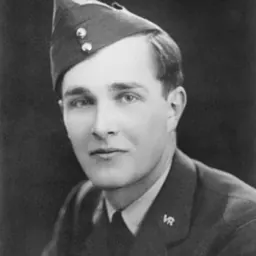
Lloyd Herbert Hughes
United States Air Force Medal of Honor recipient
About Lloyd Herbert Hughes
Lived 1921 – 1943 (aged 22). Lloyd Herbert Hughes was an American airman.
Lloyd Herbert "Pete" Hughes Jr., (July 12, 1921 – August 1, 1943), was a pilot who held the rank of Second Lieutenant in the United States Army Air Forces who received the Medal of Honor for his actions in Operation Tidal Wave during World War II.
Early life and family Hughes was born in Alexandria, Louisiana, the only son of Lloyd Herbert Hughes Sr. and Mildred Mae Rainey Hughes. Family and friends called him Pete. One source described his parents as Welsh immigrants, but Mildred was born in Josserand, Texas. The family lived in Alexandria only briefly before moving to his mother's native state of Texas. He entered the military service at San Antonio on January 28, 1942 (At the age of 20), and was appointed an aviation cadet the same day.
On November 8, 1942, Hughes married Hazel Dean Ewing.
Military service After attending flight school in Tulsa and Enid, Oklahoma, Hughes received his pilot's wings at Lubbock, Texas, on November 10, 1942. He was assigned to the 389th Bombardment Group, went to Africa in June 1943, and participated in five combat missions in the Italy-Romania area.
During Operation Tidal Wave, the most highly decorated military mission in U.S. history, 179 B-24 Liberator heavy bombers took off on an 18-hour, 2,400 mile round trip mission to destroy the largest of the oil refineries at Ploieşti, 30 miles north of Bucharest, Romania. The raid would not be a success. Fifty-four aircraft never returned and of the five U.S. Air Force airmen, including 2nd Lt. Lloyd Herbert Hughes were awarded the Medal of Honor for bravery; three of which, including Hughes, would receive the award posthumously.
During the August 1, 1943 bombing mission over the Câmpina oil fields north of the Ploieşti oil fields in Romania, Hughes was the pilot of a B-24 flying in the last element of a formation. When he arrived in the target area the enemy defenses were already alerted by previous aircraft. He approached the target at a planned, but dangerously low altitude, through intense and accurate anti-aircraft fire and densely arranged barrage balloons. Several hits from both large and small caliber anti-aircraft guns seriously damaged his aircraft and caused gasoline to leak from tanks in the bomb bay and left wing. The leak was so heavy that it blinded his waist gunner's view. Hughes could have attempted a forced landing of his damaged aircraft in one of the surrounding grain fields before he reached the target area which was blazing with burning oil tanks and refinery equipment. Flames were reaching high above the bombing level of the formation. Knowing the consequences of entering the inferno with his airplane leaking gasoline in two places, Hughes elected to carry on, rather than jeopardize the formation and the success of the attack. He flew into the wall of fire at about above the ground and dropped his bomb load with precision.
He emerged from the conflagration with the left wing of his aircraft on fire. He attempted to pull up and away from the action, trying to save his plane and crew. He successfully slowed the plane's speed from 225 to 100 miles an hour. It looked as if he would be able to crash land in the dry river bed of the Prahova River, when suddenly the left wing flew off and the plane cartwheeled into the ground. Of the ten men aboard the B-24, Hughes and five others were killed, two died of their wounds within days and the two who survived the crash became prisoners of war.
On November 13, 2010, he was inducted into the Louisiana Military Hall of Fame in Abbeville, Louisiana.
Eight months after he was killed in action, on April 18, 1944, Hughes' Medal of Honor was presented to his widow Hazel. Hughes was the first of seven Texas A&M alumni to receive the medal for actions during World War II. On March 30, 2009, his family loaned the medal to the Sanders Corps of Cadets Center on the Texas A&M campus.
Awards and decorations
with two campaign starWorld War II Victory Medal
Don’t just read it —
keep it.
Full-length biographies made to live with: read them, listen on the way to work, watch them tonight.
- E-book
- Audio
- Video
Instant download · yours to keep · every purchase keeps this site free
Important facts
People in Lloyd Herbert Hughes's life
Named in this biography and alive at the same time

Related people
Same field, nearest in time




Contemporaries
People whose lives overlapped Lloyd Herbert Hughes's




Frequently asked questions
Who was Lloyd Herbert Hughes?
United States Air Force Medal of Honor recipient
When was Lloyd Herbert Hughes born?
Lloyd Herbert Hughes was born on 12 July 1921 in Alexandria.
When did Lloyd Herbert Hughes die?
Lloyd Herbert Hughes died on 1 August 1943 in Romania.
What was Lloyd Herbert Hughes's occupation?
Lloyd Herbert Hughes was an airman.
What nationality was Lloyd Herbert Hughes?
Lloyd Herbert Hughes was American.
Sources & further reading
· Wikipedia: Lloyd Herbert Hughes
· DBpedia: Lloyd Herbert Hughes
Cite this page
APA: Biography.guide. (2026). Lloyd Herbert Hughes. https://biography.guide/lloyd-herbert-hughes/
MLA: "Lloyd Herbert Hughes." Biography.guide, https://biography.guide/lloyd-herbert-hughes/.
Chicago: "Lloyd Herbert Hughes." Biography.guide. https://biography.guide/lloyd-herbert-hughes/.
Data last updated: 2026-09-20 · Spot an error? Report a correction.
Page generated 2026-09-27 05:25 UTC