
About Raymond Coxon
Lived 1896 – 1997 (aged 100). Raymond Coxon was a painter.
Raymond James Coxon (18 August 1896 – 31 January 1997) was an English artist. He enrolled at the Leeds School of Art, the Royal College of Art, and became a teacher in the Richmond School of Art. The creative work of his long and successful career—singly and in various art groups—included landscape and portrait painting, abstract works, creating church murals and serving as a war artist during World War II. In particular he was known for the bold style of his figure and portrait work. After World War Two, his paintings became more abstract.
Life and work Coxon was born in Hanley, Staffordshire, the second of seven children to James and Georgina Coxon. When he completed his schooling, at the local Leek High School, Coxon joined the British Army. He applied to join the Artists Rifles but was rejected and joined the cavalry section of the Machine Gun Corps with whom he served, and fought, in Egypt and Palestine throughout World War I. While abroad he painted miniatures in watercolours which he sent home to his family.
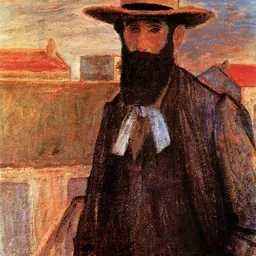
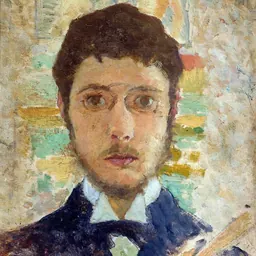
After he was discharged from the Army, Coxon enrolled at the Leeds School of Art, now the Leeds College of Art. While he was there, between 1919 and 1921, he not only met his future wife but also became friends with a fellow student, Henry Moore. In 1922 Moore and Coxon visited France and met a number of artists there, including Pierre Bonnard and Aristide Maillol. For his RCA Diploma submission, Coxon produced a mural based on Masaccio's Expulsion from the Garden of Eden. Coxon took a teaching post at the Richmond School of Art in 1925 and in 1926 he married Edna Ginesi, with Moore acting as his best-man. Coxon would later perform the same service for Moore when he married Irina Radetsky in July 1929.
Early in World War II, Coxon offered his services to the War Artists' Advisory Committee, WAAC, and in particular volunteered to return to Palestine as a war artist. That offer was refused but WAAC commissioned Coxon to produce some paintings of Army subjects in Britain, after which they purchased several other pieces from him. Independently of WAAC, Coxon received commissions from the Royal Navy and Army that saw him spend time on a corvette on convoy duty, join a river patrol on the Thames and witness parachutists making training jumps. He also produced some fine portraits during the war, notably of the Victoria Cross recipient Pip Gardner and also a portrait of his own wife in her ambulance service uniform. Coxon and Ginesi held a joint show at the Parkin Gallery in 1985 and he was the subject of a retrospective exhibition at the Potteries Museum & Art Gallery in 1987 and a memorial exhibition at the Walton Gallery in 2001.
Don’t just read it —
keep it.
Full-length biographies made to live with: read them, listen on the way to work, watch them tonight.
- E-book
- Audio
- Video
Instant download · yours to keep · every purchase keeps this site free
Important facts
Family & relationships
People in Raymond Coxon's life
Named in this biography and alive at the same time


Related people
Same field, nearest in time


Contemporaries
People whose lives overlapped Raymond Coxon's



Frequently asked questions
Who was Raymond Coxon?
British artist (1896-1997)
When was Raymond Coxon born?
Raymond Coxon was born on 18 August 1896 in Hanley.
When did Raymond Coxon die?
Raymond Coxon died on 31 January 1997 in West Sussex.
What was Raymond Coxon's occupation?
Raymond Coxon was a painter.
Sources & further reading
Cite this page
APA: Biography.guide. (2026). Raymond Coxon. https://biography.guide/raymond-coxon/
MLA: "Raymond Coxon." Biography.guide, https://biography.guide/raymond-coxon/.
Chicago: "Raymond Coxon." Biography.guide. https://biography.guide/raymond-coxon/.
Data last updated: 2026-09-20 · Spot an error? Report a correction.
Page generated 2026-09-27 05:10 UTC