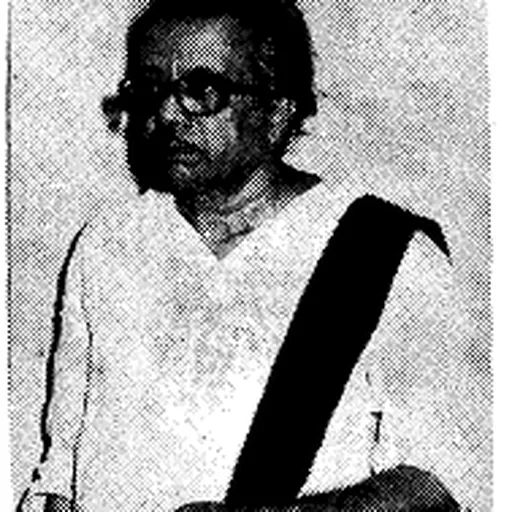
About Ravindra Kelekar
Lived 1925 – 2010 (aged 85). Ravindra Kelekar was an Indian linguist, translator, diarist, writer, activist and freedom fighter.
education = alma_mater = period = genre = subject = movement = notable_works = spouse = partner = children = 1 relatives = awards = signature =
website =
Ravindra Kelekar (7 March 1925 – 27 August 2010) was an Indian author who wrote primarily in the Konkani language, though he also wrote in Marathi and Hindi. His remains were cremated with State honours at his native village of Priol. the Gomant Sharada Award of Kala Academy, and the Sahitya Akademi Fellowship (2007)—the highest award of the Sahitya Akademi, India's National Academy of Letters. He also received the 2006 Jnanpith Award, the first ever awarded to an author writing in the Konkani language,
Early life and education Ravindra Kelekar was born on 7 March 1925, in Cuncolim, Portuguese Goa. published in the Latin script in Bombay. Soon after, being an active participant in Goa's struggle for freedom, he was imprisoned by the Portuguese. He was released when the Indian Army invaded and annexed Goa in 1961.
He joined the socio-political campaign against the merger of Goa into the neighbouring Maharashtra state, which ended after the plebiscite of 1967 (the Goa Opinion Poll), with Goa retaining its separate identity as a union territory. Goa retained this status until 1987, when it was declared a state.
After Goa's independence, Kelekar took to literary activism, getting his native tongue, Konkani, recognized as a distinct language (rather than a dialect of Marathi). He was compared favourably with pioneers in the Konkani literary movement, such as Shenoi Goembab. During this period, he wrote some of his most important works promoting the Konkani language, including Aamchi Bhas Konkanich (1962), a dialogue revealing the importance of Konkani to the common man on the street; Shallent Konkani Kityaak (1962), highlighting the significance of having Konkani medium schools in Goa; and A Bibliography of Konkani Literature in Devanagari, Roman and Kannada characters (1963). In February 1987, the Goa Legislative Assembly had passed the Official Language Bill making Konkani the Official Language of Goa. The struggle ended in 1992, when Konkani was included in the Eighth Schedule of the Indian Constitution as an official language. With life's mission completed, Kelkar retired from public life, focusing mainly of his writing. The Akademi's first Sahitya Akademi Translation Prize in Konkani also went to Kelekar in 1990 for Ami Taankan Manshant Haadle, a Konkani translation of a collection of essays in Gujarati, Mansaeena Diva, by Jhaverchand Meghani. He received the 2006 Jnanpith Award, which was the first given to a Konkani-language writer.
When the Vishwa Konkani Sahitya Academy, an offshoot of the Konkani Language and Cultural Foundation, was set up in 2006, the first work it took up for translation was Velavaylo Dhulo, a collection of Kelekar's essays. His books have been translated into Hindi and other North Indian languages, and are used by universities.
Personal life Kelekar married Godubai Sardesai in 1949; their son Girish was born in April 1950. Kelekar lived in his ancestral home—built by his father in 1937—called "Kelekar House", in the village of Priol in central Goa. The Casa Dos Kelekars, as it is formally known, is now seen as exemplary of a typical Goan community home.
Don’t just read it —
keep it.
Full-length biographies made to live with: read them, listen on the way to work, watch them tonight.
- E-book
- Audio
- Video
Instant download · yours to keep · every purchase keeps this site free
Important facts
People in Ravindra Kelekar's life
Named in this biography and alive at the same time



Related people
Same field, nearest in time



Contemporaries
People whose lives overlapped Ravindra Kelekar's



Frequently asked questions
Who was Ravindra Kelekar?
Indian author (1925–2010)
When was Ravindra Kelekar born?
Ravindra Kelekar was born on 7 March 1925 in Cuncolim.
When did Ravindra Kelekar die?
Ravindra Kelekar died on 27 August 2010 in Margao.
What was Ravindra Kelekar's occupation?
Ravindra Kelekar was a linguist, translator, diarist, writer, activist and freedom fighter.
What nationality was Ravindra Kelekar?
Ravindra Kelekar was Indian.
Sources & further reading
Cite this page
APA: Biography.guide. (2026). Ravindra Kelekar. https://biography.guide/ravindra-kelekar/
MLA: "Ravindra Kelekar." Biography.guide, https://biography.guide/ravindra-kelekar/.
Chicago: "Ravindra Kelekar." Biography.guide. https://biography.guide/ravindra-kelekar/.
Data last updated: 2026-09-21 · Spot an error? Report a correction.
Portrait: Wikimedia Commons · author & licence
Page generated 2026-09-27 05:00 UTC