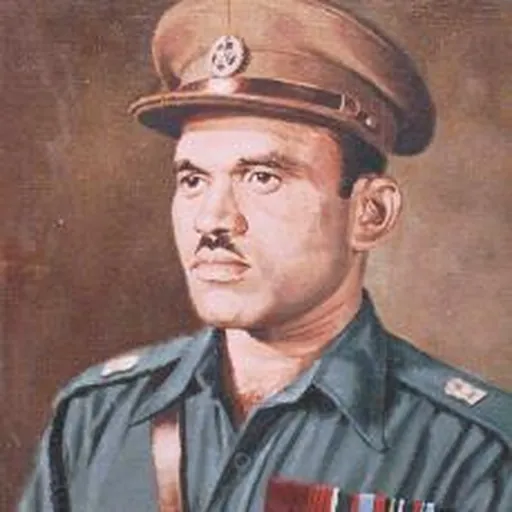
About Rama Raghoba Rane
Lived 1918 – 1994 (aged 76). Rama Raghoba Rane was an Indian military officer.
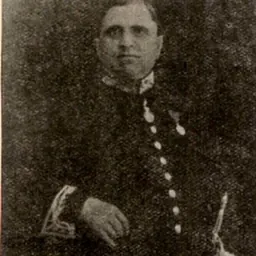
Major Rama Raghoba Rane, PVC (26 June 1918 – 11 July 1994) was an Indian military officer. He was the first living recipient of India's highest military decoration, the Param Vir Chakra, which he was awarded along with Karam Singh.
Born in 1918, Rane served in the British Indian Army during the Second World War. He remained in the military during the post-war period and was commissioned in the Bombay Sappers Regiment of the Indian Army's Corps of Engineers on 15 December 1947. In April 1948, during the Indo-Pakistani War of 1947, Rane played a key role in the capture of Rajauri by Indian forces by being instrumental in clearing several roadblocks and minefields. His actions helped clear the way for advancing Indian tanks. He was awarded the Param Vir Chakra on 8 April 1948 for his gallantry. He retired as a major from the Indian Army in 1968. During his 28 years' service with the army, he was mentioned in dispatches five times. He died in 1994 at the age of 76.
Early life Rama Raghoba Rane was born in a poor priest family on 26 June 1918 in the Chendia village, Karnataka in a Konkani speaking Maratha family. He was the son of Raghoba. P. Rane, a police constable from Chendia village of Uttara Kannada district in Karnataka. Rane's early education, mostly in district school, was chaotic due to his father's frequent transfers. In 1930, he became influenced by the Non-Cooperation Movement, which campaigned for Indian independence from British rule. His involvement with the movement alarmed his father, who moved the family back to their ancestral village at Chendia.
Military career At the age of 22, Rane decided to join the British Indian Army, while the Second World War was in full swing. On 10 July 1940, Rane enlisted in the Bombay Engineer Regiment, and passed out as the "Best Recruit", awarded the Commandant's Cane. Subsequently, he was promoted to Naik (corporal).
After his training, Rane was posted to the 28th Field Company, an engineering unit of the 26th Infantry Division which, at the time, was fighting the Japanese in Burma. As his division retreated from the Japanese after the failed Arakan Campaign, he, along with his two sections, was hand-picked by his company commander to stay back behind at Buthidaung to destroy key assets and then be evacuated by the Royal Indian Navy. Though the objective was soon achieved, the expected pickup did not happen. This forced Rane and his men to cross a river that was patrolled by the Japanese to reach their lines. Rane, along with his two sections, expertly evaded the Japanese troops, and joined the 26th Infantry Division at Bahri. For his actions, he was promoted to havaldar (sergeant).
Rane later received a Viceroy's Commission as a jemadar (now the rank of naib subedar, equivalent to a warrant officer). For his persistence and leadership qualities, Rane was selected for a short-service commission prior to the partition. In 1947, following his country's independence, Rane remained in the new Indian Army and was commissioned in the Corps of Engineers on 15 December 1947 as a second lieutenant (seniority from 14 January 1948).
War of 1947
Bust of Lt. Rama Raghoba Rane at the National War Memorial, Pune On 18 March 1948, Jhangar, lost in December 1947 to the Pakistanis, was recaptured by troops of the Indian Army, which then started to move towards Rajauri from Naushahra sector. On 8 April 1948, the 4th Dogra Battalion advanced to Rajauri. During the advance, the battalion attacked and captured the Barwali ridge, eleven kilometers to the north of Naushahra. The battalion's advance beyond Barwali was obstructed by the increasing number of roadblocks and minefields. Supporting tanks were also unable to cross the obstacles.
Rane, in command of a section of the 37th Assault Field Company, attached to the 4th Dogra Battalion, was sent forward to help clear a path for the battalion. As Rane and his team started clearing a minefield, mortar fire from the Pakistanis killed two sappers and wounded five others, including Rane. Despite this, by the evening of 8 April, Rane and his surviving men cleared the minefield which enabled the supporting tanks to move forward. A safe lane still had to be prepared for the tanks as the road ahead was still dangerous; the Pakistani forces had yet to be cleared from the area. This lane was created by Rane through the night. The next day, his section worked for twelve continuous hours to clear mines and roadblocks. As the road was still too difficult to deal with, he made a diversion for the battalion to forward. Rane continued this work despite ongoing artillery and mortar fire from the Pakistanis. — Gazette Notification: 5 Pres/50, 21-6-50
Subsequent career and later life After the war, Rane was promoted to lieutenant on 14 January 1950 and to captain on 14 January 1954. On 27 May 1955, he received a regular commission as a captain, with the service number IC-7244. |group= n During the course of his military's career, Rane was mentioned in despatches five times. He was subsequently employed as a member of the civilian staff of the Indian Army. He remained in the employment of the army until 7 April 1971 at which time he retired from the workforce. He died in 1994 at Command Hospital, Southern Command in Pune, survived by his wife, three sons and a daughter.
Legacy
The Shipping Corporation of India (SCI), a Government of India enterprise under the aegis of the Ministry of Shipping, named fifteen of her crude oil tankers in honour of the Param Vir Chakra recipients. The crude oil tanker named MT Lieutenant Rama Raghoba Rane, PVC was delivered to SCI on 8 August 1984. The tanker was phased out after 25 years service.
A statue in Rane's memory was unveiled in a ceremony on 7 November 2006 in his hometown Karwar at Rabindranath Tagore beach, Karnataka, alongside INS Chapal Warship Museum. It was inaugurated by Shivanand Naik, former Minister for Small Industries, and presided over then Flag Officer Commander-in-Chief, Western Command, Vice Admiral Sangram Singh Byce.
Don’t just read it —
keep it.
Full-length biographies made to live with: read them, listen on the way to work, watch them tonight.
- E-book
- Audio
- Video
Instant download · yours to keep · every purchase keeps this site free
Important facts
People in Rama Raghoba Rane's life
Named in this biography and alive at the same time




Related people
Same field, nearest in time



Contemporaries
People whose lives overlapped Rama Raghoba Rane's


Frequently asked questions
Who was Rama Raghoba Rane?
Param Vir Chakra receipt (1918–1994)
When was Rama Raghoba Rane born?
Rama Raghoba Rane was born on 26 June 1918 in Dharwad district.
When did Rama Raghoba Rane die?
Rama Raghoba Rane died on 11 July 1994 in Pune.
What was Rama Raghoba Rane's occupation?
Rama Raghoba Rane was a military officer.
What nationality was Rama Raghoba Rane?
Rama Raghoba Rane was Indian.
Sources & further reading
· Wikipedia: Rama Raghoba Rane
Cite this page
APA: Biography.guide. (2026). Rama Raghoba Rane. https://biography.guide/rama-raghoba-rane/
MLA: "Rama Raghoba Rane." Biography.guide, https://biography.guide/rama-raghoba-rane/.
Chicago: "Rama Raghoba Rane." Biography.guide. https://biography.guide/rama-raghoba-rane/.
Data last updated: 2026-09-23 · Spot an error? Report a correction.
Portrait: Wikimedia Commons · author & licence
Page generated 2026-09-27 05:05 UTC