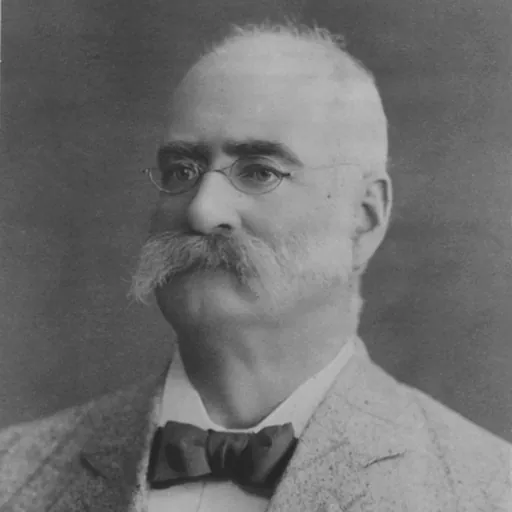
About Ralph Tate
Lived 1840 – 1901 (aged 61). Ralph Tate was an Australian and British botanist, geologist and botanical collector.
Ralph Tate (11 March 1840 – 20 September 1901) was a British-born botanist and geologist, who was later active in Australia.
Early life Tate was born at Alnwick in Northumberland, the son of Thomas Turner Tate (1807–1888), a teacher of mathematics and science, and his wife Frances (née Hunter). He was nephew to George Tate (1805–1871), naturalist and archaeologist, an active member of the Berwickshire Naturalists' Club. Tate was educated at the Cheltenham Training College and at the Royal School of Mines.
Scientific career In 1861 Tate was appointed teacher of natural science at the Philosophical Institution in Belfast. There he studied botany, publishing his Flora Belfastiensis in 1863, while also investigating the Cretaceous and Triassic rocks of County Antrim, the results of which he presented to the Geological Society of London. In 1864 Tate was appointed assistant curator at the museum of that society. In 1866 he wrote three botanical papers, and also published A Plain and Easy Account of the Land and Freshwater Mollusks of Great Britain. In 1867 he went on an exploring expedition to Nicaragua and Venezuela. In 1871 he was appointed to the mining school established by the Cleveland ironmasters first at Darlington and later at Redcar. Here he made a special study of the Lias and its fossils, in conjunction with the Rev. J. F. Blake, the results being published in an important work, The Yorkshire Lias (1876), in which the life-history of the strata was first worked out in detail.
In 1875 Tate was appointed Elder Professor of natural science at the University of Adelaide in South Australia, as well as in 1891–1894. Tate, as editor of the RSSA's Transactions and Proceedings (1889–1901),
Tate gave special attention to the Recent and Tertiary mollusca of Australia, and discovered evidence of Permian glaciation of southern Australia at Hallett Cove.
Recognition Tate was awarded the Clarke Medal by the Royal Society of New South Wales in 1893. The Tate Medal was established in 1903 by the University of Adelaide. The Ralph Tate Society of the University of Adelaide was formed in 1938 to promote original research in natural history by field excursions, similar to the McCoy Society of the University of Melbourne.
Don’t just read it —
keep it.
Full-length biographies made to live with: read them, listen on the way to work, watch them tonight.
- E-book
- Audio
- Video
Instant download · yours to keep · every purchase keeps this site free
Important facts
People in Ralph Tate's life
Named in this biography and alive at the same time


Related people
Same field, nearest in time


Contemporaries
People whose lives overlapped Ralph Tate's

Frequently asked questions
Who was Ralph Tate?
British botanist (1840-1901)
When was Ralph Tate born?
Ralph Tate was born on 11 March 1840 in Alnwick.
When did Ralph Tate die?
Ralph Tate died on 20 September 1901 in South Australia.
What was Ralph Tate's occupation?
Ralph Tate was a botanist, geologist and botanical collector.
What nationality was Ralph Tate?
Ralph Tate was Australian and British.
Sources & further reading
Cite this page
APA: Biography.guide. (2026). Ralph Tate. https://biography.guide/ralph-tate/
MLA: "Ralph Tate." Biography.guide, https://biography.guide/ralph-tate/.
Chicago: "Ralph Tate." Biography.guide. https://biography.guide/ralph-tate/.
Data last updated: 2026-09-20 · Spot an error? Report a correction.
Page generated 2026-09-27 05:10 UTC