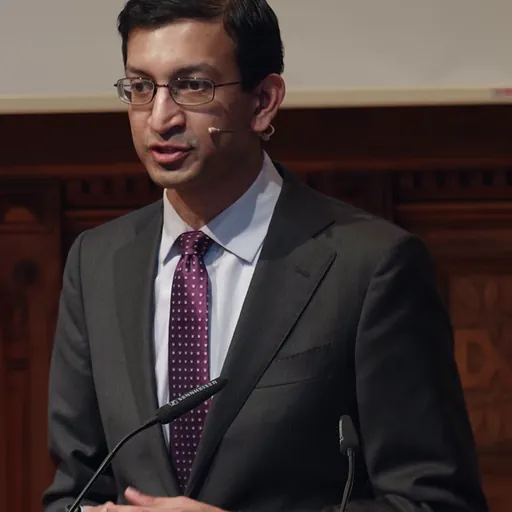
About Raj Chetty
Born 1979. Raj Chetty is an American economist, university teacher and academic.
Nadarajan "Raj" Chetty (born August 4, 1979) is an American economist who is the William A. Ackman Professor of Public Economics at Harvard University. Some of Chetty's recent papers have studied equality of opportunity in the United States and the long-term impact of teachers on students' performance. Chetty received tenure at Harvard's economics department at the age of 29, making him one of the youngest in the university's history. He is a recipient of the John Bates Clark Medal and a 2012 MacArthur Fellow. Currently, he is also an advisory editor of the Journal of Public Economics. In 2020, he was awarded the Infosys Prize in Economics.
Education and early career Raj Chetty was born in 1979 in New Delhi, India to a Tamil family, and lived there until the age of nine. His family immigrated to the United States in 1988. His mother, Rekha Chetty, became one of the first women in her South Indian community to become a physician. His father, V. Chetty, is an economist who worked as a researcher at the World Bank. with a thesis titled Consumption commitments, risk preferences, and optimal unemployment insurance.
In 2003, at the age of 24, Chetty became an Assistant Professor of Economics at the University of California, Berkeley, becoming a tenured Associate Professor there at 28. In July of the same year, he became a Founding Director of Opportunity Insights with John Friedman and Nathaniel Hendren.
Research In 2011 with John Friedman and Jonah Rockoff, Chetty found that test-score based value-added measures are not substantially biased by unobserved student characteristics and that the students of high value-added teachers have markedly better outcomes later in life.
Chetty is also known for research showing that economic mobility varies enormously within the United States and for work on the optimal level of unemployment benefits.
Chetty's contribution to economic mobility started with his 2014 paper, "Where is the Land of Opportunity? The Geography of Intergenerational Mobility in the United States." In this paper, Chetty discussed the effects of geography on economic mobility. He used information from deidentified federal income tax records, which gave him records from 1996 to 2012. The research's main focus was on intergenerational mobility in the United States as a whole. Chetty used the parent's income between the years of 1996-2000 when the participants were between the ages of 15–20. Chetty concluded that 5 significant variables strongly correlated with intergenerational mobility. Those variables are residential segregation, income inequality, school quality, social capital, and family structure. The authors concluded that intergenerational mobility is primarily a local problem. Meaning that place-based policies are better fitting for each city. This allows for each city to be able to make a plan and policy that will best help the people in that city that is affected by the constrictions of intergenerational mobility.
In 2016, Chetty, Nathaniel Hendren, and Lawrence F. Katz published two influential studies revisiting the Moving to Opportunity (MTO) experiment using newly linked IRS data. By following children from the original MTO families into adulthood, the authors were able to measure long-term outcomes such as earnings, college attendance, and neighborhood choice with far more precision than earlier work.
Their research found that the age at which children moved had a major impact on results. Children who moved to low-poverty neighborhoods before age 13 experienced higher earnings as adults, were more likely to attend college, and were more likely to live in healthier, higher-opportunity areas as adults. Older children did not show the same gains and sometimes experienced small negative effects, likely because the move disrupted school and peer networks during a sensitive period.
These findings highlighted how strongly childhood environment shapes long-run mobility and showed that housing policies can have lasting effects when they reach children early in life.
In 2020, in collaboration with the U.S. Census, Chetty worked with Hendren and Friedman to construct the Opportunity Atlas, a comprehensive Census tract-level dataset of children's outcomes in adulthood using data covering nearly the entire U.S. population. The Atlas maps the roots of affluence and poverty back to the neighborhood level, demonstrating which areas of the country offer children the best opportunities to succeed.
Recognition In 2008, The Economist and The New York Times listed Chetty as one of the top eight young economists in the world, and has since become one of the most highly cited economists of his generation. In 2010, he received the Young Labor Economist Award from the Institute for the Study of Labor for his paper "Moral Hazard Versus Liquidity and Optimal Unemployment Insurance" in the Journal of Political Economy.
In 2012, he was one of 23 fellows to receive $500,000 over the following five years from the John D. and Catherine T. MacArthur Foundation as a recipient of one of the Foundation's Genius Grants.
Chetty was awarded the Padma Shri, an award for distinguished service in any field, by the Government of India in 2015.
George Mason University economist Tyler Cowen described Chetty in 2017 as "the single most influential economist in the world today."
Research by Chetty was covered by The New York Times, The Atlantic, Our World in Data, and Vox.
In 2018, he was elected a member of the National Academy of Sciences.
In 2019, he received an Andrew Carnegie Fellowship, awarded by the Carnegie Corporation of New York.
In December 2020, he received the Infosys Prize for Social Sciences – Economics "for his pioneering research on identifying barriers to economic opportunity and for developing solutions to help people escape from poverty towards better life outcomes."
In 2023, Chetty received an honorary Doctor of Sciences from North Carolina State University.
In 2024, Chetty was awarded the Benjamin Franklin Medal by the Royal Society for Arts (RSA) for his contributions to research on social mobility and economic opportunity.
Publications Google Scholar profile
Don’t just read it —
keep it.
Full-length biographies made to live with: read them, listen on the way to work, watch them tonight.
- E-book
- Audio
- Video
Instant download · yours to keep · every purchase keeps this site free
Important facts
People in Raj Chetty's life
Named in this biography and alive at the same time




Related people
Same field, nearest in time


Contemporaries
People whose lives overlapped Raj Chetty's



Frequently asked questions
Who is Raj Chetty?
American economist
When was Raj Chetty born?
Raj Chetty was born on 4 August 1979 in New Delhi.
What is Raj Chetty's occupation?
Raj Chetty is an economist, university teacher and academic.
What nationality is Raj Chetty?
Raj Chetty is American.
Sources & further reading
Cite this page
APA: Biography.guide. (2026). Raj Chetty. https://biography.guide/raj-chetty/
MLA: "Raj Chetty." Biography.guide, https://biography.guide/raj-chetty/.
Chicago: "Raj Chetty." Biography.guide. https://biography.guide/raj-chetty/.
Data last updated: 2026-09-23 · Spot an error? Report a correction.
Portrait: Wikimedia Commons · author & licence
Page generated 2026-09-27 05:05 UTC