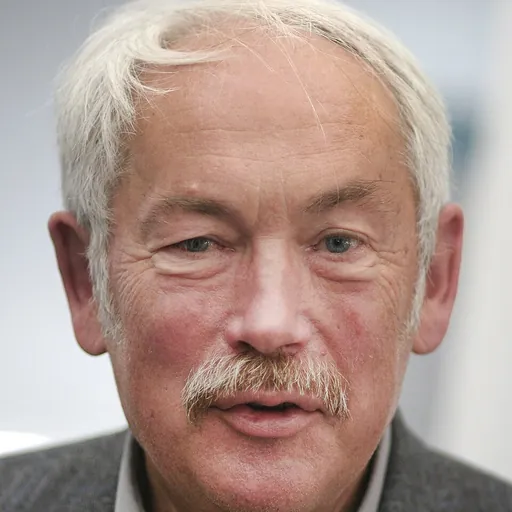
Peter Grünberg
German physicist, and Nobel Prize in Physics laureate
About Peter Grünberg
Lived 1939 – 2018 (aged 78). Peter Grünberg was a German physicist, university teacher, teacher and researcher, known for Giant magnetoresistive effect.
Peter Andreas Grünberg (; 18 May 1939 – 7 April 2018 ) was a German physicist, and Nobel Prize in Physics laureate for his discovery with Albert Fert of giant magnetoresistance which brought about a breakthrough in gigabyte hard disk drives.
Life and career Grünberg was born in Plzeň, Czechoslovakia, which at the time was known as Pilsen in the German-occupied Protectorate of Bohemia and Moravia (now the Czech Republic) to the Sudeten German family of Anna and Feodor A. Grünberg. They first lived in Dýšina to the east of Plzeň. Grünberg was a Catholic.
After the war, the family was interned; the parents were brought to a camp. His father, a Russia-born engineer who since 1928 had worked for Škoda, died on 27 November 1945 in Czech imprisonment and is buried in a mass grave in Plzeň which is also inscribed with Grünberg Theodor † 27. November 1945. His mother Anna (who died in 2002 aged 100) had to work in agriculture and stayed with her parents in the Petermann house in Untersekerschan (Dolní Sekyřany), where her children (Peter's sister was born in 1937) were brought later. The remaining Grünberg family, like almost all Germans, was expelled from Czechoslovakia in 1946. Seven-year-old Peter came to Lauterbach, Hesse where he attended gymnasium.
Grünberg received his intermediate diploma in 1962 from the Johann Wolfgang Goethe University in Frankfurt. He then attended the Technische Universität Darmstadt, where he received his diploma in physics in 1966 and his doctorate in 1969. While there, he met and married his wife, Helma Prauser, who became a schoolteacher. From 1969 to 1972, he did postdoctoral work at Carleton University in Ottawa, Canada. He later joined the Institute for Solid State Physics at Forschungszentrum Jülich, Jülich, Germany, where he became a leading researcher in the field of thin film and multilayer magnetism until his retirement in 2004. GMR was simultaneously and independently discovered by Albert Fert from the Université de Paris Sud. It has been used extensively in read heads of modern hard drives. Another application of the GMR effect is non-volatile, magnetic random access memory.
Apart from the Nobel Prize, work also has been rewarded with shared prizes in the APS International Prize for New Materials, the International Union of Pure and Applied Physics Magnetism Award, the Hewlett-Packard Europhysics Prize, the Wolf Prize in Physics and the 2007 Japan Prize. He won the German Future Prize for Technology and Innovation in 1998 and was named European Inventor of the Year in the category "Universities and research institutions" by the European Patent Office and European Commission in 2006.
Honors and awards American Physical Society's International Prize for New Materials (1994) International Union of Pure and Applied Physics (IUPAP) Magnetism Award (1994) Hewlett-Packard Europhysics Prize (1997) with Albert Fert and Stuart Parkin German Future Prize for Technology and Innovation (1998) Max Planck Society Member (2003). Germany Physical Society's Stern-Gerlach Medal (2006) European Inventor of the Year (2006) Wolf Prize in Physics (2006) Japan Prize (2007) Nobel Prize in Physics (2007) Friendship Award (China) (2016)
Selected publications
M. Schäfer, Q. Leng, R. Schreiber, K. Takanashi, P. Grünberg, W. Zinn. 1995. "Experiments on Interlayer Exchange Coupling" (invited at 5th NEC Symp., Karuizawa, Japan). J. of Mat. Sci. and Eng. . B31, 17.
Don’t just read it —
keep it.
Full-length biographies made to live with: read them, listen on the way to work, watch them tonight.
- E-book
- Audio
- Video
Instant download · yours to keep · every purchase keeps this site free
Important facts
People in Peter Grünberg's life
Named in this biography and alive at the same time
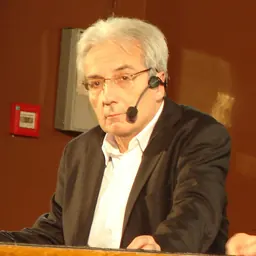



Related people
Same field, nearest in time

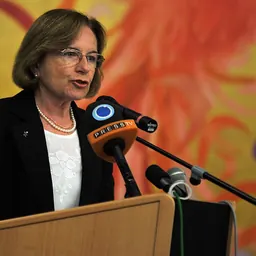

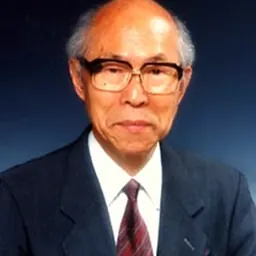

Contemporaries
People whose lives overlapped Peter Grünberg's


Frequently asked questions
Who was Peter Grünberg?
German physicist, and Nobel Prize in Physics laureate (1939-2018)
When was Peter Grünberg born?
Peter Grünberg was born on 18 May 1939 in Plzeň.
When did Peter Grünberg die?
Peter Grünberg died on 7 April 2018 in Jülich.
What was Peter Grünberg's occupation?
Peter Grünberg was a physicist, university teacher, teacher and researcher.
What was Peter Grünberg known for?
Peter Grünberg was known for Giant magnetoresistive effect.
What nationality was Peter Grünberg?
Peter Grünberg was German.
Sources & further reading
Cite this page
APA: Biography.guide. (2026). Peter Grünberg. https://biography.guide/peter-grunberg/
MLA: "Peter Grünberg." Biography.guide, https://biography.guide/peter-grunberg/.
Chicago: "Peter Grünberg." Biography.guide. https://biography.guide/peter-grunberg/.
Data last updated: 2026-09-23 · Spot an error? Report a correction.
Portrait: Wikimedia Commons · author & licence
Page generated 2026-09-27 05:05 UTC