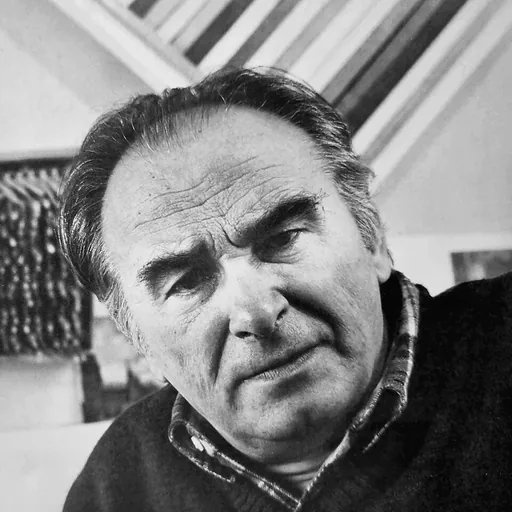
About Radoslav Kratina
Lived 1928 – 1999 (aged 70). Radoslav Kratina was a Czech sculptor, painter, mosaicist, graphic artist, photographer and exhibition curator.
Radoslav Kratina (2 December 1928 – 10 September 1999) was a Czech graphic and industrial designer, photographer, painter, curator and sculptor. His work, based on rational thinking and a materialistic conception of the world, is rarely unified and focused. Kratina's works, for which he found stimuli in the real world, and combine contemporary constructive and kinetic tendencies with an existential dimension. With his original and pioneering work he established himself on the international scene during the 1960s. After the Soviet occupation in 1968 and during the following normalization, he lost the opportunity to exhibit and his works, created in isolation, were only discovered after the fall of the communist regime in 1989.
The variability of his artefacts is consistent with the concept of open work as formulated by Umberto Eco in the 1960s. This space of postmodern freedom no longer has binding directions of development, and Kratina's variabils, in their conception, which Arsén Pohribný classifies as a stream of "irrational geometry", go beyond the common understanding of the artwork.
Life Radoslav Kratina was born on 2 December 1928 in Brno. He studied at the School of Arts and Crafts in Brno from 1943 to 1948 and after graduation worked as a textile designer. From 1952 he continued his studies at the Academy of Arts, Architecture and Design in Prague, first in the studio of graphic designer and painter Josef Novák (1952–1953), and later with Prof. Alois Fišárek (1953–1957). In 1955 he married fashion designer Helena Křížová. As his final work, he submitted a set of blueprint patterns for the dividing panels in the interior of a restaurant at the Expo 58 in Brussels From 1957 to 1962 he worked as an industrial designer of textiles and toys (exhibition at ÚLUV in Prague, 1961).
After moving to a new apartment in 1962, he began to work as freelancer. His wife Helena, who worked as a designer at Oděvní tvorba (Clothing Design), was a reliable source of support for him, as she was allowed to travel abroad and partly supported him financially. In the 1960s he participated in several collective exhibitions together with artists who dealt with structural abstraction, lettrism and constructivism. In 1964 he assembled his first variable object from matchsticks.
In 1967, together with Arsén Pohribný and other artists, he co-founded the Club of Concretists and participated in a joint exhibition in Alpbach. The following year he participated in the exhibitions New Sensibility. Crossroads and Guests in Prague and Brno, and between 1968 and 1971 in a series of exhibitions of the Club of Concretists at home and abroad. Kratina acted as secretary and organizer of all the club's activities throughout this time.
After the occupation in 1968, some members of the Club of Concretists emigrated and the club ceased its activities in 1971. Kratina lost the opportunity to exhibit and until 1989 he privately and in isolation developed the possibilities of his transformable objects and wrote accompanying texts in which he tried to interpret his own work as accurately as possible. He himself also photographed various spatial variations of variabils himself. In 1989, at the end of normalization, after a nearly twenty-year pause in Kratina's own exhibitions, Karel Holešovský stated about his variabils: "despite their relevance, their mission is not adequately fulfilled in today's society. . are excluded from more general use in the appreciation of their artistic qualities... a certain lack of understanding is surprising..." (although) Kratina is an internationally recognized artist whose work is maturing into sovereign artistic excellence.
In 1980–1983, in connection with efforts to save the tombstone of Jindřich Štyrský, Kratina created an extensive set of documentary photographs of artistically valuable tombstones in Prague and out-of-Prague cemeteries.
At the end of normalization in September 1989, before the restoration of the Club of Concretists, After 1989, the activity of regional associations of the Club of Concretists was resumed, along with exhibitions at home and abroad. Kratina was represented at all major exhibitions covering modern Czech art since the early 1960s and at a number of solo exhibitions in regional galleries and in Prague. Retrospective exhibitions surveying his work in detail were held posthumously in Liberec (2000) and in 2013 at the Prague City Gallery (Stone Bell House). In addition to Arsén Pohribný and Jiří Valoch, Kratina's work has also been studied by Josef Hlaváček, Jan Sekera, Jan Kříž, Karel Holešovský and especially Zbyněk Sedláček, who prepared an inventory of Kratina's work.
Radek Kratina died in Prague on 10 September 1999 as a result of a serious illness.
Artistic foundations The manifestations of constructivism and geometric abstraction in Czech art of the 1960s, which Jiří Padrta summarized under the comprehensive designation "New Sensibility", were a reaction to the existential work of artists engaged in structural abstraction (Informel) and New Figuration. The artists drew on the constructivism of the interwar Czechoslovak and European avant-garde (Union of Modern Culture Devětsil, Bauhaus, De Stijl, Abstraction-Création), but they were also familiar with contemporary tendencies, represented by Swiss Constructivism, Kineticism or the Zero group. The new aesthetic was represented by the French movement Les nouveaux réalistes, the GRAV (Groupe de Recherche d'Art Visuel)
The group of concretists initially formed within the circle of the art groups Křižovatka (Crossroads) - since 1963 and Syntéza (Synthesis) since 1966 and in 1967 founded its own Club of Concretists. The initiator was Radek Kratina together with Tomáš Rajlich, Jiří Hilmar, Miroslav Vystrčil and art theorist Arsén Pohribný. Exhibitions under the title New Sensitivity: Crossroads and Guests were held in 1968 in Brno and Karlovy Vary and in 1969 in Prague Mánes Gallery. The Club of Concretists presented itself independently for the first time at exhibitions in Žilina and Prague in 1968. Soon after its foundation, the club grew to 36 permanent members. After the Warsaw Pact invasion of Czechoslovakia, some emigrated and the rest were not allowed to exhibit. The club disbanded after 1970.
Artwork Applied art After graduating from the School of Arts and Crafts in Brno, Radek Kratina devoted himself to textile design in 1949–1952. Here he applied his innate sense of order and harmony in the design of decorative cloth and indigo prints based on the principle of regular geometric patterns. He also designed collections of wooden toys and building blocks.
He also worked as a textile designer during his subsequent studies at the Academy of Arts, Architecture and Design in Prague (1952–1957). His graduation work was a textile panneau for a restaurant at the Expo 58 in Brussels, on which he used rubber stamps to create figurative motifs composed of several geometric elements. Kratina's toy designs were inspired by the figures that children assemble from chestnuts and offered a variable combination of individual turned parts. Another series of toys made of flat stylized shapes offered similar transformations. became the exhibition of his generational friends Rychnov ´63, especially the creators of informel, which attracted him by its unconventional approaches and directness of expression. He was also interested in the graphic experiments of Vladimír Boudník. The exhibition in Rychnov represented a radical and irreversible step for Kratina's move towards the formulation of an uncompromising creative gesture and at the same time a choice of a clear artistic orientation, determined by his need to seize things and to fulfill a sense of concreteness.
Between 1963 and 1965 Kratina devoted himself to oil painting, relief paintings, monotypes, frottage, assemblages, collage and sculptural compositions made of plaster. He used a variety of scrap materials found around his home to make his printmaking matrices and printed the artworks using two rubber cylinders from a hand wringer. He achieved interesting results with objects that could not be rolled with paint directly, but by frottage through the attached flimsy. He experimented with paraffin, loose materials or plaster cast on newsprint. For the creation of lettrist monotypes he reprinted fragments of texts from foreign newspapers and magazines with his own original method, taking advantage of the difference in the absorption of the font colour and the free space of the magazine pages and from the first impression on coated paper he printed a positive so that the typeface could be read again
At the end of the 1960s, he created a set of two-colour prints on handmade paper with repeating geometric elements, and in the 1970s a set of colour serigraphs using a similar principle as Jan Kubíček or Zdeněk Sýkora.
In the mid-1960s he assembled structural reliefs, which he initially used as matrices for printing monotypes and later fixed as independent works. In his structural reliefs he followed only the compositional order without any content aspects. The transition from informal texture to an ordered serial structure represents a fundamental developmental feature of Kratina's graphic work.
In 1964, he created his "Zero Variabile" from matches stacked inside a wooden frame of equal depth, where it was possible to change the layout of the resulting relief by finger pressure. He thus discovered the unwittingly transformable structure and variability of the work as a new quality he had not originally aimed for. Kratina's notion of geometric abstraction is rooted in his previous structural work and contains a wealth of detail that places him at the counterpoint of the constructivist minimization of means of expression. Ever since his graphic experiments, he has pursued an aesthetic order that has led him steadily to geometric abstraction. The theme of his work is structural, based on a multitude of elements that can be rearranged, folded and moved in various ways, creating relationships of dissimilar clusters from accumulated details. The first were the Horizontal Sticks (1965) - a vertical assembly of red and white flag sticks that allowed for horizontal displacement. Initially, his material was a variety of wooden elements whose surfaces were differentiated by white, red and blue (Rollers on the Axis, 1967, Homage to Stazewsky, 1967), sometimes supplemented by other colours (20 x 6 Cubes, 1967). These objects were usually visually linked to the wall and showed a significant variation in their frontal colour structure.
Kratina's wooden objects, although based on geometric principles, bore traces of the author's handwriting and thus stood out somewhat from the strictly rational work of other constructivists who emphasized perfect material processing. Kratina used them to introduce a principle of play that was unusual and contradicted the geometric form of the works. However, the woodworking was not precise enough for his purposes, and besides, wood was subject to climatic influences and drying, making it difficult to position objects. In 1975–1976, he used Plexiglas for several variations due to its transparency, but problems with finishing soon discouraged him. In the late 1960s and early 1970s, Kratina returned to printmaking and created a series of colour serigraphs.
Highlights The precise shape of the machined metal parts allowed for more complex spatial and shape solutions. The work was installed in 1991 and deinstalled after a few years. It was bought from the scrap heap by the director Ivo Janoušek for the National Technical Museum. Transformable Object was damaged in the warehouse during the floods and was finally rescued and restored for Radoslav Kratina's exhibition at the Prague City Gallery in 2013.
Kratina's variabils, which he himself called "a provider of possibilities", were created with the aim of involving the viewer in their transformation. He considered this to be a more humane and democratic idea than mere passive observation of kinetic sculpture. Kratina, however, puts limits on the anarchy of the game and insists on the moral qualities and his own responsibility for the commissioning of the elements of the game, as well as on the identity of the sculptural idea, which does not lose its individual character even in the face of the infinite possibilities of variations of a particular variabile.
Unlike kinetic objects that are driven by a motor, this concept, which relies on the active involvement of the viewer in the process of creation, is quite unique. It is not the goal, but only a means to create the final version. What distinguishes a variabil from a classical sculpture is its interpenetration of space, similar to the construction of branches filling the inside of a tree's crown. Variabil articulates space and offers transparencies, subtle nuances of distances and relationships, intersections and crossings of bodies, contrasts and rhythms that can be perceived as spatial beauty full of excitement. The adjustability of the elements throughout the 360-degree range allows the use of a rich range of lights and shadows that rhythmize the surface of the object and complete the final impression. The mechanical principle of the additive assembly of geometric elements thus transcends the rigorous schemes of geometric abstraction and strangely grows into an organic principle of life and growth.
Kratina's concept of creation is also unique in that the works have no beginning and no end and are conceived as a chained entity. The artist sometimes returns to variations of tried and tested solutions (Wooden Mane, 1967, Metal Mane, 1979), but his working method consists in the search for new rational constructions of objects. Moravian Gallery in Brno City Museum of Brno Prague City Gallery Museum of Decorative Arts in Prague Klatovy / Klenová Gallery National Museum, Wrocław Museum of Art, Łódź Staatliche Kunstsammlungen Dresden Institut für moderne Kunst, Nuremberg Gallery of Art, Karlovy Vary Gallery of Visual Arts in Ostrava Museum Kampa Regional Gallery Liberec North Bohemian Art Gallery in Litoměřice West Bohemian Gallery in Plzeň Gallery of Benedikt Rejt, Louny Galerie Zlatá husa, Praha Regional Gallery of Highlands in Jihlava East Bohemian Gallery in Pardubice
Exhibitions (selection) Solo (selection) 1966 Objects and Variabils by Radek Kratina, Theatre of Music, Ústí nad Labem 1967 Radek Kratina: Objects and Variabils 1963 - 1966, Regional Gallery of Highlands in Jihlava 1967 Radek Kratina: Objects, Variabils, Monotypes, Jaroslav Kral Gallery, Brno 1967 Radoslav Kratina, Galerie bratří Čapků, Prague 1967 Radek Kratina: Variabils, Benedikt Rejt Gallery, Louny 1969 Radek Kratina, Jiří Valenta, Tvář Gallery, Havířov, Workers' Club, Milevsko 1970 Demartini, Kratina, Alšova síň UB, Prague 1978 Radek Kratina: Objects, Variabils, Monotypes, Sonnenring Galerie, Rotemburg 1988 Zdeněk Sýkora: Paintings, Radek Kratina: Objects, with text by R. Kratina: Real Movement as a Possibility, Atrium, Prague 1989 Radek Kratina: Variabils and Objects, Kabinet of Applied Art, Brno 1990 Králík, Kratina, District Museum of Bohemian Paradise 1990 Zippe, Kratina, Art Gallery, Žďár nad Sázavou 1990 Zdeněk Prokop, 10 objects by R. Kratina, Jičín 1991 Zippe, Kratina, Galerie U bílého jednorožce, Klatovy, Czech Cultural Centre Bratislava, Tatra Gallery, Poprad 1991 Chatrný, Kratina, Karlovy Vary Art Gallery 1991 Radek Kratina: Transformation, Benedikt Rejt Gallery, Louny 1991 Radek Kratina: Variabils, Z-Galerie Operngasse, Vienna 1992 Cultural Centre of the Czechoslovakia, Berlin (with V. Hulík) 1993 Kratina, Pešek, Galerie Zámeček, Příbram 1994 Radek Kratina: Experimental Prints and Frottage from the 1960s, Letohrádek Ostrov 1995/96 Radoslav Kratina: Reliefs and Variable Objects, Exhibition Hall Sokolská 26, Ostrava 1996 Radoslav Kratina: Variable Objects, Langův dům Gallery, Frýdek-Místek 1998 Radoslav Kratina: Movement as Possibility, House of Art, Ostrava 2000 Radek Kratina: Idea con variazioni, Exhibition Hall Husova 19–21, Prague 2000 Radek Kratina (1928 - 1999): Selections from his life's work, Regional Gallery in Liberec 2004 Radek Kratina: Variabils and Monotypes, Galerie Montanelli, Prague 2005 Radek Kratina, Komart Gallery, Bratislava, Galerie am Festungsgraben, Berlin 2011 Radek Kratina, Dalibor Chatrný, Galerie Závodný, Mikulov 2012 Kratina in Dynamo, Dynamo design, Prague 2013 Radek Kratina (1928-1999), Dům U Kamenného zvonu, Prague 2017 Radek Kratina: Konstanty a proměnné / Constants and Variables, Museum Kampa, Praha
Collective (selection) 1958 Expo 58, Brussels 1964, 1966 Jazz in Fine Arts, Theatre of Music, Prague 1967 Mostra d´arte contemporanea cecoslovacca, Castello del Valentino, Turin 1967 Klub der Konkretisten, Alpbach 1967 Premi Inernacional Dibuix Joan Miró, Barcelona 1968 5 Künstler aus Prag, Paderborn, Medebach 1968/69 Club der Konkretisten Prag, Galerie im Hause Behr, Stuttgart, Galerie Mahlerstrasse, Vienna 1968 II. Międzynarodowe Biennale Plakatu, Warsaw 1968 1969 Klub konkrétistů, Galerie Pluymen, Nijmegen, Bratislava 1969 Club van Konkretisten Praag, Tiffany's Gallery, Den Haag 1969 5 Künstler aus Prag, Kassel, Paderborn 1969 22 grafici della Cecoslovacchia, Libreria Feltrinelli, Firenze 1969 Klub konkretistu Cekoslovacchia, Galleria Fiamma Vigo, Rome, Turin 1969 Klub der Konkretisten, Galerie Mahlerstrasse, Wien, Tiffany's Gallery, Scheweningen 1969 Salon d´Asnieres Peintres et Sculptures d´Aujourd´hui Quatre Artistes Tchécoclovaques, Asnieres sur Seina 1969 Tendence 4, Zagreb 1970 Club van Konkretisten Praag, Heineken Galerij, Amsterdam, Galerie de Bazuin, Harlingen 1970 Expo 70, Osaka 1971 Klub der Konkretisten: Objekte und Graphik, Galerie Interior, Frankfurt 1971 Konstruktive Kunst aus der CSSR, Galerie Sabine Vitus, Nuremberg 1972 35 artisti cecoslovacchi contemporanei Grafica e oggetti, Unimedia Galeria d´arte contemporanea, Genoa 1974 Tschechische Künstler, Galerie Wendtorf-Swetec, Düsseldorf 1980 Die Kunst Osteuropas im 20. Jahrhundert, Garmisch-Partenkirchen 1984 Zeitgenössische Kunst der ČSSR, Galerie Dialog e. V., Berlín 1985 Konstruktive Tendenzen II, Galerie Dialog e. V., Berlín 1987 Klub der Konkretisten 1967 - 1987, Objekte und Grafiken, Galerie Rafay, Kronberg 1990 Neue Blätter aus der ČSSR, Kupferstichkabinett, Dresden 1991 Hýbače, Východoslovenská galéria, Košice, Galéria Gerulata, Bratislava, NTM Prague 1992 Nová geometrie / New Geometry, National Technical Museum (Prague) 1992 Arte contemporanea ceca e slovacca 1950 - 1992, Palazzo del Broletto, Novara 1992/2003 Minisalon, Galerie Nová síň, Praha, Mons, New York, Hollywood, Cincinnati, Indianapolis, Chicago, Rapids, Albuquerque, Forth Myers, Columbia, North Dartmouth, Saint Petersburg, Prague, Brussels, Jakarta, Ubud, Surabaya, Paris 1992 Radoslav Kratina, Viktor Hulík: Variabils, Bewegnung in Objekten und Collagen, Galerie 2 G - Gegenwart, Berlin 1992 Situation Pragoise, Galerie Le Manoir, Ville de Martigny 1993 Geometria Bohemia: Tschechische Geometrie / Cseh Geometrikus Müvészet, Műcsarnok, Kunsthalle Budapest 1993 Inter - Kontakt - Grafik - Praha ’93, Mánes, Prague 1993 Výstava současného českého sochařství / Exhibition of the contemporary Czech sculpture, Mánes, Prague 1994 Zwischen Zeit Raum I, Galerie Wendtorf-Swetec, Düsseldorf 1994/95 Nová citlivost / New sensitivity, Severočeská galerie výtvarného umění v Litoměřicích, Dům U Jonáše, Pardubice, Oblastní galerie Vysočiny v Jihlavě, Dům umění města Opavy, Pražákův palác, Brno, Olomouc 1997/99 Klub konkrétistů / Club of concretists, Oblastní galerie Vysočiny v Jihlavě, Dům umění, Zlín, Galerie výtvarného umění v Ostravě, Oblastní galerie v Liberci, Klatovy, Alšova jihočeská galerie, Hluboká, Slovenská národná galéria, Bratislava, Stockholm 1998/2000 Česká serigrafie / Czech serigraphy, Galerie výtvarného umění v Ostravě, Staroměstská radnice, Praha, Dům umění města Opavy, Galerie moderního umění v Hradci Králové, Dům umění, Zlín, Štátna galéria, Banská Bystrica 1999 Umění zrychleného času. Česká výtvarná scéna 1958 - 1968 / The Art of Accelerated Time. Czech Art Scene 1958 - 1968, Prague, Cheb 2000 Schenkungen, Museum Bochum 2001 Serigrafia dall´Europa centrale / Siebdruck aus Miiteleuropa, Palais Esplanade, Merano 2003/4 Ejhle světlo / Look Light, Moravian Gallery in Brno, Prague castle riding hall, Prague 2005 Emigration out/in 1: Běla Kolářová, Jiří Kolář, Radek Kratina, Hugo Demartini, Saarländische Galerie – Europäisches Kunstforum e.V., Berlin 2006 Weltanschauung, Palazzo Belmonte Riso, Palermo 2008 International triennale of contemporary art 2008, National Gallery Prague 2010 New Sensitivity, National Art Museum of China, Beijing
Don’t just read it —
keep it.
Full-length biographies made to live with: read them, listen on the way to work, watch them tonight.
- E-book
- Audio
- Video
Instant download · yours to keep · every purchase keeps this site free
Important facts
People in Radoslav Kratina's life
Named in this biography and alive at the same time




Related people
Same field, nearest in time



Contemporaries
People whose lives overlapped Radoslav Kratina's


Frequently asked questions
Who was Radoslav Kratina?
Czech designer, graphic, sculptor and artist (1928-1999)
When was Radoslav Kratina born?
Radoslav Kratina was born on 2 December 1928 in Brno.
When did Radoslav Kratina die?
Radoslav Kratina died on 10 September 1999 in Prague.
What was Radoslav Kratina's occupation?
Radoslav Kratina was a sculptor, painter, mosaicist, graphic artist, photographer and exhibition curator.
What nationality was Radoslav Kratina?
Radoslav Kratina was Czech.
Sources & further reading
Cite this page
APA: Biography.guide. (2026). Radoslav Kratina. https://biography.guide/radoslav-kratina/
MLA: "Radoslav Kratina." Biography.guide, https://biography.guide/radoslav-kratina/.
Chicago: "Radoslav Kratina." Biography.guide. https://biography.guide/radoslav-kratina/.
Data last updated: 2026-09-23 · Spot an error? Report a correction.
Portrait: Wikimedia Commons · author & licence
Page generated 2026-09-27 05:07 UTC