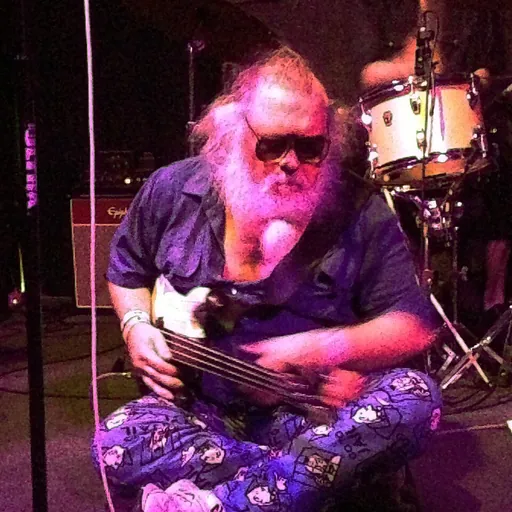
R. Stevie Moore
American musician who pioneered lo-fi/DIY music
About R. Stevie Moore
Born 1952. R. Stevie Moore is an American singer-songwriter, singer, guitarist, musician, songwriter and session musician.
Robert Steven Moore (born January 18, 1952) is an American multi-instrumentalist, singer, and songwriter who pioneered lo-fi (or "DIY") music. Often called the "godfather of home recording",
Born the son of Nashville A-Team bassist Bob Moore, Steven grew up in the 1960s listening to the Beatles, the Beach Boys, the Mothers of Invention, and Jimi Hendrix. his body of work incorporates a variety of music genres, both popular and experimental, and his records are typically styled after freeform radio. He describes his prolific output as "a diary of sound". Much of his output, he later said, was "uncontrollable—compelled without compulsion. I didn't seek out to do this. It just came out of me. I had this music inside of me and I wanted to be a pop star. It was like a disease that I had to record and write." Over the years he would describe himself as "a huge record collector and music historian" with interests ranging from beatnik and avant-garde to noise and jazz: "I love attempts at all genres and styles – even if I fail. It doesn't matter."
Moore began working as a studio musician and assistant at his father's music publishing company, Mimosa Music. He briefly attended Vanderbilt University, but dropped out in 1971 to pursue his passions for writing, recording and performing music. That same year, he moved out of his parents' house and rented an apartment at the Music Row area in Nashville. He formed a close friendship with next-door neighbor Victor Lovera, who he called "one of my best friends and ... very influential for my songwriting." Victor Lovera died in 1998.
Throughout the early 1970s, Moore continued to play local shows with a group of high-school friends whose band name changed frequently. His music tastes—which mainly encompassed artists like the Beach Boys, the Move, Frank Zappa, and Todd Rundgren—were mostly out of step with the prevailing music culture in Nashville. Palmer continued to encourage Moore to put his music out, and in 1976, Phonography was Moore's first album to be released on an outside label (Palmer's HP Music).
Phonography was reviewed in New York's Trouser Press as "an outrageous collection of musical brain spewage" and "a true slash of genius". Moore credits the review's author, Ira Robbins, as "the one who helped turn people on to Phonography and those early independent records." Phonography later became the best-known album of his career
1978–2010: New Jersey period
In February 1978, Moore relocated to Montclair, New Jersey According to him, although he lived 13 miles away from the Lincoln Tunnel in the proceeding decades, he rarely ever traveled into New York City. Over the decade, he made sporadic appearances on the television variety show The Uncle Floyd Show. At this point, he was heavily influenced by Public Image Ltd: "[they] changed my life! That whole postpunk thing, minimalist dub, drums and bass. It almost sounds like fragments, not finished songs. I loved that music."
In 1982, he launched the R. Stevie Moore Cassette Club, a mail-order service that issued his recordings on cassette. He acknowledged the number of albums he made available: "People tell me I'm shooting myself in the foot, releasing so much — I've heard that for years. But I can't help it. It's who I am." Between 1984 and 1988, the French label New Rose issued four of his albums on vinyl, starting with Everything You Always Wanted to Know About R. Stevie Moore (But Were Afraid to Ask). The album, a double-disc retrospective, proved briefly popular in France, with a single "Chantilly Lace" from the album becoming a minor sleeper hit there, and prompting Moore to undertake a promotional visit to the country. The 2009 compilation Me Too, issued on Cherry Red Records, was annotated by Dave Gregory of XTC. In 2011, he established a new band with guitarist J.R. Thomason and embarked on his first ever tours, including Europe. He said: "Things are just exploding left and right and I can't keep up with it all. I need management. It's a great problem to have, but I can't take advantage of it. I'm just one person. It's crazy." and lasted for the next two years. In 2017, the album was given an official release through Bar/None Records and was met with generally favorable reviews. That April, Moore and Falkner appeared together for a one-off performance at the South by Southwest music festival. Moore reflected that he had to stop his worldwide touring due to "health issues that are worsening," adding that his career "started takin' off ... way too late in life" and that he had recently "given up making proper rock and pop, rock and roll music. I just kinda maintain my back catalog, I don't record much anymore."
In 2019, Bar/None released Afterlife, a compilation of Moore tracks that were recorded at professional studios between 2006 and 2013. The album also features contributions from Ariel Pink, Jason Falkner, and Lane Steinberg. Most of the selections are remakes of decades-plus old songs. Moore said that the "final album playlist was purposefully kept safe, clean and more hi-fi mainstreamy, without my usual quirky left turns and lo-fi inserts."
On December 31, 2019, he issued a statement on his website purporting that he would offer "absolutely no further song writing, recording, performing, travelling, [or] interviews."
Moore made his first live public appearance since 2019 at Ariel Pink’s performance at the Coliseum in Nashville on 26 November 2025, where he delivered two spoken-word sets and joined the encore on harmonica.
Impact and recognition
Moore might not have been the first rock musician to go entirely solo, recording every part from drums to guitar ... However, he was the first to explicitly aestheticize the home recording process itself. ... making him the great-grandfather of lo-fi. — Matthew Ingram, The Wire He worked with Moore on a remake of Moore's "Dates" in 1999.
A wider recognition of Moore's music came in the late 2000s as a result of newer acts who cited him as an influence. In 2005, Pink contributed a song to Moore's Conscientious Objector compilation. He told a journalist around this era that he was "trying to like, reverse time. I'm trying to get Todd Hyman to reissue him on Acute. Then it can get like, the David-Fricke-fuckin'-Rolling Stone treatment. It's about time. It's criminal that he's not well known. Especially in light of the fact that I'm getting attention. ... Mojo has never even printed a word about him. Uncut, never a word." In 2006, Pink curated the Moore retrospective Ariel Pink's Picks Vol. 1, and in 2012, the duo released the collaborative album Ku Klux Glam. Moore also hesitated to be associated with the "outsider music" tag, explaining that while he "loves" artists like Wesley Willis and Daniel Johnston, "they have no concept as to how to write or arrange a Brian Wilson song." He noted having "sort of ... two discographies: my own that contains all of my self-released material and the official releases, which are what record labels decided to put out over the years." During a 1984 appearance on The Scott and Gary Show, he stated that he had 109 releases in total. In 2012, his Bandcamp page listed over 200 releases. In response to this Wikipedia article about Moore, which formerly stated that the count was "at least 200", he requested fans on his website to tally a more accurate estimate. In February 2018, he received a count of 354 releases listed on his "tapelist" page (including video and live recordings), 391 on his "albums list" page, and 344 on Bandcamp.
Official studio albums Delicate Tension (1978) Clack! (1980) Glad Music (1986) Teenage Spectacular (1987) Warning (1988) Objectivity (1997) (with Yukio Yung) FairMoore (2002) (with Jad Fair) The Yung & Moore Show (2006) (with Yukio Yung) Advanced (2011) Ku Klux Glam (2012) (with Ariel Pink) The Great American Songbook – Vol. 1 (2014) (with Jad Fair) Make It Be (2015) (with Jason Falkner) The Embodiment of Progressive Ideals (2018) (with Alan Jenkins and the Kettering Vampires) Fake News Trending (2019) (with Gary Wilson)
Selected compilations Phonography (1976) Everything You Always Wanted To Know About R. Stevie Moore But Were Afraid To Ask (1984) What's The Point?!! (1984) Verve (1985) R. Stevie Moore (1952-19??) (1987) Has-Beens and Never-Weres (1990) Greatesttits (1990) Contact Risk (1993) Revolve (1995) The Future Is Worse Than The Past (1999) Hundreds of Hiding Places (2002) Nevertheless Optimistic (2003) Meet the R. Stevie Moore (2008) Me Too (2009) Ariel Pink's Picks Vol. 1 (2011) Hearing Aid (2012) Lo Fi Hi Fives... A Kind Of Best Of (2012) Personal Appeal (2013) "Late Night Tales: Franz Ferdinand presents" (2014) Afterlife (2019) On Earth (2021) Freedom Vs. Fate (2021) "Cool Daddio": Original Film Soundtrack (2022)
Don’t just read it —
keep it.
Full-length biographies made to live with: read them, listen on the way to work, watch them tonight.
- E-book
- Audio
- Video
Instant download · yours to keep · every purchase keeps this site free
Important facts
People in R. Stevie Moore's life
Named in this biography and alive at the same time







Related people
Same field, nearest in time




Contemporaries
People whose lives overlapped R. Stevie Moore's

Frequently asked questions
Who is R. Stevie Moore?
American musician who pioneered lo-fi/DIY music
When was R. Stevie Moore born?
R. Stevie Moore was born on 18 January 1952 in Nashville.
What is R. Stevie Moore's occupation?
R. Stevie Moore is a singer-songwriter, singer, guitarist, musician, songwriter and session musician.
What nationality is R. Stevie Moore?
R. Stevie Moore is American.
Sources & further reading
Cite this page
APA: Biography.guide. (2026). R. Stevie Moore. https://biography.guide/r-stevie-moore/
MLA: "R. Stevie Moore." Biography.guide, https://biography.guide/r-stevie-moore/.
Chicago: "R. Stevie Moore." Biography.guide. https://biography.guide/r-stevie-moore/.
Data last updated: 2026-09-21 · Spot an error? Report a correction.
Portrait: Wikimedia Commons · author & licence
Page generated 2026-09-27 05:01 UTC